Facts
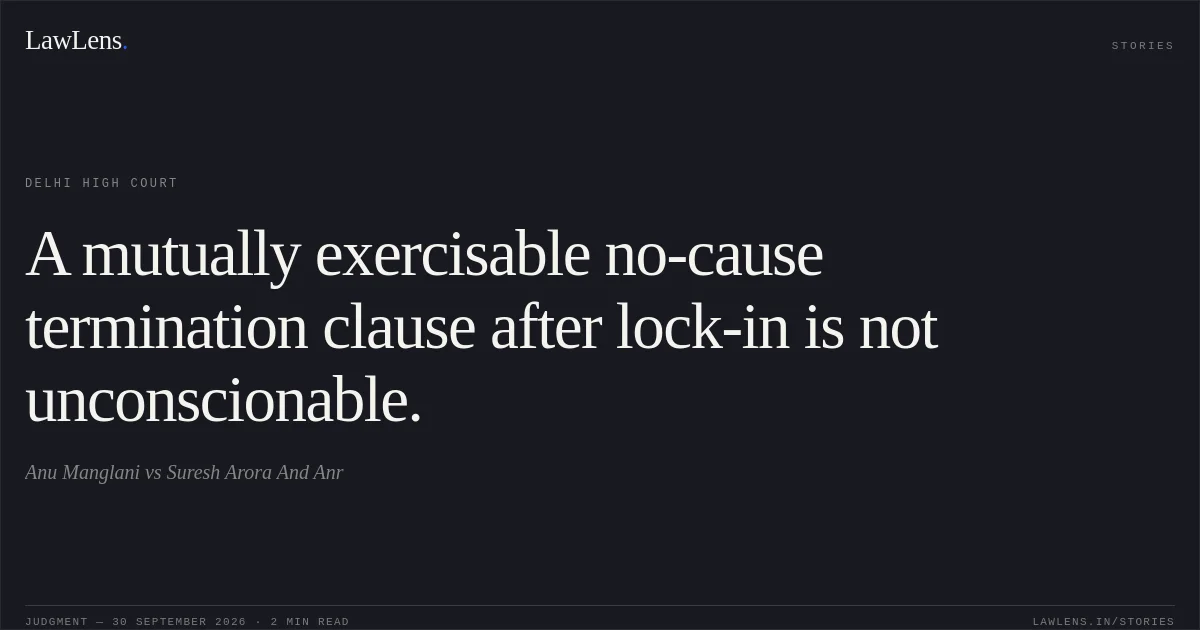
The respondents, owners of a commercial shop in South Extension-I, leased it to the appellant under a registered lease deed dated 14 October 2021.
Source reference: p. 2–6The deed imposed a 12-month lock-in period and thereafter permitted either party to terminate the lease without assigning reasons on three months’ written notice.
Source reference: p. 2–6The appellant admitted executing the lease but challenged the termination provisions as unconscionable.
Source reference: p. 2–6After rent went unpaid, the respondents issued a termination notice on 12 January 2023 and sued for possession and monetary relief.
Source reference: p. 2–6The Trial Court decreed possession, arrears of rent and mesne profits under Order XII Rule 6 CPC.
Source reference: p. 2–6The appellant appealed, challenging the termination clause, the use of judgment on admissions, and the Trial Court’s pecuniary jurisdiction.
Source reference: p. 2–6Issues
Whether the Trial Court was justified in decreeing possession and monetary relief under Order XII Rule 6 CPC, given the appellant’s challenge to the lease’s termination provisions as unconscionable.
Source reference: p. 5–6, 15–19Whether the lease could be terminated without assigning reasons after the lock-in period, on three months’ notice.
Source reference: p. 7–9Whether the Trial Court lacked pecuniary jurisdiction, as the appellant contended.
Source reference: p. 5Law Applied
Section 13 of the Commercial Courts Act, 2015, read with Section 96 and Order XLI Rule 1 CPC, provides the appellate basis for challenging the decree.
Source reference: no citationUnder Order XII Rule 6 CPC, a court may enter judgment on admissions where the relevant admission is clear and unequivocal and leaves no substantial dispute requiring trial; the power is discretionary and should not be exercised where material facts remain genuinely contested.
Source reference: p. 15–17The Court relied on Pushpa & Ors. v. Dayawati & Ors., 2026 INSC 603, including its restatement of the principles in Himani Alloys Ltd. v. Tata Steel Ltd.
Source reference: p. 15–17The parties’ registered lease deed governed termination: clauses 11.1 and 11.3 provided for termination by either party, after the 12-month lock-in period, on three months’ notice without assigning reasons.
Source reference: p. 7–9Reasoning
The appellant admitted the registered lease deed and did not allege forgery or fabrication; the landlord–tenant relationship and agreed rent were also admitted.
Source reference: p. 8–10, 15–19The Court held that the contractual termination right was mutual, applied after the lock-in period, and was not shown to involve domination of one party by the other or to violate applicable law.
Source reference: p. 8–10, 15–19The respondents’ termination under the agreed notice provisions therefore raised no substantial triable issue, and the unconscionability challenge did not prevent judgment on admissions.
Source reference: p. 8–10, 15–19The Court also found that the appellant had failed to pay rent for an extended period and had continued in possession.
Source reference: p. 8–10, 15–19Although pecuniary jurisdiction was raised on appeal, the judgment contains no separate analysis of that objection.
Source reference: p. 5Holding
The High Court dismissed the appeal, holding that the admitted lease and its valid termination provisions supported the decree under Order XII Rule 6 CPC.
The Trial Court’s decree for possession, arrears of rent and mesne profits therefore remained undisturbed; all pending applications were disposed of.
Source reference: p. 19The judgment did not separately decide the pecuniary-jurisdiction objection.
Source reference: p. 19Acts & Sections Cited
4 provisions across 2 statutes referred to in this judgment. Each provision opens on LawLens.
Commercial Courts Act, 20151
Code of Civil Procedure, 19083
Original Court PDF
Anu ManglanivsSuresh Arora And Anr
Click to open original judgment
Original judgment, available to read, download and summarize on LawLens.in