Facts
The Union of India invited tenders for construction of dwelling units and allied external services for officers and PBOR at Sector 31, Chandigarh. The respondent-contractor’s tender was accepted on 6 March 2007 for ₹28,23,81,272.50, with the work scheduled for completion by 15 March 2008; the period was later extended to 15 May 2008.
Source reference: paras. 3–4After completion of the physical works, disputes arose concerning the final bill, additional sales tax/VAT liability, watch and ward charges for completed units not taken over, composition fees, and interest on delayed running-account bills.
Source reference: para. 5The Engineer-in-Chief referred the disputes to arbitration on 21 November 2012. The respondent raised 25 claims, while the Union of India raised recoveries and counterclaims, including an alleged unadjusted sales-tax liability of ₹64.84 lakh.
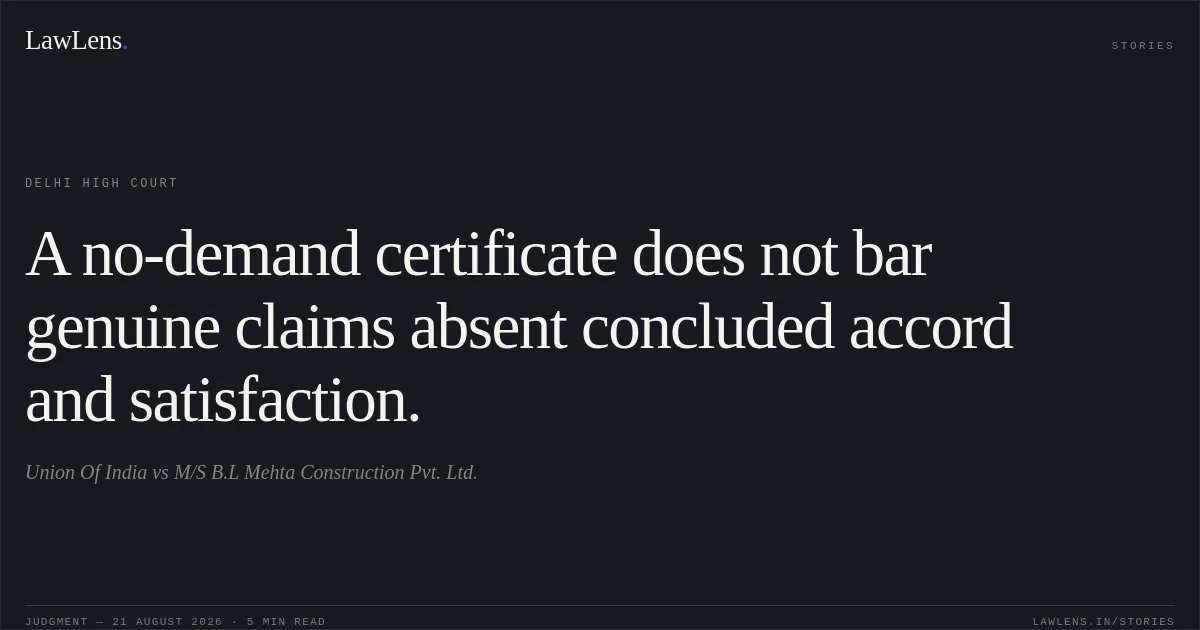
Source reference: paras. 6–7The Sole Arbitrator rejected the Union’s objection that several claims were barred under Condition 55 of the General Conditions of Contract because the respondent had submitted the final bill with a no-demand certificate. The Arbitrator held that the certificate had been revoked by the respondent’s letter dated 22 December 2011, particularly since the final bill had remained unpaid for approximately three and a half years.
Source reference: paras. 8–10The Arbitrator substantially allowed the respondent’s monetary claims and rejected the Union’s counterclaims. The Union challenged the award dated 30 October 2014, as corrected/amended by the consequential additional award, under Section 34 of the Arbitration and Conciliation Act, 1996.
Source reference: paras. 1–2, 11–12Issues
1. Whether the respondent’s submission of the final bill along with a no-demand certificate under Condition 55 of the GCC constituted accord and satisfaction, thereby extinguishing the claims and rendering them non-arbitrable?
Source reference: paras. 22–342. Whether the Arbitrator’s decision to determine the Union’s Section 16 jurisdictional objection during the arbitral proceedings, rather than as a separate preliminary issue before considering the merits, constituted a procedural irregularity warranting interference under Section 34?
Source reference: paras. 22–273. Whether the award of ₹69.84 lakh towards additional sales-tax liability, together with rejection of the Union’s corresponding counterclaim, was unsupported by contractual provisions or evidence?
Source reference: paras. 35–444. Whether the award of ₹33 lakh towards watch and ward charges, assessed at ₹1.50 lakh per month for 22 months, was perverse or unsupported by sufficient evidence?
Source reference: paras. 45–505. Whether the award of interest on delayed running-account bills and pre-suit and pendente lite interest was contrary to the contract or the Arbitration and Conciliation Act, 1996?
Source reference: paras. 51–53Law Applied
The Court applied Section 34 of the Arbitration and Conciliation Act, 1996, which permits limited supervisory review of an arbitral award on specified statutory grounds and does not authorise appellate reappreciation of evidence or substitution of the Court’s interpretation for a plausible interpretation adopted by the Tribunal.
Source reference: paras. 20–21, 54–58Section 16 embodies the principle of kompetenz-kompetenz and empowers the Arbitral Tribunal to rule on its own jurisdiction; it does not require every jurisdictional objection to be decided as a separate preliminary issue before the merits are considered.
Source reference: paras. 23–27The Court also applied Section 31(7), under which an Arbitral Tribunal may award interest subject to the Act and the contract.
Source reference: paras. 51–53Contractual Condition 55 concerning the no-demand certificate and Condition 56 concerning settlement of the final bill were interpreted in the light of the surrounding circumstances, including non-payment of contractual dues.
Source reference: paras. 28–34Special Condition 25.3 permitted contractual adjustment for statutory variation in tax liability after submission of the tender.
Source reference: paras. 35–40The Court relied on R.L. Kalathia & Co. v. State of Gujarat, (2011) 2 SCC 400, and Arabian Exports (P) Ltd. v. National Insurance Co. Ltd., (2025) 10 SCC 388, for the principle that a no-demand certificate does not invariably bar genuine subsequent claims; and on Maharshi Dayanand University v. Anand Coop. L/C Society Ltd., (2007) 5 SCC 295, in considering the treatment of jurisdictional objections during arbitral proceedings.
Source reference: paras. 14–15, 31Reasoning
The Court held that the Arbitrator had in fact adjudicated the Union’s Section 16 objection by order dated 12 December 2013; therefore, the objection concerned only the timing of the decision and did not establish a legally significant procedural defect.
Source reference: paras. 25–27On accord and satisfaction, the Court found that the no-demand certificate could not be treated as conclusive because the final bill had remained unpaid for a substantial period and the respondent had subsequently revoked the certificate. The Arbitrator’s conclusion that there was no concluded settlement was a factual finding based on the contract and surrounding circumstances, and was neither perverse nor unsupported by evidence.
Source reference: paras. 28–34Regarding sales tax, the Tribunal had relied on Special Condition 25.3, the withdrawal of the earlier tax concession by notification dated 21 May 2007, audited accounts, certificates, and payment-related material. Its direction requiring a bank guarantee pending finalisation of the relevant assessment provided an additional safeguard for the Union.
Source reference: paras. 35–44The Union’s challenge essentially sought a fresh appraisal of the tax records, which was impermissible under Section 34 absent perversity, disregard of contractual terms, or a finding based on no evidence.
Source reference: paras. 35–44The award of watch and ward charges was based on the Tribunal’s finding that the completed dwelling units remained under the respondent’s care for approximately 22 months because the Union delayed taking possession. The monthly assessment of ₹1.50 lakh was treated as a reasonable quantification based on the nature and scale of the project.
Source reference: paras. 45–50The absence of individual vouchers or primary expenditure records did not, by itself, establish perversity or patent illegality. Similarly, the award of interest was not shown to contravene the contract or Section 31(7).
Source reference: paras. 45–53Holding
The Court answered the issues against the Union of India. It held that the no-demand certificate did not extinguish the respondent’s claims in the circumstances, that the Arbitrator validly dealt with the Section 16 objection, and that the findings concerning additional sales tax, watch and ward charges, and interest fell within the permissible scope of arbitral adjudication.
No ground of patent illegality, perversity, violation of the fundamental policy of Indian law, or other statutory ground under Section 34 was established.
Source reference: paras. 59–61The petition challenging the arbitral award was accordingly dismissed, with no order as to costs; pending applications, if any, were disposed of.
Source reference: paras. 59–61Acts & Sections Cited
3 provisions across 1 statute referred to in this judgment. Each provision opens on LawLens.
Arbitration and Conciliation Act, 19963
Original Court PDF
Union Of IndiavsM/S B.L Mehta Construction Pvt. Ltd.
Click to open original judgment
Original judgment, available to read, download and summarize on LawLens.in