Facts
The Appellant’s marriage with Ambika, daughter of a Central Government employee, was solemnised on 07.12.2014. Although the spouses lived separately from 2016, no decree of divorce or judicial separation was obtained.
Source reference: para. 7.1–7.2The Appellant claimed that he paid his wife monthly maintenance and provided her medical coverage under the Employees’ State Insurance Corporation Scheme (ESICS).
Source reference: para. 7.1–7.2In 2020, the Appellant’s father-in-law sought inclusion of his daughter as a dependent under the Central Government Health Scheme (CGHS), supported by an affidavit stating that she was unemployed, had no independent income, and was wholly dependent upon him.
Source reference: para. 7.3–7.4She died on 17.03.2021.
Source reference: para. 7.3–7.4The Appellant complained that her inclusion involved suppression of her subsisting marriage and ESICS coverage, and alleged misuse of CGHS facilities and loss to the public exchequer.
Source reference: para. 7.4, 10, 17Following directions in earlier writ and contempt proceedings, the Respondent rejected the grievance by order dated 20.06.2025, holding that the CGHS card had been issued in accordance with policy and valid documentation, with no evidence of misuse or monetary loss.
Source reference: para. 7.5–7.7The learned Single Judge dismissed the Appellant’s challenge on 23.02.2026. The present Letters Patent Appeal challenged both decisions.
Source reference: para. 6, 7.8Issues
Whether the Appellant possessed any personal or enforceable legal right to challenge the alleged irregular grant of CGHS benefits to his wife as a dependent of his father-in-law.
Source reference: paras. 18–20Whether the Court could adjudicate allegations that the father-in-law and the SDM relied upon false affidavits or suppressed material facts without impleading them as parties and without evidence on the disputed factual issues.
Source reference: para. 21Whether the Respondent’s decision dated 20.06.2025, holding that the CGHS benefit had been granted in accordance with applicable policy and documentation, warranted interference under writ or appellate jurisdiction.
Source reference: paras. 22–24Law Applied
The Court applied the CGHS definition and eligibility conditions governing dependent daughters, as reflected in the applicable CGHS Guidelines and Office Memorandum dated 04.08.1994, including the requirements concerning residence, dependency, income, and the status of a daughter as divorced, abandoned, separated, or widowed.
Source reference: paras. 8–9It further applied the principle that writ jurisdiction is ordinarily not exercised to determine disputed questions of fact requiring evidence, particularly where affected parties have not been impleaded and heard.
Source reference: para. 21The Court also held that an individual who is not himself the beneficiary and who cannot demonstrate a personal or enforceable legal right cannot seek judicial directions concerning the grant or withdrawal of benefits extended to another beneficiary; such matters fall within the administrative and disciplinary domain of the competent authority.
Source reference: paras. 18–20Reasoning
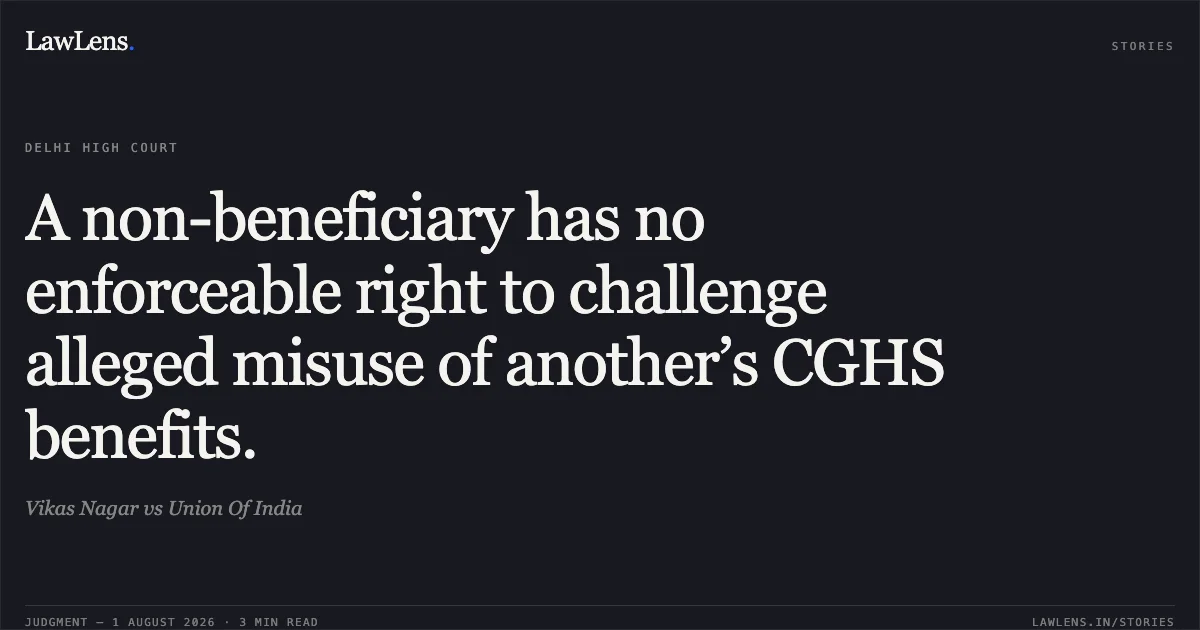
The Court held that the Appellant was not the CGHS beneficiary and therefore could not assert a personal or enforceable right arising from the alleged irregularity in benefits extended to his wife through his father-in-law.
Source reference: paras. 19–20Any recovery, disciplinary action, or investigation concerning the father-in-law or officials was for the Respondent to consider administratively.
Source reference: no citationThe allegations of false affidavits, suppression of ESICS coverage, and financial loss were disputed factual matters.
Source reference: para. 21Since neither the father-in-law nor the SDM had been impleaded, no adverse relief could be granted against them without affording them an opportunity to respond.
Source reference: para. 21The Court further accepted the Respondent’s finding that the benefit had been granted on the basis of the documents and affidavit produced, and that the Appellant had not established that his wife had simultaneously received benefits under both CGHS and ESICS or that any loss had been caused to the public exchequer.
Source reference: paras. 22, 24The Court also found that the earlier order in LPA 328/2026 merely preserved the Appellant’s right to pursue the present appeal and did not create any additional substantive right.
Source reference: para. 23Holding
The Court answered the issues against the Appellant.
It held that he lacked any personal or enforceable right to challenge the alleged misuse of CGHS benefits, that the allegations concerning false affidavits and public loss could not be adjudicated in the proceedings in the absence of the concerned parties and evidentiary determination, and that the Respondent’s order disclosed no basis for judicial interference.
Source reference: paras. 21–24The Letters Patent Appeal was dismissed, the order dated 20.06.2025 and the Single Judge’s judgment dated 23.02.2026 were upheld, pending applications were disposed of, and there was no order as to costs.
Source reference: para. 26Original Court PDF
Vikas NagarvsUnion Of India
Click to open original judgment
Original judgment, available to read, download and summarize on LawLens.in