Facts
Respondent Nos. 1 and 2 purchased a flat from Respondent No. 3 under a 2010 conveyance that incorporated a deed of declaration containing an arbitration clause covering disputes relating to maintenance and management of the complex.
Source reference: para. 34–35The petitioner, a maintenance company engaged by Respondent No. 3 under a 2017 agreement, claimed unpaid common-area maintenance charges and invoked the arbitration clause.
Source reference: para. 7, 10, 17–19After the parties failed to agree on an arbitrator, the petitioner applied under Section 11 of the Arbitration and Conciliation Act, 1996.
Source reference: para. 11, 22Issues
1. Whether, at the Section 11 referral stage, the petitioner had made out a prima facie case that it was a veritable party to the arbitration agreement despite not signing the conveyance or deed of declaration.
Source reference: para. 22, 332. Whether the objections concerning the petitioner’s authority, limitation and the amount claimed required determination by the court at the referral stage or could be left to the arbitral tribunal.
Source reference: para. 22, 47–483. Whether an independent sole arbitrator should be appointed after the parties failed to agree on the constitution of the tribunal.
Source reference: para. 49Law Applied
Section 11(6-A) of the Arbitration and Conciliation Act, 1996 confines the referral court to a prima facie examination of the existence of an arbitration agreement; it does not permit a laborious or contested inquiry, which is for the tribunal to determine under Section 16 (In re Interplay Between Arbitration Agreements under the Arbitration and Conciliation Act, 1996 and Stamp Act, 1899; SBI General Insurance Co. Ltd. v. Krish Spg.).
Source reference: para. 24–26Under Sections 2(1)(h) and 7, a non-signatory may be a party where its conduct and relationship with signatories demonstrate consent; relevant factors include mutual intention, relationship, commonality of subject matter, the composite nature of the transaction and participation in performance, which must be positive, direct and substantial (Cox & Kings Ltd. v. SAP India (P) Ltd.; Ajay Madhusudan Patel v. Jyotrindra S. Patel).
Source reference: para. 27–30, 33The referral court must be prima facie satisfied that the non-signatory is a veritable party; a mere commercial connection is insufficient, but disputed factual questions should be left to the tribunal once that threshold is met (Hindustan Petroleum Corporation Ltd. v. BCL Secure Premises (P) Ltd.).
Source reference: para. 31–33The tribunal retains authority under Section 16 to determine its jurisdiction, and the referral court’s prima facie view does not bind it.
Source reference: para. 25–26, 33Reasoning
The conveyance and incorporated declaration established a written arbitration agreement binding on Respondent Nos. 1 and 2 and the developer, and expressly covered disputes concerning maintenance and management.
Source reference: para. 34–36The declaration contemplated a developer-promoted maintenance body; the petitioner relied on its engagement by the developer, its performance of maintenance functions, the assignment of enforcement rights under the 2017 agreement, and the respondents’ alleged payments to it.
Source reference: para. 38–41Given the overlap between the petitioner’s maintenance claim and the arbitration clause, the Court found a prima facie basis to treat the petitioner as more than an absolute stranger.
Source reference: para. 42–44Whether it was the contemplated maintenance body, whether its authority continued, and the respondents’ other factual objections were disputed matters for the tribunal, not a mini-trial under Section 11.
Source reference: para. 45–48The claim for bills issued between April 2024 and March 2026 was not ex facie time-barred when arbitration was invoked in April 2026.
Source reference: para. 48Holding
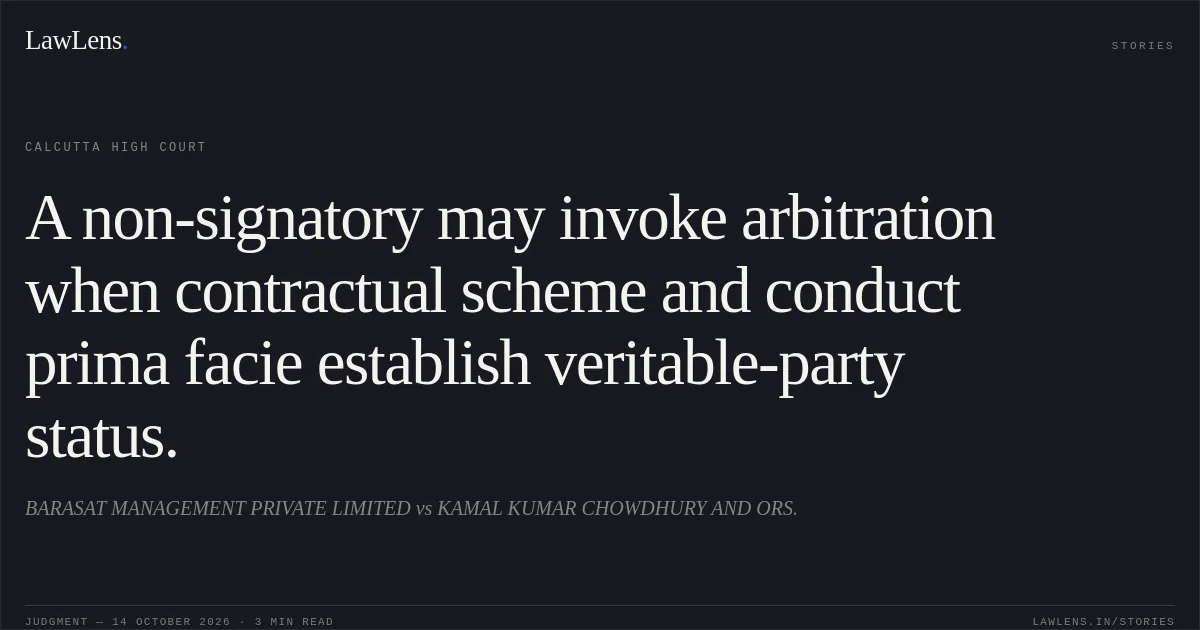
The Court held that a valid arbitration agreement existed and that the petitioner had made out a prima facie case of being a veritable party to it; the tribunal would determine jurisdiction and the respondents’ remaining objections under Section 16.
The petition was allowed, and Ms. Srijani Ghosh, Advocate, was appointed sole arbitrator, subject to the required disclosure and Section 12(5) of the Act. The arbitrator was to fix remuneration under the Fourth Schedule or as agreed by the parties, and the petition was disposed of.
Source reference: para. 53–58Acts & Sections Cited
8 provisions across 2 statutes referred to in this judgment. Each provision opens on LawLens.
Arbitration and Conciliation Act, 19967
Limitation Act, 19631
Original Court PDF
BARASAT MANAGEMENT PRIVATE LIMITEDvsKAMAL KUMAR CHOWDHURY AND ORS.
Click to open original judgment
Original judgment, available to read, download and summarize on LawLens.in


