Facts
A Drugs Inspector alleged that Hinduja Hospital had acquired, stocked and distributed a batch of Visilon that was found to be not of standard quality, misbranded and contaminated.
Source reference: pp. 2–5, 17–19The petitioner, the Hospital’s Managing Trustee, was prosecuted with others under the Drugs and Cosmetics Act, 1940.
Source reference: pp. 2–5, 17–19The complaint identified him as Managing Trustee but did not otherwise allege that he was responsible for the Hospital’s or pharmacy’s operations, or that he had participated in or authorised the relevant acts.
Source reference: pp. 2–5, 17–19The Magistrate rejected his discharge application, and the Sessions Court dismissed his revision. He challenged both orders before the High Court.
Source reference: p. 1Issues
Whether the petitioner could be held vicariously liable under Section 34 of the Drugs and Cosmetics Act merely because he was described as the Hospital’s Managing Trustee, where the complaint contained no specific allegations about his role or responsibility.
Source reference: pp. 14–19, 28–32Whether the complaint disclosed a prima facie basis for liability under Section 27 of the Act, including an allegation that the petitioner caused or authorised another person to carry out the prohibited acts.
Source reference: pp. 15–16, 32–35Law Applied
Section 34 of the Drugs and Cosmetics Act provides for vicarious liability where an offence is committed by a “company”; its explanation includes a body corporate, firm or other association of individuals, but does not expressly include a trust or trustee.
Source reference: pp. 14–15, 28–29Because Section 34 creates penal vicarious liability, it must be strictly construed; designation alone is insufficient, and the complaint must contain factual averments showing that the accused was in charge of and responsible for the conduct of the relevant business.
Source reference: pp. 25–30, 36–38Section 27 applies to a person who manufactures, sells, stocks or distributes drugs, personally or through another person acting on that person’s behalf; the complaint must at least allege a factual basis connecting the accused to those acts.
Source reference: pp. 15–16, 32–35The Court relied, among other authorities, on State of Haryana v. Brij Lal Mittal and Lalankumar Singh v. State of Maharashtra for the need to plead the accused’s role under Section 34, and on Sunil Bharti Mittal v. CBI for the principle that criminal liability is not automatically imputed from status or position.
Source reference: pp. 37–42It also applied Sankar Padam Thapa v. Vijaykumar Dineshchandra Agarwal, which rejected equating a trust with a company in the context considered there; the High Court treated that distinction as relevant to Section 34.
Source reference: pp. 20–24, 27–29Reasoning
The complaint’s only allegation against the petitioner was that he was the Hospital’s Managing Trustee; it did not allege that he supervised the pharmacy, controlled drug procurement or distribution, knew of the alleged defects, or directed or authorised the impugned conduct.
Source reference: pp. 17–19, 31–35The Court held that the title “Managing Trustee” could not, without supporting allegations, be treated as equivalent to “Managing Director” or as proof of responsibility for day-to-day business.
Source reference: pp. 14–15, 23–24, 28–32It also concluded that a trust was not included in Section 34’s definition of “company” and could not be brought within that provision by equating it with a company or association of individuals.
Source reference: pp. 14–15, 23–24, 28–32Nor did the complaint plead the petitioner’s involvement through another person as contemplated by Section 27.
Source reference: pp. 32–35Applying the requirement of specific pleadings for penal vicarious liability, the Court found no prima facie case against him.
Source reference: pp. 35–42Holding
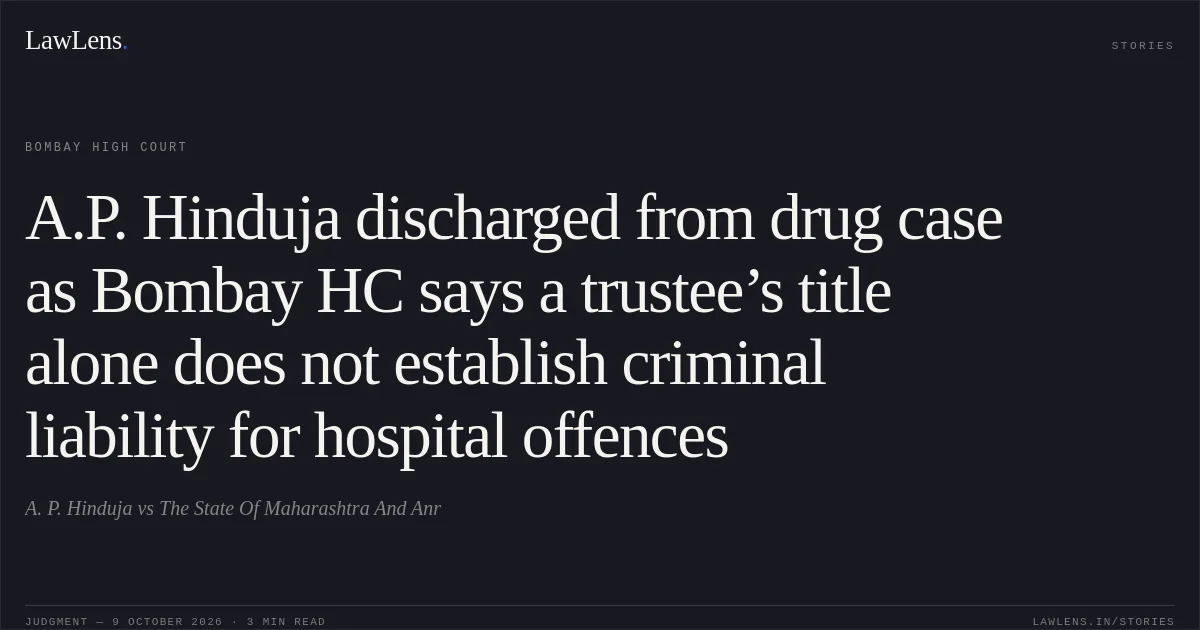
The High Court held that the complaint disclosed no sufficient basis to prosecute the petitioner under Sections 27 or 34 of the Drugs and Cosmetics Act.
It allowed the petition, set aside the impugned orders insofar as they concerned him, and discharged him from the criminal proceedings.
Source reference: pp. 42–44Acts & Sections Cited
19 provisions across 7 statutes referred to in this judgment. Each provision opens on LawLens.
Code of Criminal Procedure, 19735
Bharatiya Nagarik Suraksha Sanhita, 20231
Drugs and Cosmetics Act, 19405
Companies Act, 20131
Negotiable Instruments Act, 18811
Indian Trust Act, 18822
Indian Penal Code, 18604
Original Court PDF
A. P. HindujavsThe State Of Maharashtra And Anr
Click to open original judgment
Original judgment, available to read, download and summarize on LawLens.in