Facts
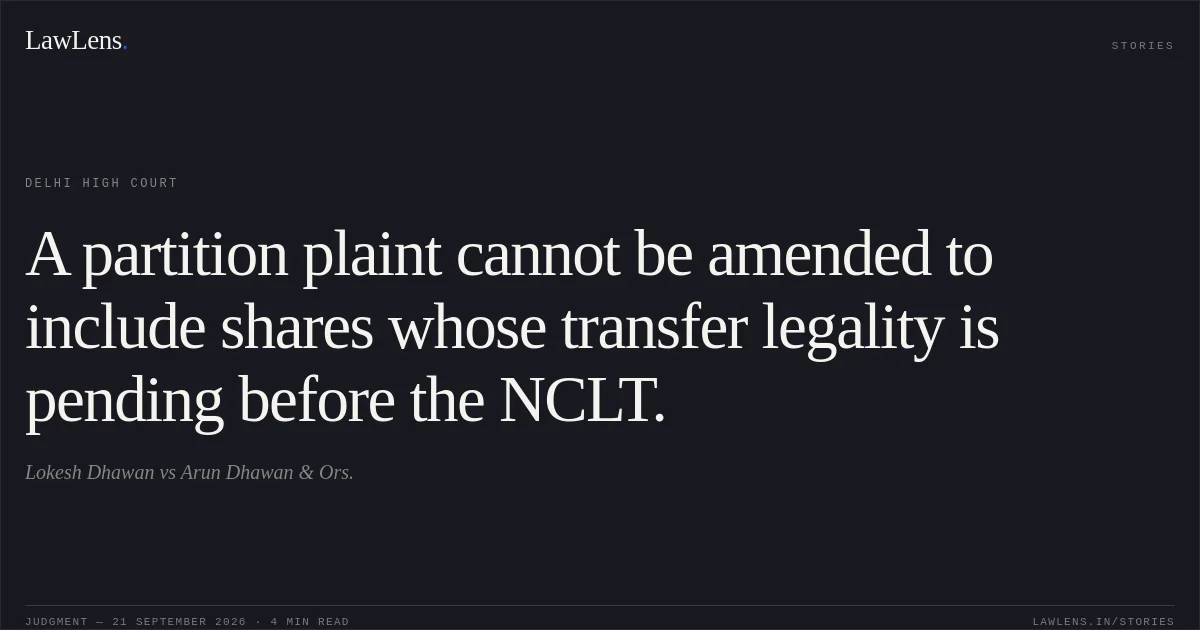
The petitioner and respondents were members of the Dhawan family. Late Sh. K.C. Dhawan, the parties’ father, owned approximately 85% of the shares in Dhawan Electricals Pvt. Ltd. He died intestate on 17 June 2010. The petitioner alleged that, pursuant to a forged board meeting, his father’s shares were fraudulently transferred to respondent no. 1 before his death. The respondents maintained that the shares had been validly transferred during the father’s lifetime and therefore did not form part of his estate.
Source reference: pp. 2–3, paras 4–7The petitioner instituted a partition suit in 2012 concerning the deceased’s immovable properties. He subsequently filed proceedings before the Company Law Board under Sections 397, 398, 402 and 403 of the Companies Act, 1956, challenging the transfer of shares and alleging oppression and mismanagement.
Source reference: pp. 2–3, para. 7; p. 12, para. 40In 2014, he sought amendment of the plaint under Order VI Rule 17 CPC to include movable assets, including the disputed shares, within the partition claim. The trial court dismissed the amendment application on the grounds that the petitioner, being a director and shareholder, would have known of the transfer; the issue was pending before the NCLT; and the amendment would alter the nature of the suit. The petitioner challenged that order before the High Court.
Source reference: pp. 3–4, para. 9; p. 4, para. 10Issues
Whether the trial court could permit an amendment seeking partition of shares whose transfer to respondent no. 1 was already under adjudication before the NCLT?
Source reference: pp. 9–12, paras 27–39Whether the petitioner satisfied the requirement of due diligence under the proviso to Order VI Rule 17 CPC, despite filing the amendment application after instituting proceedings challenging the share transfer?
Source reference: pp. 13–14, paras 42–47Whether the trial court adopted an impermissibly restrictive approach by considering the pending NCLT proceedings and the legal effect of the proposed amendment?
Source reference: pp. 5–6, paras 14–16; pp. 14–15, paras 48–50Law Applied
The Court applied Order VI Rule 17 CPC, including its proviso requiring a party seeking amendment after commencement of trial to establish that, despite due diligence, the matter could not have been raised earlier; amendments necessary for determining the real controversy may ordinarily be allowed, but not where they cause injustice, prejudice, or contravene law, as recognised in LIC v. Sanjeev Builders Pvt. Ltd., (2022) 16 SCC 1.
Source reference: p. 13, para. 42Sections 397, 398, 402 and 403 of the Companies Act, 1956 confer broad jurisdiction on the CLB/NCLT in oppression and mismanagement proceedings, including jurisdiction over issues incidental or integral to resolving the corporate dispute, as recognised in Radharamanan v. Chandrashekhar Raja, Kamal Kumar Gupta v. Ruby General Hospital Ltd., Tata Consultancy Services Ltd. v. Cyrus Investments (P) Ltd., and Mrs. Shailja Krishna v. Satori Global Ltd.
Source reference: pp. 9–11, paras 31–35Section 430 of the Companies Act bars civil-court adjudication of matters falling within the jurisdiction of the NCLT.
Source reference: p. 6, para. 18The Court further relied on BK Narayana Pillai v. Parameswaran Pillai, Rajesh Sharma v. Krishan Pal, Baldev Singh v. Manohar Singh, Kailash v. Nanhku, Aruna Oswal v. Pankaj Oswal and Ammonia Supplies Corporation Pvt. Ltd. v. Modern Plastic Containers Pvt. Ltd. in addressing amendment principles, commencement of trial, and the respective jurisdiction of civil courts and company tribunals.
Source reference: pp. 5–8, 11–12, paras 14–24, 36–41Reasoning
The Court held that the legality of the 17 June 2010 share transfer was central to the petitioner’s pending oppression and mismanagement proceedings and fell within the NCLT’s wide jurisdiction.
Source reference: pp. 9–11, paras 28–35Until the NCLT determined that the transfer was invalid, the shares could not be treated as part of the deceased’s estate or included in the partition suit. The petitioner’s reliance on inheritance and title jurisdiction was rejected because the immediate question was not succession but the validity of the prior corporate transfer; inheritance issues would arise only if the transfer were first annulled.
Source reference: pp. 11–12, paras 36–39The petitioner also failed the due-diligence requirement: he was a director, shareholder and salary-drawing participant in the closely held family company, and had himself instituted proceedings challenging the transfer in 2012 before seeking the amendment in 2014.
Source reference: p. 14, paras 44–47Consequently, allowing the amendment would prejudice the respondents and permit the civil court to deal with disputed shares that were already the subject of NCLT proceedings. The Court therefore found no error in the trial court’s refusal to allow the amendment.
Source reference: pp. 13–15, paras 42–50Holding
The High Court dismissed the petition and upheld the trial court’s order refusing amendment of the plaint. It held that the disputed shares could not be included in the partition suit while the NCLT proceedings concerning the legality of their transfer remained pending, and that the petitioner had not demonstrated due diligence under Order VI Rule 17 CPC.
All pending applications were also dismissed.
Source reference: p. 16, para. 53Acts & Sections Cited
1 provisions across 1 statute referred to in this judgment. Each provision opens on LawLens.
Companies Act, 20131
Original Court PDF
Lokesh DhawanvsArun Dhawan & Ors.
Click to open original judgment
Original judgment, available to read, download and summarize on LawLens.in