Facts
The appellant claimed possession of land belonging to the second respondent.
Source reference: para. 4He had obtained an injunction in a civil suit, O.S. No. 7 of 1999, on the basis of possession; that decree was affirmed on appeal and was pending in second appeal, without suspension of the injunction.
Source reference: para. 4Separately, in 2013, the appellant applied to the Tahsildar/Tenancy Record Officer to have his name recorded as a cultivating tenant. The proceedings continued until 2016, when the Tahsildar recorded that the appellant and the second respondent had appeared and consented to the order, and closed the file.
Source reference: para. 5The appellant disputed giving consent and contended that he had not been afforded an opportunity to adduce evidence.
Source reference: paras. 6–7The Single Judge dismissed his writ petition, directed him to hand over possession to the second respondent within three months, and imposed costs of Rs. 10,000. The appellant challenged that order in this writ appeal.
Source reference: para. 1Issues
Whether the appellant had shown grounds to interfere with the Tahsildar’s disposal of his application to be recorded as a cultivating tenant, including his claims that he had not consented to the order and had been denied an opportunity to present evidence.
Source reference: paras. 5–7, 10Whether the civil-court injunction based on possession supported the appellant’s claim to remain in possession as a cultivating tenant.
Source reference: paras. 4, 9Whether the Single Judge’s order, including the direction to hand over possession and the award of costs, warranted interference in appeal.
Source reference: paras. 1, 12–13Law Applied
Section 6 of the Tamil Nadu Cultivating Tenants Protection Act, 1955, bars the jurisdiction of the civil court in matters where the claimant asserts rights as a cultivating tenant.
Source reference: para. 4The Court distinguished a civil injunction obtained on the basis of possession from a determination of cultivating-tenancy status: the injunction, as described in this case, did not establish that status.
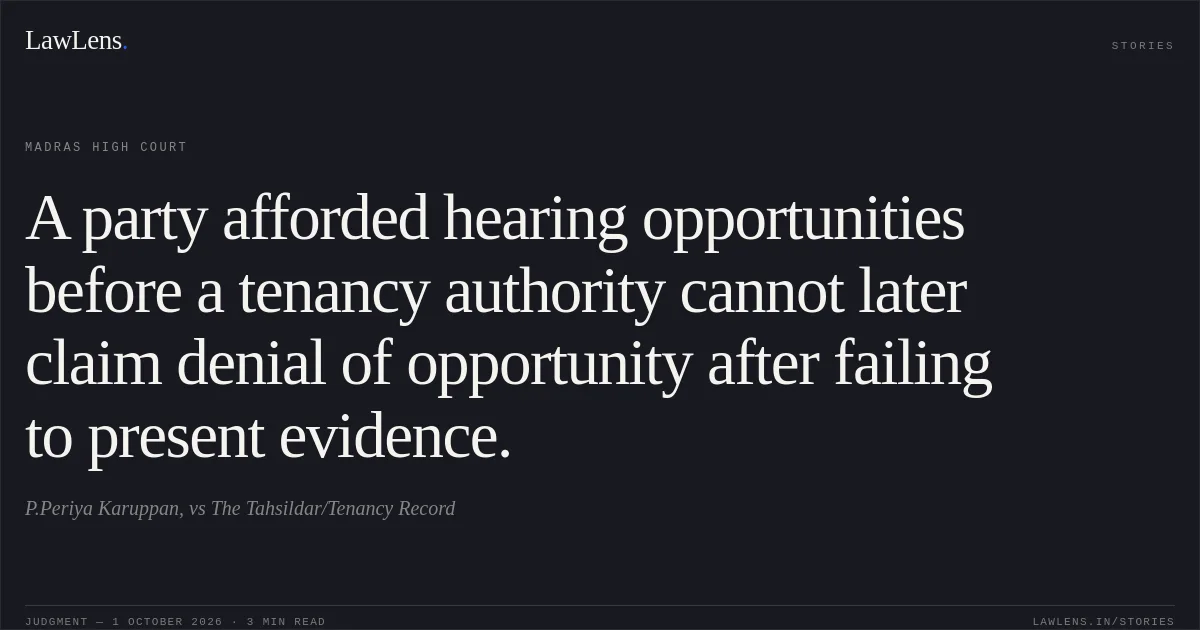
Source reference: paras. 4, 9The Court also held that a party who had hearing opportunities before the authority but did not tender evidence or arguments could not, after conclusion of the proceedings, rely on the alleged absence of an opportunity, absent a claim that the party had been prevented from using those opportunities.
Source reference: paras. 7, 10Reasoning
The Court considered the appellant’s civil-court injunction and his later claim to cultivating-tenancy status to be distinct bases for asserting possession.
Source reference: paras. 4, 9Because the civil suit was brought on possession rather than cultivating-tenancy rights, the injunction did not establish his status as a cultivating tenant; the Court also noted that such a tenancy claim would fall within the statutory bar on civil-court jurisdiction.
Source reference: paras. 4, 9As to the Tahsildar’s proceedings, the Court relied on the recorded history of hearings and the absence of a claim that the appellant had been prevented from presenting evidence. It therefore rejected his complaints about consent and opportunity, also noting the impleading application filed near the end of the proceedings.
Source reference: paras. 5–8, 10It found no basis to disturb the Single Judge’s decision.
Source reference: para. 12Holding
The writ appeal was dismissed. The Court declined to interfere with the Single Judge’s order, including the direction to hand over possession to the second respondent within three months and the costs of Rs. 10,000.
No further costs were imposed in the appeal, and the connected miscellaneous petitions were closed.
Source reference: paras. 1, 12–13Acts & Sections Cited
2 provisions across 2 statutes referred to in this judgment. Linked provisions open on LawLens.
Letters Patent1
Tamil Nadu Cultivating Tenants Protection Act, 19551
Original Court PDF
P.Periya Karuppan,vsThe Tahsildar/Tenancy Record
Click to open original judgment
Original judgment, available to read, download and summarize on LawLens.in