Facts
In December 2008, the Appellant entered into a "Manning Agreement" with the Respondent for 17 vessels
Source reference: para. 3In July 2009, a vessel was damaged after striking a submerged rock
Source reference: para. 5In 2014, the Respondent unilaterally recovered Rs. 2,87,84,305/- from the Appellant's pending bills as a penalty for the grounding, citing "negligence" under Clause 3.20 of the agreement
Source reference: para. 6Clause 3.20 stipulated that the Administration's decision regarding financial loss due to negligence would be final, binding, and could not be challenged in any court or arbitration
Source reference: para. 19The Appellant disputed liability, leading to the appointment of a sole arbitrator by the Supreme Court
Source reference: para. 7The Arbitrator held Clause 3.20 void under Section 28 of the Indian Contract Act and awarded the recovered amount to the Appellant
Source reference: paras. 9, 11While the District Judge upheld the award, the High Court of Calcutta set it aside, ruling that Clause 3.20 created an "excepted matter" over which the arbitrator had no jurisdiction
Source reference: paras. 12-13Issues
Whether the High Court was correct in law to set aside the arbitral award by treating the dispute as an "excepted matter" under Clause 3.20
Source reference: para. 15Whether a contractual clause can validly authorize one party to be the sole arbiter of a disputed breach and simultaneously bar all legal and arbitral remedies
Source reference: paras. 24-25Law Applied
The Court primarily applied the fundamental principle of the Rule of Law that no person shall be a judge in their own cause (Nemo judex in causa sua)
Source reference: para. 25It relied on State of Karnataka v. Shree Rameshwara Rice Mills, which established that a party to a contract cannot adjudicate a disputed breach; such power is limited to cases where the breach is admitted
Source reference: para. 26It further cited J.G. Engineers Private Limited v. Union of India, affirming that the question of breach must be decided by an adjudicatory forum, not the party alleging the breach
Source reference: para. 27The Court invoked Section 28 of the Indian Contract Act, 1872, which renders agreements in restraint of legal proceedings void
Source reference: para. 31The maxim Ubi jus ibi remedium (where there is a right, there is a remedy)
Source reference: para. 30Section 9 of the Code of Civil Procedure and the principles in Sri Vedagiri Lakshmi Narasimha Swami Temple v. Induru Pattabhirami Reddi prevent any interpretation that creates a "vacuum" in legal remedies
Source reference: paras. 31-32Reasoning
The Court reasoned that Clause 3.22 (Arbitration) was widely worded to include "any dispute," while Clause 3.20 sought to grant the Respondent unilateral power to determine "negligence" and "wilful act"
Source reference: paras. 21-23The Court held that the Administration cannot be the judge of a breach when the other party disputes liability, as this violates the Rule of Law
Source reference: para. 25Harmoniously construing the contract, the Court clarified that Clause 3.20’s "finality" applies only to the quantification of loss in instances where the breach is admitted
Source reference: paras. 28, 35Since the Appellant disputed negligence, the issue of liability fell squarely within the arbitrator's jurisdiction under Clause 3.22
Source reference: para. 29The Court rejected the "excepted matter" argument, noting that "excepting" a matter from arbitration is permissible, but "excluding" justice by barring both courts and arbitration is illegal
Source reference: paras. 37-38It described the Respondent’s attempt to foreclose all legal remedies while reserving its own right to sue as "grossly discriminatory"
Source reference: para. 38Holding
The Supreme Court allowed the appeals, set aside the High Court’s judgment, and restored the arbitral award dated 08.05.2017
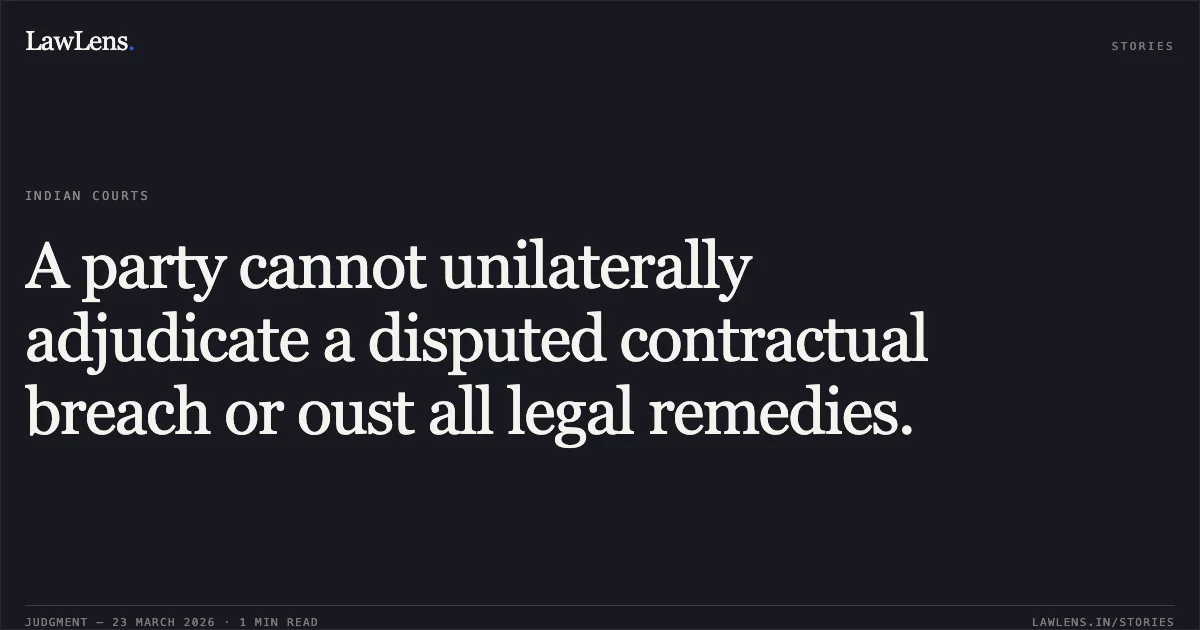
The Court held that one party to a contract cannot unilaterally decide on a disputed breach, and any clause barring a party from challenging such a decision in a court of law or arbitration is contrary to the Rule of Law and Section 28 of the Indian Contract Act
Source reference: paras. 34, 40The dispute was found to be within the arbitrator's domain as the liability was contested
Source reference: para. 41Acts & Sections Cited
5 provisions across 3 statutes referred to in this judgment. Each provision opens on LawLens.
Code of Civil Procedure, 19081
Indian Contract Act, 18721
Arbitration and Conciliation Act, 19963
Original Court PDF
M/S. Abs Marine ServicesvsAndaman And Nicobar Administration
Click to open original judgment
Original judgment, available to read, download and summarize on LawLens.in


![Subsequent exoneration does not retrospectively invalidate a finalized promotion select list.. UNNIKRISHNAN M vs M/o Environment And Forests. CAT - ['Ernakulam']. LawLens](/stories/thumbnails/subsequent-exoneration-does-not-retrospectively-invalidate-a-finalized-promotion-select-li-ce80a0e84f2f4887857271e8b4341c42.webp)