Facts
The appellants and the respondent entered into a loan agreement dated 14 April 2001 under which the respondent advanced ₹15 lakh interest-free to fund construction of an office complex of approximately 13,000 sq. ft., to be completed within ten months, with a maximum five-month extension.
Source reference: para. 2–9, 12–13The respondent was to lease the premises on agreed terms.
Source reference: para. 2–9, 12–13The appellants claimed the respondent breached the agreement by refusing to take the premises and sought damages; the respondent alleged that the appellants had not completed the agreed construction and sought repayment of the loan.
Source reference: para. 2–9, 12–13The Single Judge dismissed the appellants’ damages suit and partly decreed the respondent’s recovery suit, ordering payment of ₹13.5 lakh with interest.
Source reference: para. 2–9, 12–13The appellants appealed both rulings.
Source reference: para. 2–9, 12–13Issues
1. Whether the respondent breached the agreement dated 14 April 2001 and, if so, whether the appellants were entitled to damages
Source reference: para. 19(i)2. Whether the respondent was entitled to recover the interest-free loan advanced under the agreement.
Source reference: para. 19(ii)Law Applied
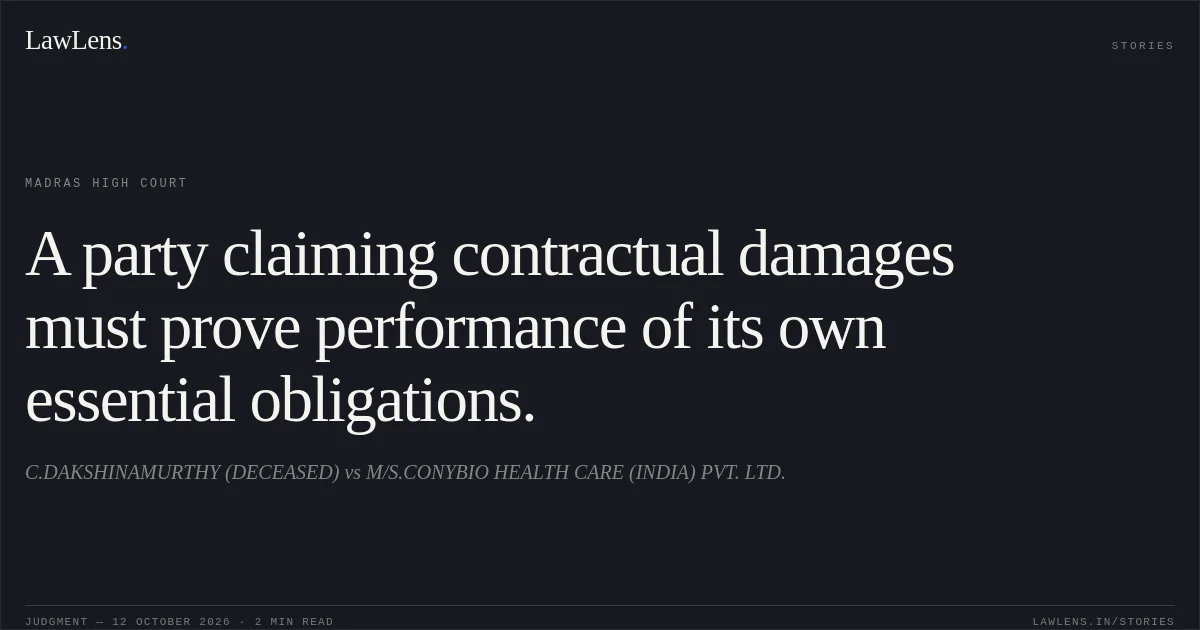
A claimant seeking contractual damages must establish that the other party breached the contract and that the breach caused a pecuniary loss; a party that has not performed its essential contractual obligations cannot claim damages for losses arising from the other party’s alleged default.
Source reference: para. 25, 29The parties’ rights were also governed by the terms of their agreement, including Clause 8, which required a penalty for delay and permitted revocation of the agreement and presentation of the security cheques if construction was not completed within fifteen months.
Source reference: para. 27–28The Court referred to Section 138 of the Negotiable Instruments Act in connection with the respondent’s notice following dishonour of the cheques.
Source reference: para. 28It distinguished Food Corporation of India, Bhopal v. M/s. Babulal Agarwal, where the owner had performed its obligations within the agreed timeline.
Source reference: para. 29Reasoning
The appellants did not establish that they had completed the agreed 13,000 sq. ft. within the contractual period.
Source reference: para. 23–25Their evidence showed that the sanctioned plan covered only 4,646 sq. ft.; there was no completion certificate or other proof establishing the agreed construction and timely completion, and evidence indicated that third-party tenants had occupied parts of the premises.
Source reference: para. 23–25The Court therefore found the respondent’s explanation—that it had moved to alternative premises because the agreed premises were not completed—more probable, and held that the appellants had not proved either the respondent’s breach or resulting loss.
Source reference: para. 24–26As to the loan, the ₹15 lakh advance and the security cheques were admitted, and the appellants had repaid only ₹1.5 lakh.
Source reference: para. 27–28Applying the agreement and considering the dishonoured cheques, the Court found no basis to disturb the order for recovery of the remaining ₹13.5 lakh.
Source reference: para. 27–28Holding
The Court answered both issues against the appellants: they were not entitled to damages, and the respondent was entitled to recover the unpaid loan balance.
It dismissed both appeals, confirmed the Single Judge’s judgment—including the direction to pay ₹13.5 lakh with interest at 12% per annum from filing to judgment and 6% thereafter until realization—and made no order as to costs.
Source reference: para. 28, 30Acts & Sections Cited
1 provisions across 1 statute referred to in this judgment. Each provision opens on LawLens.
Negotiable Instruments Act, 18811
Original Court PDF
C.DAKSHINAMURTHY (DECEASED)vsM/S.CONYBIO HEALTH CARE (INDIA) PVT. LTD.
Click to open original judgment
Original judgment, available to read, download and summarize on LawLens.in