Facts
Respondent No. 3, Surendra Kumar Sethia, instituted a civil suit claiming that he held a valid patta over the disputed property and seeking an injunction restraining the State authorities from constructing a road thereon.
Source reference: para. 2Ayub Sodha, the petitioner, was impleaded as a defendant under Order I Rule 10 read with Section 151 of the Code of Civil Procedure, 1908, asserting that the land formed part of a public way and that the injunction would obstruct public convenience.
Source reference: para. 2.1After remand proceedings, the Trial Court, by order dated 30 May 2012, directed the parties to maintain status quo regarding the suit property.
Source reference: para. 2.2The State preferred an appeal under Order XLIII CPC. Although the appellate proceedings were initially decided on merits, the High Court subsequently remanded the matter for determination of the State’s application under Section 5 of the Limitation Act; the Appellate Court ultimately dismissed the State’s appeal on 2 May 2023.
Source reference: paras. 2.3–2.4The petitioner, despite being a party to the suit and injunction proceedings, did not independently appeal against the Trial Court’s order under Order XLIII CPC. He instead invoked Articles 226 and 227 of the Constitution to challenge both the appellate order and the original status-quo order.
Source reference: para. 2.5Issues
1. Whether the petitioner could challenge the Trial Court’s order dated 30 May 2012 under Articles 226 and 227 after failing to avail the statutory appeal available under Order XLIII Rule 1 CPC.
Source reference: paras. 4–4.22. Whether the petitioner, who was not the appellant before the lower Appellate Court, could assail the appellate order passed in an appeal preferred by the State Government.
Source reference: paras. 4.1–4.33. Whether the impugned orders disclosed any manifest illegality, jurisdictional error, perversity, or other exceptional circumstance warranting interference under the supervisory jurisdiction of Article 227.
Source reference: paras. 4.4–6Law Applied
The Court applied Order XXXIX Rules 1 and 2 CPC governing temporary injunctions and Order XLIII Rule 1 CPC, under which an order granting or refusing temporary injunction is independently appealable.
Source reference: para. 4It further applied the principle that where an efficacious statutory remedy is available, a litigant ordinarily cannot bypass that remedy by invoking the extraordinary jurisdiction under Articles 226 and 227 of the Constitution.
Source reference: para. 7The Court reiterated that Article 227 confers supervisory, not appellate or revisional, jurisdiction and is to be exercised sparingly only in cases of manifest perversity, patent illegality, jurisdictional error, or palpable miscarriage of justice.
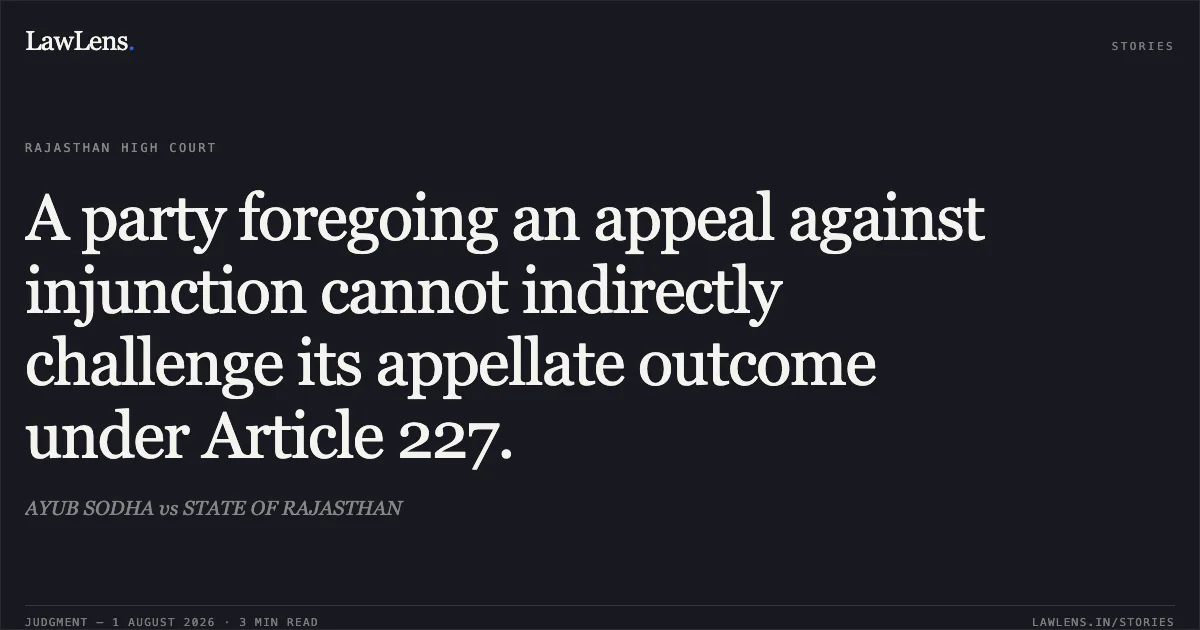
Source reference: para. 4.4A party that consciously fails to challenge an order through the available statutory remedy cannot indirectly question that order by challenging appellate proceedings initiated by another party.
Source reference: paras. 4.1–4.3The Court also noted that Order XXXIX Rule 4 CPC remained available, subject to its legal maintainability and the facts of the case.
Source reference: para. 8Reasoning
The petitioner had been impleaded in, and was directly affected by, the proceedings concerning the temporary injunction; therefore, the order dated 30 May 2012 gave him an independent right of appeal under Order XLIII Rule 1 CPC.
Source reference: paras. 2.1, 4His failure to exercise that remedy permitted the order to attain finality qua him, and he could not use the State’s separate appeal as a vehicle to obtain an indirect adjudication of his own challenge.
Source reference: paras. 4–4.3Since the appellate order arose exclusively from the State’s appeal, the petitioner had no independent basis to assail it after consciously abstaining from challenging the original order.
Source reference: no citationIn any event, the Trial Court had exercised its discretion after considering the material before it, and the High Court found no manifest illegality, perversity, jurisdictional infirmity, or exceptional circumstance justifying Article 227 intervention.
Source reference: paras. 4.4–6Holding
The High Court dismissed the writ petition, holding that the petitioner could not challenge either the Trial Court’s status-quo order or the appellate order through Articles 226 and 227 after failing to avail the statutory appeal under Order XLIII CPC.
No jurisdictional error, perversity, or manifest illegality was found in the impugned orders.
Source reference: para. 8The dismissal was without prejudice to any remedy otherwise available in law, including an application under Order XXXIX Rule 4 CPC if legally maintainable and warranted by the circumstances.
Source reference: para. 8Acts & Sections Cited
2 provisions across 2 statutes referred to in this judgment. Each provision opens on LawLens.
Code of Civil Procedure, 19081
Limitation Act, 19631
Original Court PDF
AYUB SODHAvsSTATE OF RAJASTHAN
Click to open original judgment
Original judgment, available to read, download and summarize on LawLens.in