Facts
On 17 June 2018, a dispute arose between the parties concerning the use of an agricultural access road. Both sides alleged assaults and lodged cross-FIRs. The applicants’ FIR, I-C.R. No. 37 of 2018, alleged offences under Sections 323, 294(b), 307, 506(2) and 120B of the IPC and Sections 27(1) and 30 of the Arms Act. Respondent No. 2’s FIR, I-C.R. No. 38 of 2018, alleged offences under Sections 143, 147, 148, 149, 323, 324 and 294(b) of the IPC. Both cases were charge-sheeted, committed to the Sessions Court and tried jointly as Sessions Case Nos. 37 and 39 of 2019.
Source reference: pp. 2–3, paras. 3–5During the trial in Sessions Case No. 39 of 2019, the injured complainant filed an application at Exhibit 42 seeking alteration/addition of charges under Section 216 of the Cr.P.C., including Sections 326, 452 and 307 of the IPC. Relying principally on the medical certificate recording serious fractures and head injuries, the trial court altered the charge by adding Sections 326 and 307 IPC and directed that the amended charge be read over to the accused, with liberty to recall previously examined witnesses.
Source reference: pp. 3, 6–8, paras. 6, 9The applicants challenged the order dated 21 April 2026, contending that, under P. Kartikalakshmi v. Sri Ganesh, no party had a right to seek alteration of charge under Section 216 Cr.P.C.
Source reference: p. 4, para. 8Issues
1. Whether the trial court misinterpreted and improperly applied the Supreme Court’s decision in P. Kartikalakshmi v. Sri Ganesh while altering the charges under Section 216 Cr.P.C.
Source reference: p. 5, para. 92. Whether an order altering or adding charges under Section 216 Cr.P.C. is invalid merely because the court acted upon an application filed by the injured complainant or another party rather than acting entirely suo motu.
Source reference: pp. 8–10, paras. 10–12Law Applied
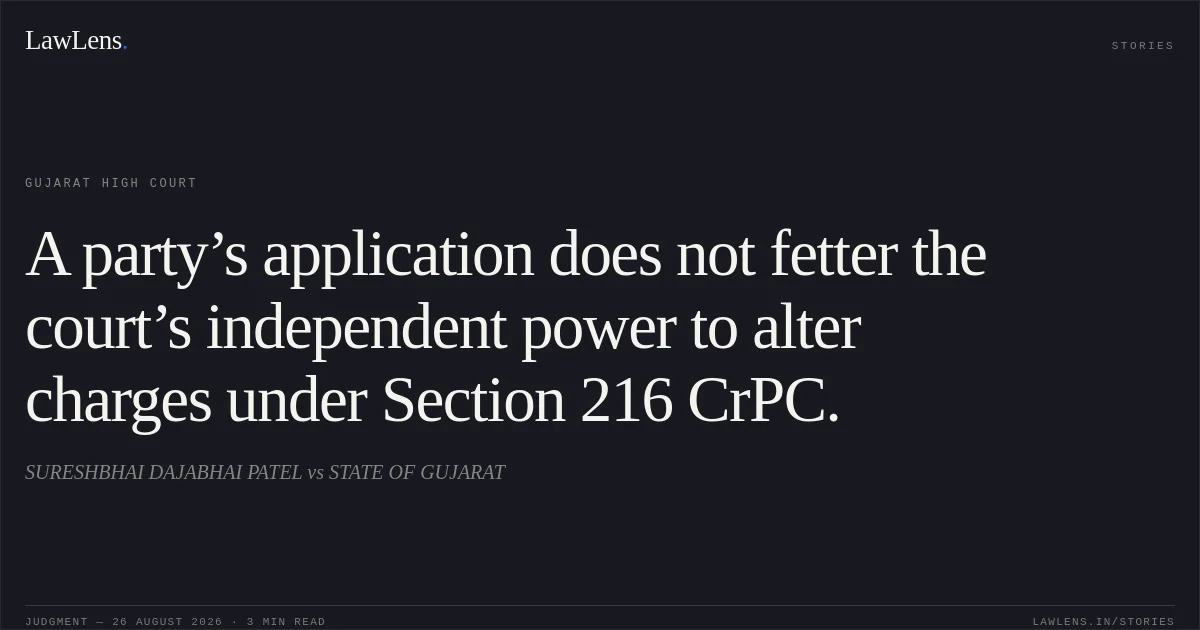
Section 216 of the Cr.P.C. empowers the trial court to alter or add any charge at any time before judgment is pronounced.
Source reference: pp. 8–10, paras. 10–11Under P. Kartikalakshmi v. Sri Ganesh, (2017) 3 SCC 347, this power is vested exclusively in the court; no complainant, accused or prosecution possesses a vested right to demand alteration or addition of a charge by filing an application. However, a party may bring relevant facts or circumstances to the court’s notice, after which the court must independently apply its mind and decide whether alteration or addition of the charge is necessary.
Source reference: pp. 8–10, paras. 10–11The court also considered the alleged offences under Sections 307 and 326 of the IPC in the context of the medical evidence and allegations of assault with a deadly weapon.
Source reference: pp. 6, 10, paras. 9, 12Reasoning
The High Court held that P. Kartikalakshmi does not prohibit a party from placing relevant facts before the trial court; it only denies that party a vested right to obtain alteration of charge.
Source reference: pp. 9–10, paras. 11–12The application at Exhibit 42 merely brought the injured witness’s medical condition and the alleged assault with an axe to the court’s attention. The trial court independently considered the medical certificate, which recorded a parietal bone fracture, tibia fracture and depressed skull fracture, along with the allegations of assault with a deadly weapon. It then concluded that the facts disclosed the necessity of adding Sections 326 and 307 IPC and also safeguarded the accused’s procedural rights by directing that the amended charge be read over and permitting recall of previously examined panch witnesses.
Source reference: pp. 6–8, para. 9Since the alteration was based on the court’s own satisfaction and not on any enforceable right of the complainant, the order was consistent with Section 216 Cr.P.C. and P. Kartikalakshmi.
Source reference: pp. 9–10, paras. 11–12Holding
The Court answered the issues against the applicants. It held that the trial court had not misinterpreted P. Kartikalakshmi and that the alteration of charges was not invalid merely because the matter was brought before it through an application filed by the injured complainant.
The Special Criminal Application was rejected, the Rule was discharged, and the trial court’s order dated 21 April 2026 adding Sections 326 and 307 IPC was allowed to stand.
Source reference: p. 11, para. 13Acts & Sections Cited
15 provisions across 3 statutes referred to in this judgment. Each provision opens on LawLens.
Indian Penal Code, 1860
Arms Act, 19592
Code of Criminal Procedure, 19731
Original Court PDF
SURESHBHAI DAJABHAI PATELvsSTATE OF GUJARAT
Click to open original judgment
Original judgment, available to read, download and summarize on LawLens.in
![Courts will not interfere with transfers absent mala fides or violation of statutory rules.. M Ramya vs EMPLOYEES STATE INSURANCE CORPORATION (ESIC). CAT - ['Chennai']. LawLens](/stories/thumbnails/courts-will-not-interfere-with-transfers-absent-mala-fides-or-violation-of-statutory-rules-a6845e9ca6f548fca284c51c8351957f.webp)
![Courts cannot direct one-time recruitment age relaxation absent authority in the governing rules or advertisement.. UT OF PUDUCHERRY vs M ANDAL. CAT - ['Chennai']. LawLens](/stories/thumbnails/courts-cannot-direct-one-time-recruitment-age-relaxation-absent-authority-in-the-governing-895d78fde47143e2a8ed0207c4b6a44f.webp)
![A review cannot correct an allegedly erroneous decision absent an error apparent on the record.. Ajit Kumar Jha vs RAILWAY BOARD. CAT - ['Delhi']. LawLens](/stories/thumbnails/a-review-cannot-correct-an-allegedly-erroneous-decision-absent-an-error-apparent-on-the-re-8ac952fd4eba470c92f7da20af72a220.webp)