Facts
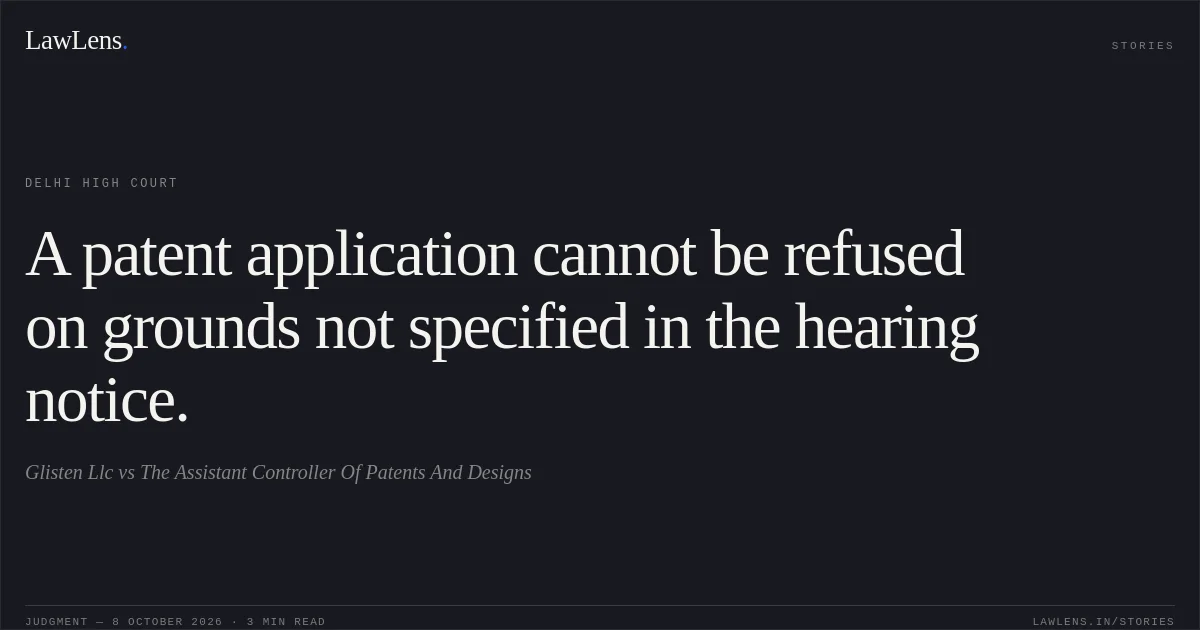
Glisten LLC appealed under Section 117A of the Patents Act, 1970 against the refusal of its Indian patent application for “Gemstone Coating and Methods of Making and Using the Same” on the ground that claims 1–17 lacked inventive step.
Source reference: para. 1, 3The FER had raised an inventive-step objection against claims 1–18 over documents D1 and D2.
Source reference: para. 4However, the hearing notice confined its inventive-step objection to claim 18, based on alleged lack of support in the specification; Glisten then gave up claim 18 and proceeded with claims 1–17.
Source reference: para. 6–8The Controller nevertheless refused the application on the basis that claims 1–17 were obvious over D1 in combination with D2.
Source reference: para. 9, 30Issues
1. Whether the Controller could refuse claims 1–17 for lack of inventive step when the hearing notice confined that objection to claim 18, without first notifying Glisten of the objection against claims 1–17 and providing an opportunity to respond.
Source reference: para. 15, 28–302. Whether the Court was required to determine the substantive inventive-step merits of claims 1–17 in this appeal.
Source reference: para. 15Law Applied
Sections 14 and 15 of the Patents Act, 1970 require the Controller, before disposing of an application, to communicate the gist of adverse objections and permit the applicant to be heard; the refusal power under Section 15 must be exercised consistently with that process.
Source reference: para. 16–19Section 80 further requires an opportunity to be heard before the Controller exercises discretion adversely to an applicant.
Source reference: para. 18These provisions embody audi alteram partem: notice must clearly and precisely identify the case to be met, and a decision on an unnotified ground violates natural justice.
Source reference: para. 21–23The Court relied on Biecco Lawrie Ltd. v. State of West Bengal, Canara Bank v. V.K. Awasthy, Assistant Commissioner, Commercial Tax Department v. Shukla and Brothers, Agriboard International LLC v. Deputy Controller of Patents and Designs, Perkinelmer Health Sciences Inc. v. Controller of Patents, Proprietect L.P. v. Controller of Patents, and Phillip Morris Products S.A. v. Assistant Controller of Patents and Designs for the requirements of adequate notice, hearing, and reasoned decision-making.
Source reference: para. 21–27In patent examination, the hearing notice identifies the objections that remain; an objection omitted from it, or a fresh ground, must be communicated and answered before an adverse order is made.
Source reference: para. 28Reasoning
The hearing notice raised an inventive-step objection only against claim 18 and grounded it in the absence of working examples; it did not state that claims 1–17 remained obvious over D1 and D2 or explain how those documents rendered them obvious.
Source reference: para. 7, 29Glisten gave up claim 18 in response, while the Controller’s final order rejected claims 1–17 on the separate D1–D2 combination and found the wear-test evidence insufficient to establish an unexpected technical effect.
Source reference: para. 8–9, 30Because Glisten had not been notified of that case, its general written submissions could not substitute for specific notice, and it lost the opportunity to address the evidentiary deficiency identified in the final order.
Source reference: para. 31–32The Court therefore resolved the appeal on procedural fairness and did not decide whether claims 1–17 substantively involved an inventive step.
Source reference: para. 15Holding
The Court held that the refusal violated Section 14 and the principles of natural justice because the ground ultimately relied upon had not been put to Glisten for response.
It allowed the appeal, set aside the refusal order dated 23 January 2026, and restored the application to the Controller for fresh consideration in accordance with the Act and the Patents Rules, 2003.
Source reference: para. 34All rights and contentions were left open, and the Court’s observations were not to influence the merits decision.
Source reference: para. 35–36Acts & Sections Cited
6 provisions across 1 statute referred to in this judgment. Each provision opens on LawLens.
Patents Act, 19706
Original Court PDF
Glisten LlcvsThe Assistant Controller Of Patents And Designs
Click to open original judgment
Original judgment, available to read, download and summarize on LawLens.in