Facts
In OA 2416/2016, the Central Administrative Tribunal (CAT) declared the petitioners entitled to a second financial upgradation in PB-3 with Grade Pay of ₹5,400 after 24 years of regular service, and directed the respondents to implement that relief.
Source reference: pp. 1–2, paras. 2–3The respondents initially issued an order on 3 April 2025 fixing the petitioners’ pay in PB-3, but by a subsequent order dated 23 September 2025 revised the fixation to a scale beginning at ₹13,450, which the parties accepted fell in PB-2.
Source reference: pp. 2–4, paras. 4–8, 16The petitioners initiated contempt proceedings, alleging that the revised order contravened the CAT’s direction.
Source reference: no citationThe CAT dismissed the contempt petition on the ground that the correctness of pay fixation could not be examined in contempt proceedings.
Source reference: p. 4, paras. 9–11The petitioners challenged that dismissal before the High Court.
Source reference: p. 5, para. 11Issues
1. Whether the CAT was justified in dismissing the contempt petition solely because the dispute concerned the correctness of pay fixation under the ACP/MACP Scheme.
Source reference: p. 5, para. 122. Whether the respondents’ revised order fixing pay in PB-2, rather than PB-3, could constitute willful or contumacious disobedience of the CAT’s direction.
Source reference: pp. 5–6, paras. 14–18Law Applied
Contempt requires disobedience that is willful or contumacious; every instance of non-compliance does not warrant punishment.
Source reference: pp. 8–9, paras. 25–27Under J.S. Parihar v. Ganpat Duggar, (1996) 6 SCC 291, contempt proceedings are not ordinarily the forum to review the merits of a subsequent administrative decision or to issue fresh substantive directions; such a decision may give rise to a fresh cause of action for judicial review.
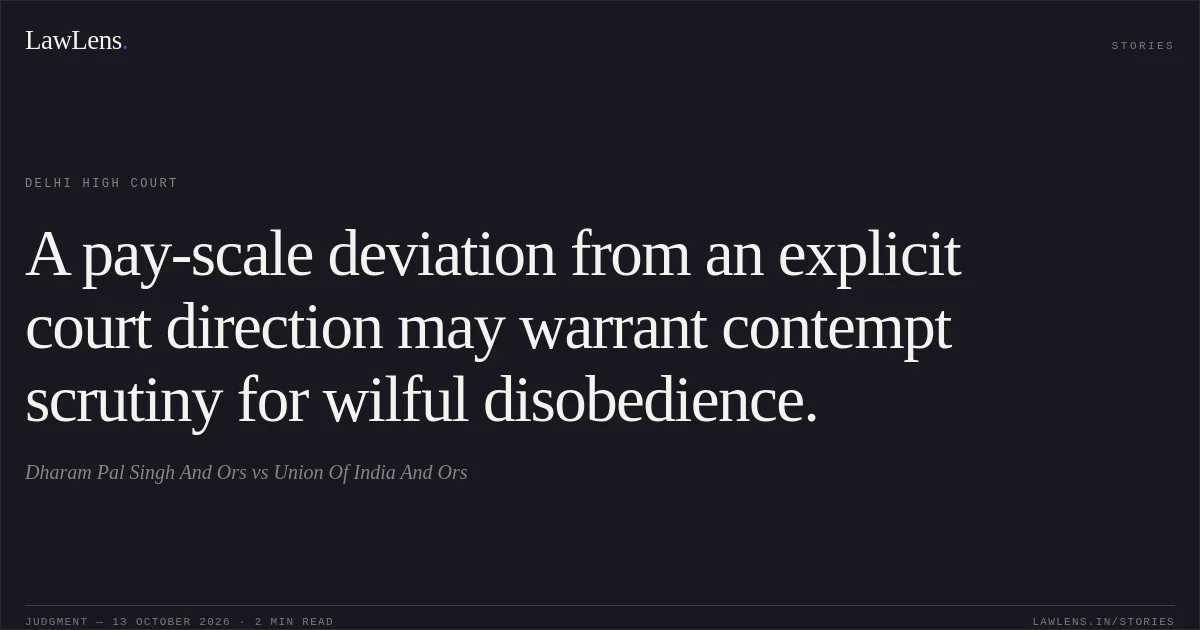
Source reference: pp. 6–7, para. 19However, where an alleged breach concerns a clear court direction, the contempt court may examine whether the subsequent action contravenes it and, if so, whether the breach is sufficiently willful or contumacious to justify contempt proceedings.
Source reference: pp. 5–6, paras. 12, 17–18Reasoning
The CAT’s direction expressly entitled the petitioners to the second upgradation in PB-3, while the later order placed their pay in PB-2; the respondents’ counsel acknowledged that the revised scale fell in PB-2.
Source reference: pp. 2, 5–6, paras. 2–3, 14–16The High Court considered that this apparent departure presented a focused question of compliance, not necessarily a complex pay-fixation dispute requiring a fresh original proceeding.
Source reference: no citationJ.S. Parihar did not preclude the Tribunal from determining whether the later order contravened the specific direction and whether any contravention was willful or contumacious.
Source reference: pp. 6–8, paras. 17–20The High Court left that determination to the Tribunal.
Source reference: no citationHolding
The High Court quashed the CAT’s order dismissing the contempt petition and remitted the petition for fresh consideration in light of its observations.
It expressed no view on whether the revised pay-fixation order was contemptuous, leaving the Tribunal to determine both whether disobedience occurred and whether it was willful or contumacious.
Source reference: pp. 8–9, paras. 25–27The parties were directed to appear before the Tribunal on 30 October 2026, and the writ petition was allowed to that extent without costs.
Source reference: p. 8, paras. 23–24, 28Acts & Sections Cited
3 provisions across 2 statutes referred to in this judgment. Linked provisions open on LawLens.
the Act (alias, unresolved)2
Rajasthan High Court Ordinance 19491
Original Court PDF
Dharam Pal Singh And OrsvsUnion Of India And Ors
Click to open original judgment
Original judgment, available to read, download and summarize on LawLens.in