Facts
The complainant alleged that land allotted to his father had been transferred through sale deeds executed in 2002, including deeds in favour of the petitioners, and that the accused later threatened to take possession of the land.
Source reference: p. 2–3He filed a complaint in 2015 alleging offences under Sections 468, 471, 415, 323, 506 and 120B IPC.
Source reference: p. 2–3The Magistrate took cognizance and issued summons on 17 September 2015; the petitioners’ criminal revision was dismissed on 15 January 2019.
Source reference: p. 1–2, 6–7The petitioners sought quashing, relying, among other grounds, on the delay in filing the complaint, the pending partition suit, and the absence of an affidavit supporting the complaint.
Source reference: p. 3–4Issues
1. Whether the cognizance and summoning orders should be quashed because the allegations arose from a land-title and possession dispute in which a civil proceeding was pending.
Source reference: p. 4–5, 8–92. Whether the alleged delay in filing the complaint and the absence of an affidavit warranted quashing at the threshold.
Source reference: p. 3–4, 9Law Applied
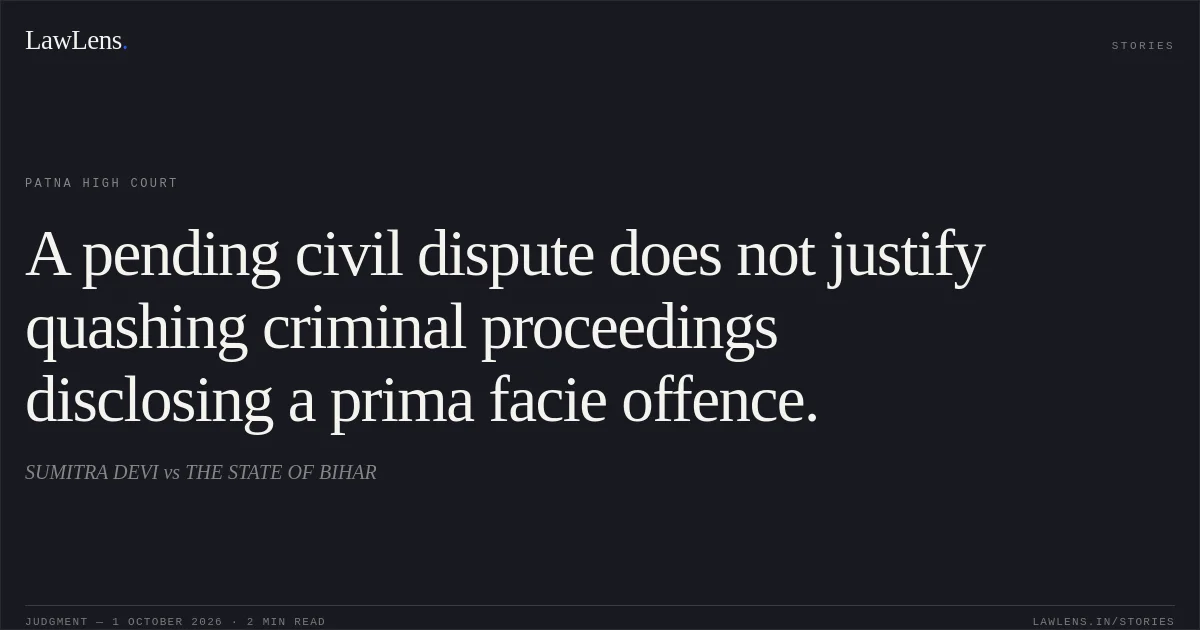
The Court applied the principle that the pendency of a civil proceeding does not, by itself, bar a criminal proceeding; both may continue where the complaint discloses a criminal offence and a prima facie case.
Source reference: p. 8It also stated that disputed factual questions—including the alleged forgery, the complainant’s knowledge, and the parties’ claims to title and possession—are not appropriately determined in the exercise of inherent jurisdiction at the threshold.
Source reference: p. 8–9The alleged offences were under Sections 468, 471, 415, 323, 506 and 120B IPC, and the Magistrate had issued process under Section 204 CrPC.
Source reference: p. 2Priyanka Srivastava v. State of Uttar Pradesh was cited by the petitioners on the affidavit issue, while Anukul Singh v. State of U.P. and Rikhab Birani v. State of Uttar Pradesh were cited by the parties; the Court did not expressly adopt or analyse those authorities in its reasoning.
Source reference: p. 4–5Reasoning
The Court accepted that the dispute concerned land and that a partition suit was pending, but held that this circumstance alone did not justify quashing because civil and criminal proceedings may proceed simultaneously if a prima facie criminal case is disclosed.
Source reference: p. 8It treated the petitioners’ objections concerning the 2002 sale deeds, the complainant’s claimed discovery in 2015, delay, title and possession, and the alleged forgery as disputed factual matters for consideration at trial rather than at the quashing stage.
Source reference: p. 8–9The absence of an affidavit did not persuade the Court to quash, given that the Magistrate had considered the complaint and supporting materials and found sufficient ground to proceed.
Source reference: p. 9Holding
The Court found no sufficient ground to interfere with the Magistrate’s order taking cognizance or the revisional court’s order affirming it.
It dismissed the criminal miscellaneous application as devoid of merit and directed that a copy of the judgment be sent to the court below with the trial-court record, if any.
Source reference: p. 10Acts & Sections Cited
3 provisions across 1 statute referred to in this judgment. Each provision opens on LawLens.
Code of Criminal Procedure, 19733
Original Court PDF
SUMITRA DEVIvsTHE STATE OF BIHAR
Click to open original judgment
Original judgment, available to read, download and summarize on LawLens.in