Facts
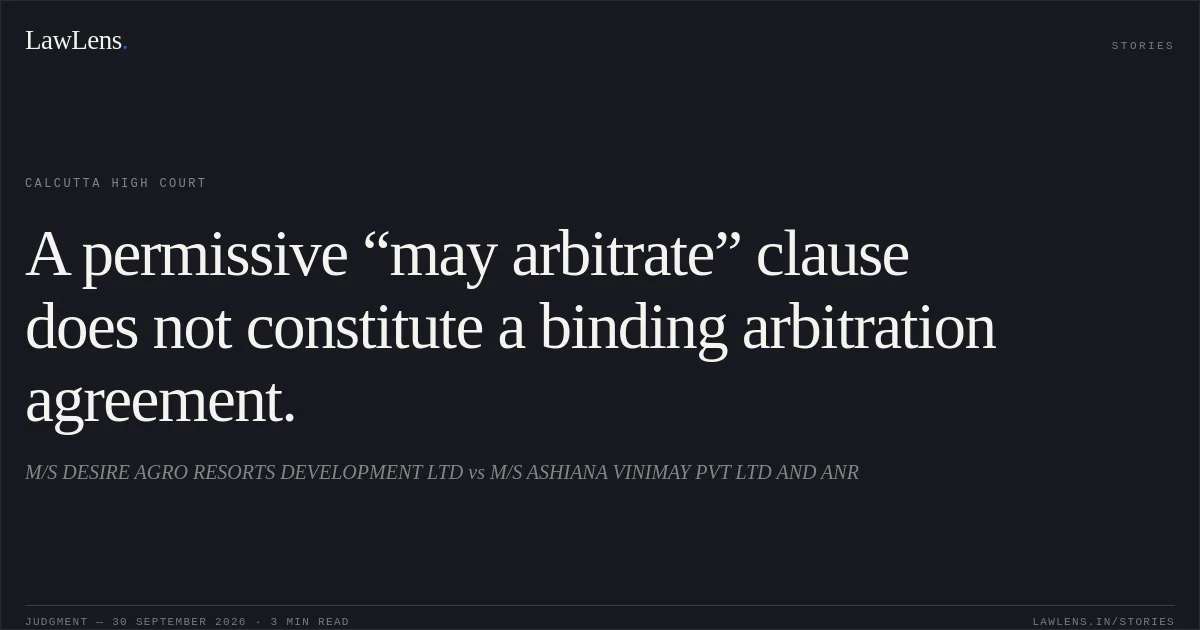
The petitioner and Respondent No. 1 executed a Memorandum of Understanding (MOU) on 30 November 2009 concerning, among other matters, the demarcation and exchange of land and construction of a common metalled road. Clause 9 provided for disputes to be resolved mutually and, failing that, stated they “may be referred” to arbitration. At Respondent No. 1’s request, the petitioner later conveyed certain plots to Respondent No. 2 under registered sale deeds said to be subject to the MOU.
Source reference: para. 3–6Alleging that Respondent No. 1 had failed to construct the road and was dealing with the relevant land contrary to the MOU, the petitioner obtained an interim injunction under Section 9 of the Arbitration and Conciliation Act, 1996, and then issued a Section 21 notice invoking arbitration. The respondents did not appoint an arbitrator, and the petitioner applied under Section 11(6).
Source reference: para. 7–10The respondents disputed the existence of a binding arbitration agreement and also raised objections concerning Respondent No. 2’s status and limitation.
Source reference: para. 15–17Issues
1. Whether Clause 9 of the MOU constituted a valid and binding arbitration agreement under Section 7 of the Arbitration and Conciliation Act, 1996, permitting appointment of an arbitrator under Section 11(6).
Source reference: para. 19, 26–292. Whether the Court needed to determine the respondents’ objections concerning Respondent No. 2 and limitation.
Source reference: para. 29Law Applied
Section 7 of the Arbitration and Conciliation Act, 1996 requires an agreement to submit disputes to arbitration; the parties must demonstrate an intention to be bound by resolution through a private tribunal.
Source reference: no citationIn Bihar State Mineral Development Corporation v. Encon Builders, (2003) 7 SCC 418, the Supreme Court identified the essential elements of a valid arbitration agreement, including an intention to settle disputes through a private tribunal and the parties’ agreement to be bound by its decision.
Source reference: para. 21Under Jagdish Chander v. Ramesh Chander, (2007) 5 SCC 719, a clause must disclose a determination and obligation to arbitrate; a mere possibility of arbitration, or a clause contemplating further consent, is insufficient.
Source reference: para. 22The Supreme Court’s decision in BGM and M-RPL-JMCT (JV) v. Eastern Coalfields Ltd., 2025 SCC OnLine SC 1471, held that language stating disputes “may be sought” through arbitration is merely enabling and does not establish a binding agreement to arbitrate.
Source reference: para. 24–25The Section 11 inquiry into the existence of an arbitration agreement is prima facie, but the court must examine whether the document satisfies Section 7’s essential requirements.
Source reference: para. 25Reasoning
The Court read Clause 9 as requiring the parties first to attempt mutual settlement, after which disputes “may” be referred to arbitration. Unlike a clause prescribing arbitration as a definite, binding dispute-resolution mechanism, Clause 9 did not require either party to refer a dispute to arbitration and left that step dependent on further agreement.
Source reference: para. 26–27Applying Jagdish Chander and BGM, the Court held that the word “may” made the clause an enabling provision rather than an unequivocal commitment; the parties were therefore not ad idem on arbitration when they executed the MOU.
Source reference: para. 27Since no valid arbitration agreement existed, the Court did not examine whether Respondent No. 2 was bound by the clause or whether the claims were time-barred.
Source reference: para. 29Holding
The Court held that Clause 9 did not constitute a valid and binding arbitration agreement under Section 7, so the petitioner could not obtain an arbitrator’s appointment under Section 11(6).
The petition was dismissed.
Source reference: no citationThe dismissal was confined to the maintainability of the Section 11 petition and did not preclude the petitioner from pursuing other remedies available in law, including in relation to the interim order in the Section 9 proceedings.
Source reference: para. 30–31Acts & Sections Cited
6 provisions across 2 statutes referred to in this judgment. Each provision opens on LawLens.
Arbitration and Conciliation Act, 19965
Limitation Act, 19631
Original Court PDF
M/S DESIRE AGRO RESORTS DEVELOPMENT LTDvsM/S ASHIANA VINIMAY PVT LTD AND ANR
Click to open original judgment
Original judgment, available to read, download and summarize on LawLens.in