Facts
The Catholic Diocese of Karwar sued to evict Ramu Krishna Gouda from a servant’s quarter, asserting ownership under a 1978 sale deed and alleging that the defendant’s father had occupied the premises as a servant of the previous owner
Source reference: p. 2–3, 5–6The defendant disputed the Diocese’s title, claimed that the property belonged to the Government and relied on revenue records; he also claimed that his father had occupied the premises for many years
Source reference: p. 3, 7–8After an initial dismissal and remand, the trial court decreed the suit for possession. The first appellate court affirmed, and the defendant appealed under Section 100 CPC
Source reference: p. 3–4Issues
1. Whether the Diocese established its title and entitlement to possession despite the defendant’s challenge based on government revenue records and the alleged government ownership of the property
Source reference: p. 5–92. Whether the concurrent findings of the courts below disclosed an error giving rise to a substantial question of law under Section 100 CPC
Source reference: p. 10Law Applied
The appeal was brought under Section 100 CPC, which permits a second appeal only where a substantial question of law arises.
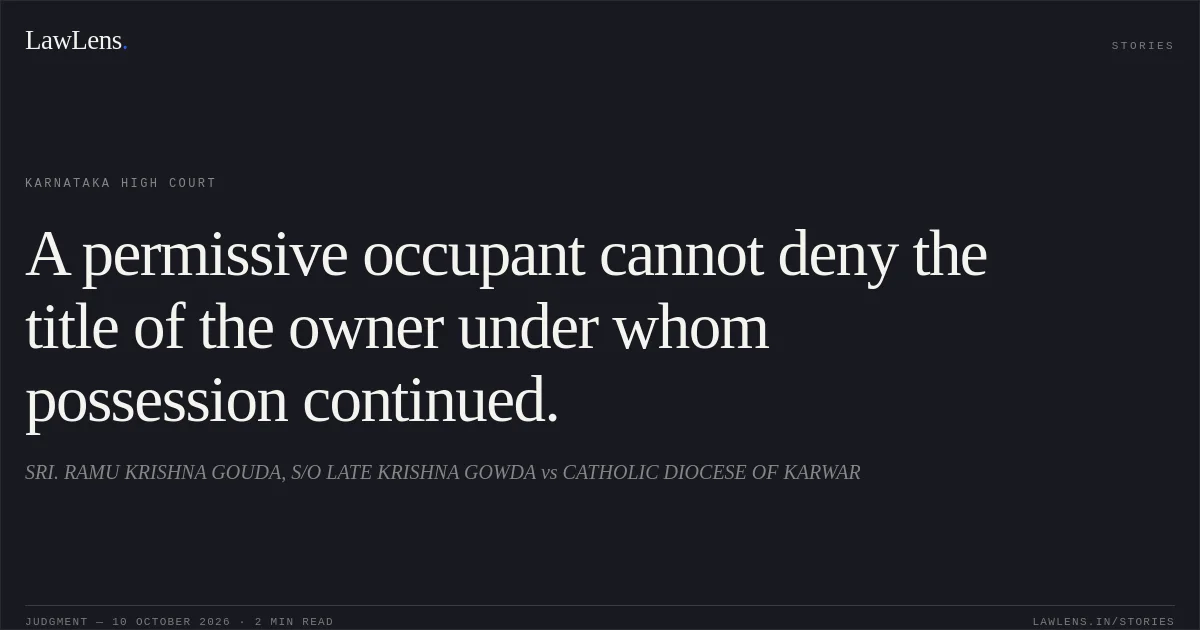
Source reference: p. 8–10The Court applied the principle that a person whose possession began permissively through the former owner and continued under the plaintiff institution cannot rely merely on that possession to deny the institution’s title or right to recover possession.
Source reference: p. 8–10Reasoning
The Court found that the Diocese produced a 1978 sale deed in its favour and evidence that revenue entries were subsequently mutated in its name.
Source reference: p. 5It also noted that the defendant’s own account accepted the transfer of the property to the Diocese, while asserting that his father had been allowed to remain in the quarters.
Source reference: p. 6–7The defendant’s revenue records showed earlier government entries and the presence of a Forest Officer, but he produced no other material demonstrating that the Government had exercised ownership over the suit property.
Source reference: p. 8Because the defendant’s occupation was permissive and the courts below had concurrently assessed the evidence, the Court found no error warranting second-appellate interference.
Source reference: p. 8–10Holding
The Court held that no substantial question of law arose.
It dismissed the regular second appeal, leaving in force the decree directing the defendant to deliver vacant possession of the suit premises to the Diocese.
Source reference: p. 9–10Acts & Sections Cited
1 provisions across 1 statute referred to in this judgment. Each provision opens on LawLens.
Code of Civil Procedure, 19081
Original Court PDF
SRI. RAMU KRISHNA GOUDA, S/O LATE KRISHNA GOWDAvsCATHOLIC DIOCESE OF KARWAR
Click to open original judgment
Original judgment, available to read, download and summarize on LawLens.in