Facts
Sarojini petitioned for probate of a Will dated 26 April 1999, said to have been executed by M. Subramaniyan.
Source reference: paras. 3, 5–6After the matter was contested, it proceeded as T.O.S. No. 40 of 2001.
Source reference: paras. 3, 5–6Following the deaths of Sarojini and the contesting defendant, Kamala, Rajavelu sought Letters of Administration, and Thilagavathy—Kamala’s sister’s daughter—was impleaded as a defendant.
Source reference: paras. 3, 5–6The Single Judge granted Letters of Administration to Rajavelu. Thilagavathy appealed, alleging that the Will was unproved and surrounded by suspicious circumstances.
Source reference: paras. 6, 8Issues
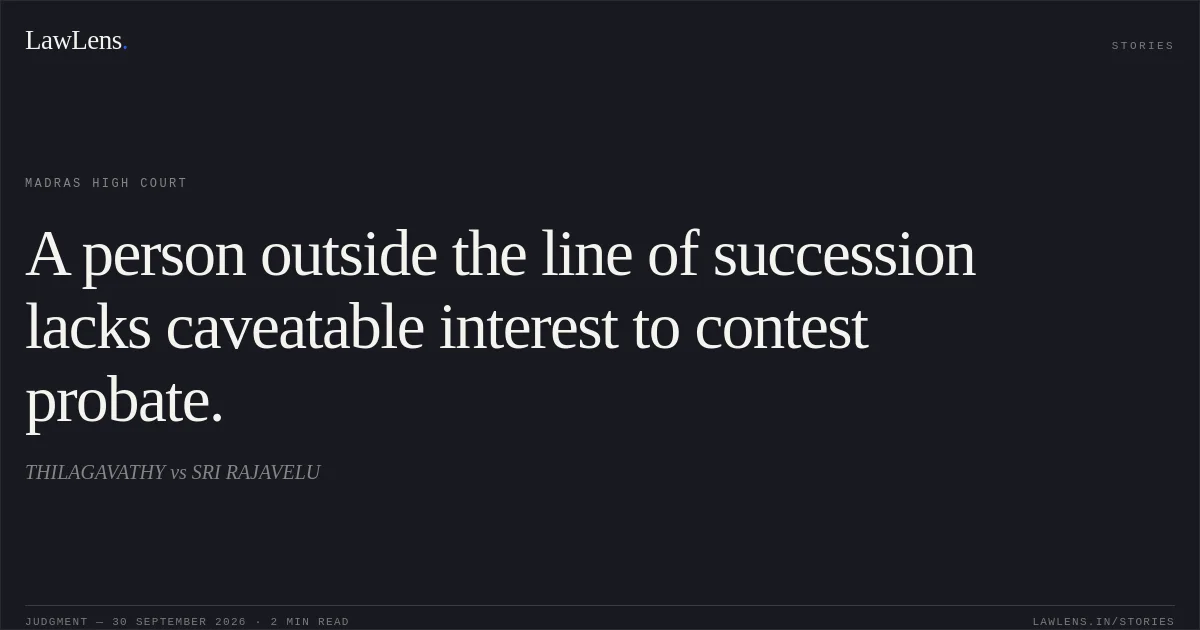
Whether Thilagavathy had a caveatable interest to maintain the appeal.
Source reference: para. 13Whether execution of the Will, Ex. P1, had been proved.
Source reference: para. 13Whether suspicious circumstances surrounded the execution of the Will.
Source reference: para. 13Law Applied
Under Section 63 of the Indian Succession Act, 1925, a Will must be executed and attested in accordance with the statutory requirements; the propounder must prove due execution, including through an attesting witness.
Source reference: no citationA person seeking to oppose or revoke a grant must have a caveatable interest—such as a claim under the testator or a likelihood of inheriting the estate (Ramani U. Krishnan v. Dr. Ammini Praveen Joshua @ Veena).
Source reference: pp. 10–11A Will is not to be rejected merely on assumed suspicion where the statutory proof is satisfied and the transaction is not unnatural (Madhukar D. Shende v. Tarabai Aba Shedage).
Source reference: pp. 14–15Disinheritance of a wife may be suspicious depending on the circumstances, particularly where the Will favours a stranger or distant relative (Sardari Lal v. Bishan Dass).
Source reference: pp. 16–17The Court also considered the parties’ succession positions under the Hindu Succession Act.
Source reference: pp. 5, 9Reasoning
The Court held that Thilagavathy, as the niece of the testator’s wife, would not inherit while the testator’s children were available; it therefore found she had no caveatable interest.
Source reference: pp. 9–11On the merits, Kamala’s written statement alleged undue influence and coercion but did not deny execution, and the Court found that the attesting witness’s evidence satisfied Section 63. It also found no evidence establishing coercion or undue influence.
Source reference: p. 12The signature variations were not material, given the comparison with later service-register entries and the attesting witness’s evidence; the asserted relationship-related concerns and other inconsistencies did not undermine proof of the Will.
Source reference: pp. 13–16The Will favoured the testator’s son, not a stranger, and the Court considered the pension provision for Kamala relevant in rejecting the disinheritance-based suspicion.
Source reference: pp. 16–17Holding
The Court answered that Thilagavathy lacked caveatable interest and found that execution of the Will was proved and no material suspicious circumstance was established.
It dismissed the appeal, confirmed the grant of Letters of Administration to Rajavelu, and directed the parties to bear their own costs.
Source reference: paras. 23–24Acts & Sections Cited
7 provisions across 2 statutes referred to in this judgment. Each provision opens on LawLens.
Indian Succession Act, 19256
Hindu Succession Act, 19561
Original Court PDF
THILAGAVATHYvsSRI RAJAVELU
Click to open original judgment
Original judgment, available to read, download and summarize on LawLens.in