Facts
The plaintiffs sought a declaration of title and permanent injunction concerning Survey No. 1372, admeasuring 0.121 hectare, situated at Mouja Aswar, District Bhind.
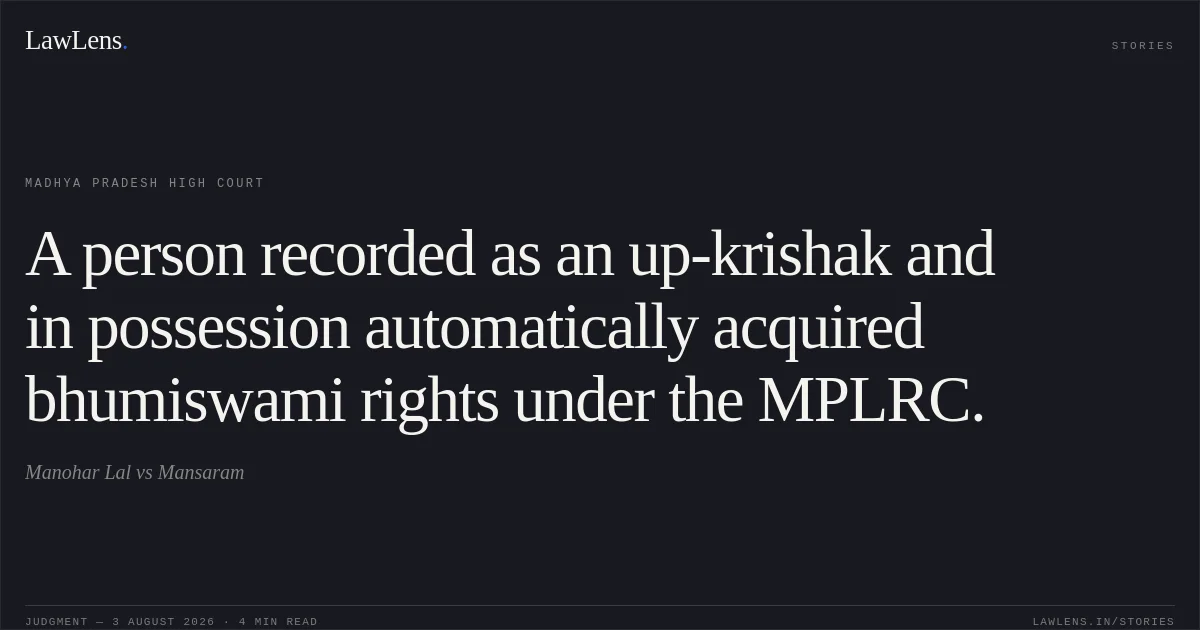
Source reference: paras. 3–6They claimed that their predecessor Ganpat had been recorded as a Mourushi Krishak/Up-Krishak and had acquired Bhumiswami rights under the Madhya Pradesh Land Revenue Code, 1959 (“MPLRC”).
Source reference: paras. 3–6After Ganpat’s death, the property allegedly devolved upon his sons Darele and Baiju and thereafter upon the plaintiffs.
Source reference: paras. 3–6Defendant Mansaram claimed title under a registered sale deed dated 07.01.1971 executed by Gupal, who was recorded as Bhumiswami.
Source reference: para. 7Mansaram also relied upon a written consent allegedly given by Darele and asserted that the plaintiffs’ suit was barred by limitation and was defective for not seeking possession.
Source reference: para. 7The trial Court decreed the suit, declared the plaintiffs to be Bhumiswami, held the sale deed void to the extent of the plaintiffs’ interest, and granted permanent injunction.
Source reference: para. 8The first appellate Court reversed that decision and dismissed the suit, leading to the present second appeal under Section 100 of the Code of Civil Procedure.
Source reference: paras. 1, 9Issues
1. Whether the first appellate Court was justified in reversing the trial Court’s judgment and decree?
Source reference: para. 2, substantial question of law no. 12. Whether the sale deed dated 07.01.1971 executed by Gupal in favour of Mansaram was valid, particularly in view of the alleged consent of the plaintiffs?
Source reference: para. 2, substantial question of law no. 23. Whether the plaintiffs’ suit, including the challenge to the sale deed, was barred by limitation?
Source reference: para. 2, substantial question of law no. 3Law Applied
The Court applied Sections 157, 158 and 185(1)(ii)(d) of the MPLRC, holding that persons in protected cultivating possession or recognised tenancy status at the commencement of the Code could acquire Bhumiswami rights automatically, without a formal order.
Source reference: paras. 26–27Revenue entries carry a presumption of correctness unless rebutted by evidence.
Source reference: para. 25A transferor cannot convey a better title than he possesses; consequently, a sale deed executed by a person lacking title is ineffective against the true owner.
Source reference: para. 27A co-sharer’s unilateral consent cannot bind another co-sharer, particularly where the consenting person was not authorised to represent the latter.
Source reference: para. 29Relying on Rao Nihalkaran v. Ram Gopal, AIR 1966 SC 1485, the Court recognised the statutory protection and conferment of tenure rights under the MPLRC.
Source reference: para. 26Relying on Hussain Ahmed Choudhury v. Habibur Rahman, 2025 SCC OnLine SC 892, it held that a non-executant claiming title need not necessarily seek cancellation of an instrument under Section 31 of the Specific Relief Act, 1963; a title declaration may include a determination that the instrument is void or not binding on the plaintiff.
Source reference: paras. 37–39The Court distinguished K.C. Kapoor v. Radhika Devi, AIR 1981 SC 2128, because Darele had no authority to consent on behalf of Baiju.
Source reference: para. 30Reasoning
The revenue records from 1950 onwards consistently recorded Gupal as Krishak/Bhumiswami and Ganpat as Up-Krishak, Up-Pattedar or Mourushi Krishak, thereby supporting Ganpat’s actual possession at the commencement of the MPLRC.
Source reference: paras. 22–25Applying Section 185(1)(ii)(d) and the principle in Rao Nihalkaran, the Court held that Ganpat automatically acquired Bhumiswami rights, and the subsequent entries showing Gupal and Mansaram as Bhumiswami could not defeat those accrued rights.
Source reference: paras. 26–27Gupal therefore lacked competence to execute the 1971 sale deed.
Source reference: paras. 26–27Independently, the property had devolved jointly upon Darele and Baiju; since Baiju was alive when the sale deed was executed, Darele’s alleged consent could not bind Baiju or transfer his interest.
Source reference: para. 29The consent itself indicated recognition of Darele’s connection with the property but did not establish authority to represent Baiju.
Source reference: para. 29The Court further found that the defendant failed to prove when or how possession had passed from Ganpat or the plaintiffs to Gupal or Mansaram.
Source reference: para. 31Although the plaintiffs became aware of the sale deed at least by 1998 and formally challenged it by amendment in 2003, the Court held that the principal relief was declaration of title.
Source reference: paras. 33–40Under Hussain Ahmed Choudhury, determination of the sale deed’s non-binding effect was incidental to the title dispute and did not warrant dismissal of the entire suit on limitation grounds.
Source reference: paras. 33–40Holding
The Court answered substantial questions of law nos. 1 and 2 in favour of the plaintiffs.
It held that Ganpat, and consequently the plaintiffs, had acquired and succeeded to Bhumiswami rights; Gupal had no valid title to convey; and the sale deed dated 07.01.1971 in favour of Mansaram was legally ineffective against the plaintiffs, particularly in the absence of Baiju’s consent.
Source reference: paras. 27, 32The Court also held that the suit was not liable to be dismissed as barred by limitation because the declaration of title encompassed the issue of whether the sale deed was void or non-binding.
Source reference: para. 40The first appellate Court’s judgment and decree were set aside, the trial Court’s decree declaring the plaintiffs’ title and granting permanent injunction was restored, and the parties were directed to bear their own costs.
Source reference: paras. 42–43Acts & Sections Cited
12 provisions across 5 statutes referred to in this judgment. Each provision opens on LawLens.
Code of Civil Procedure, 19081
Registration Act, 19081
MP Land Revenue Code 19595
Specific Relief Act, 19632
Original Court PDF
Manohar LalvsMansaram
Click to open original judgment
Original judgment, available to read, download and summarize on LawLens.in