Facts
The petitioner alleged that private respondents had fraudulently entered their names in revenue records and executed a sale deed concerning land claimed by the petitioner’s family. He also alleged threats and physical assault.
Source reference: paras. 3–7After complaints to the police and the Senior Superintendent of Police allegedly yielded no effective action, the petitioner filed a writ petition under Article 226 seeking consideration of the complaints, registration of an FIR, a fair investigation, and protection for his family.
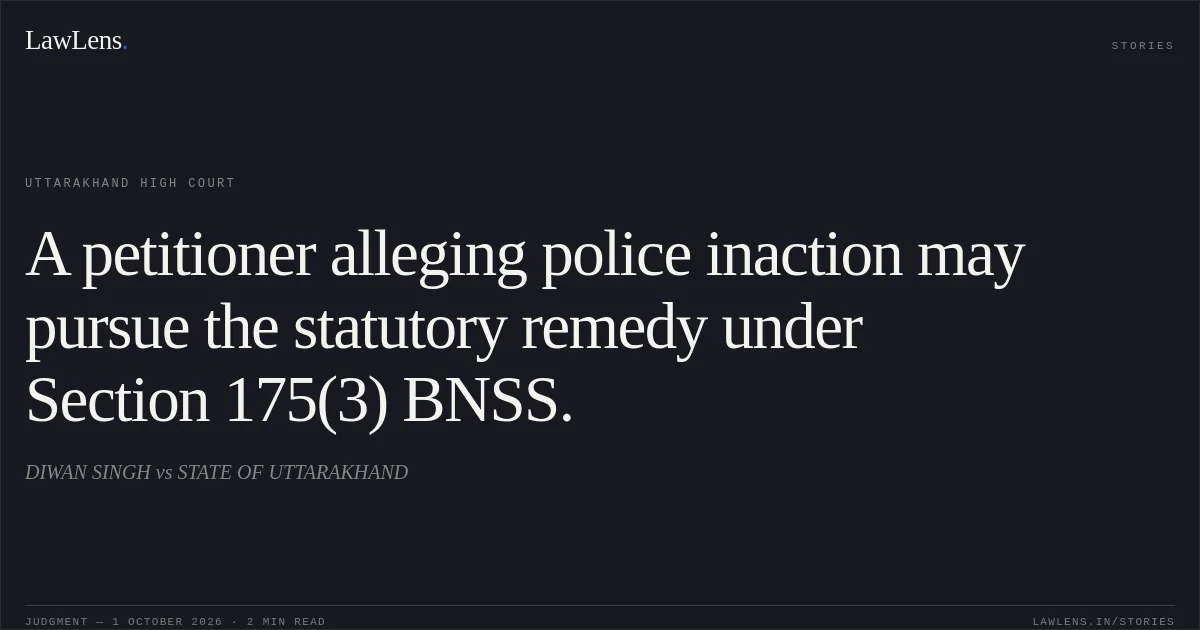
Source reference: paras. 3–7The State opposed the petition on the ground that the petitioner could seek an order from the jurisdictional Magistrate under Section 175(3) of the Bharatiya Nagarik Suraksha Sanhita, 2023 (BNSS).
Source reference: para. 8Issues
Whether the petitioner should be permitted to pursue a writ petition seeking police action when the statutory remedy under Section 175(3) of the BNSS is available before the competent Magistrate.
Source reference: paras. 8–9Whether the Court should express any view on the merits of the allegations or the requested relief at this stage.
Source reference: paras. 9–10Law Applied
Article 226 of the Constitution empowers the High Court to issue writs, but where a statutory remedy is available, the Court may direct the petitioner to pursue that remedy in the first instance. Section 175(3) of the BNSS provides a remedy before the competent Magistrate in relation to a request for police action.
Source reference: paras. 8–10The Court did not rely on any cited precedent or determine the legal merits of the allegations.
Source reference: paras. 8–10Reasoning
The petitioner sought writ relief on the basis that the complaints disclosed cognizable offences and the police had failed to act. The State identified Section 175(3) of the BNSS as an available statutory remedy.
Source reference: paras. 8–10In view of that remedy, the Court considered it appropriate for the petitioner to approach the competent Magistrate, without assessing the allegations or expressing an opinion on their merits.
Source reference: paras. 8–10Holding
The Court disposed of the writ petition, granting the petitioner liberty to approach the competent Magistrate under Section 175(3) of the BNSS.
It directed that any such application be considered and decided in accordance with law and without influence from observations in the order. The Court expressed no opinion on the merits of the allegations; pending applications, if any, were also disposed of.
Source reference: paras. 9–11Acts & Sections Cited
1 provisions across 1 statute referred to in this judgment. Each provision opens on LawLens.
Bharatiya Nagarik Suraksha Sanhita, 20231
Original Court PDF
DIWAN SINGHvsSTATE OF UTTARAKHAND
Click to open original judgment
Original judgment, available to read, download and summarize on LawLens.in