Facts
The Rajasthan Petroleum Dealers Association filed a public interest writ petition under Article 226 challenging NOCs granted for petroleum retail outlets.
Source reference: para. 1It alleged non-compliance with various environmental, safety, road and siting requirements, and sought cancellation of the NOCs or directions to ensure compliance.
Source reference: paras. 3–10The respondents contended that the allegations were general and unsupported by site-specific evidence of breach of a mandatory requirement.
Source reference: paras. 11–14The High Court considered the petitioner’s standing to bring the case as a PIL and the statutory framework governing NOCs.
Source reference: paras. 15–21Issues
Whether the petition, given the petitioner’s personal interest in the subject matter, satisfied the requirements of a bona fide public interest litigation.
Source reference: paras. 15–19, 22Whether the petitioner established a specific breach of a mandatory legal requirement or other ground warranting interference with the granted NOCs under Article 226.
Source reference: paras. 18, 20–21Law Applied
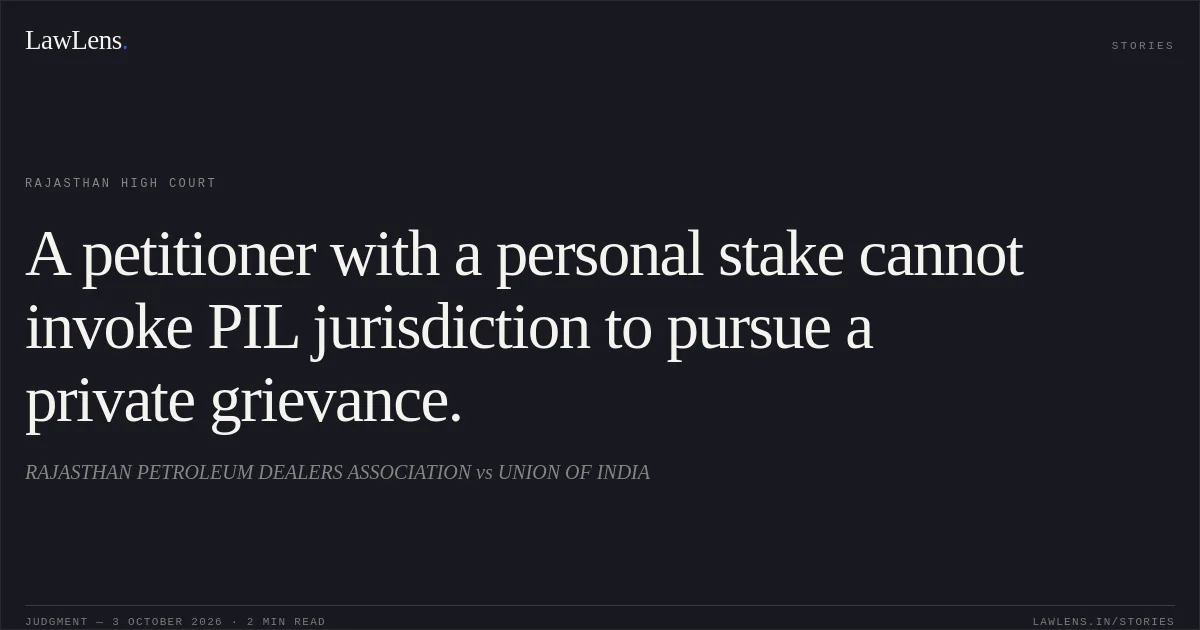
Under Article 226, PIL jurisdiction is intended to advance genuine public causes and must be invoked bona fide; a petition brought to vindicate a personal or private interest cannot acquire PIL status merely by raising public-interest concerns.
Source reference: paras. 16–19The Court relied on Hari Shankar Jain v. Bar Council of India, (2006) 1 SCC 580, and Ashok Kumar Pandey v. State of West Bengal, (2004) 3 SCC 349, concerning bona fide standing and the rejection of PILs used to pursue private interests.
Source reference: paras. 16–19Rules 144 and 154(2) of the Petroleum Rules, 2002 govern the NOC process and provide an appeal against refusal or cancellation of an NOC, but not against its grant; absence of such an appeal does not itself establish that a granted NOC is unlawful.
Source reference: paras. 20–21A challenge under Article 226 must independently establish a mandatory statutory breach, jurisdictional error, perversity or other legally sustainable ground.
Source reference: para. 21Reasoning
The Court found that the material indicated the petitioner had a personal interest in the dispute, so the petition did not meet the bona fide threshold for PIL jurisdiction.
Source reference: paras. 15, 17–19, 22It also observed that the allegations concerning multiple guidelines and safeguards were generalized and did not establish that the particular NOCs violated an applicable mandatory statutory requirement.
Source reference: paras. 11–14, 18Although Rule 154(2) provided no appeal against the grant of an NOC, that omission did not make the NOCs illegal; the petitioner still had to demonstrate a legally sustainable ground for writ interference.
Source reference: paras. 20–21Holding
The Court held that the petition was a misconceived PIL and dismissed it at the threshold because the petitioner’s personal interest precluded recourse to PIL jurisdiction.
Pending applications, if any, were also disposed of.
Source reference: para. 23Original Court PDF
RAJASTHAN PETROLEUM DEALERS ASSOCIATIONvsUNION OF INDIA
Click to open original judgment
Original judgment, available to read, download and summarize on LawLens.in