Facts
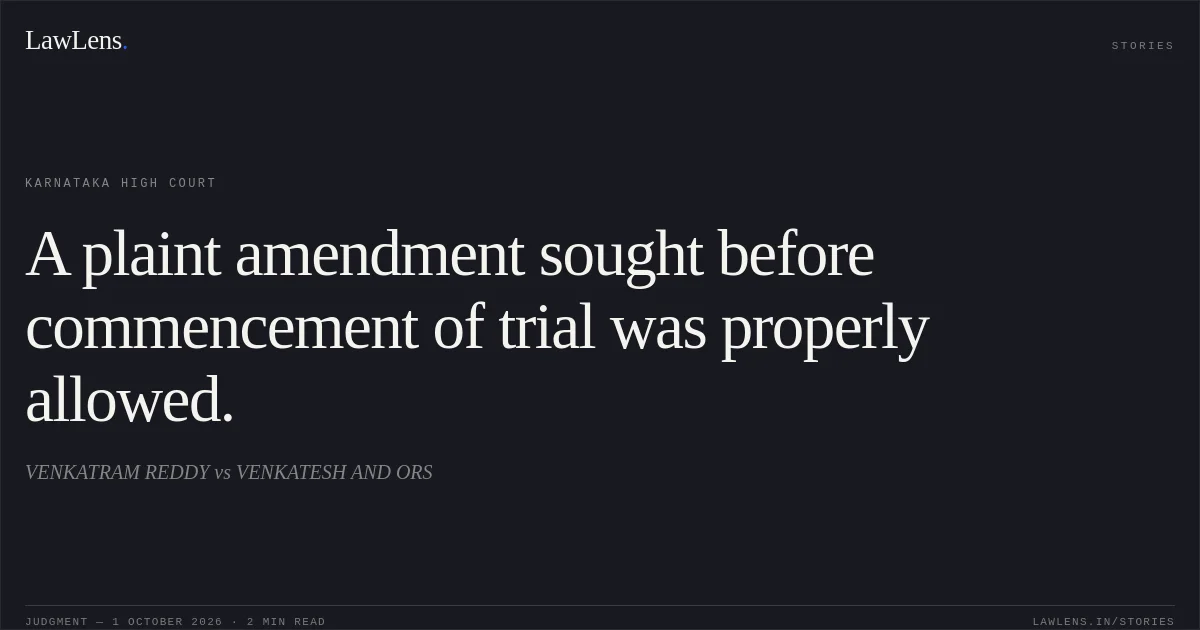
Respondents 1 and 2 sued the petitioner seeking a declaration of an easementary right of way and an injunction against construction in the suit lane.
Source reference: p. 3–4They later applied to amend the plaint to seek a mandatory injunction requiring removal of a Tulsi katta and closure of a pit dug for a public tap in the lane.
Source reference: p. 3–4The petitioner opposed the amendment, arguing, among other things, that the proposed reliefs were barred by limitation and that the application was belated.
Source reference: p. 3–4The trial court allowed the amendment before framing issues, imposing costs of Rs. 500.
Source reference: p. 5–6The petitioner challenged that order under Article 227 of the Constitution.
Source reference: p. 5–6Issues
1. Whether the trial court was justified in allowing the amendment application filed before commencement of trial, notwithstanding the petitioner’s objections that the proposed reliefs were time-barred and the application belated.
Source reference: p. 4–62. Whether the costs imposed by the trial court required modification.
Source reference: p. 6–7Law Applied
The Court relied on the principle concerning amendment of pleadings under Order VI Rule 17 CPC and on Rajesh Kumar Aggarwal v. K.K. Modi, (2006) 4 SCC 385, which it cited for the proposition that an amendment application filed before commencement of trial is to be allowed.
Source reference: p. 5–6The judgment does not separately analyze the limitation objection or set out a distinct test for deciding it.
Source reference: p. 6Reasoning
The Court noted that the trial court had not framed issues and that the respondents’ amendment application was filed before commencement of trial.
Source reference: p. 5–7Applying the proposition it drew from Rajesh Kumar Aggarwal, the Court held that the trial court was justified in allowing the amendment and found no error warranting interference with that decision.
Source reference: p. 5–7It did not separately determine the petitioner’s limitation objection.
Source reference: p. 6The Court considered the Rs. 500 costs inadequate and modified that part of the order.
Source reference: p. 6–7Holding
The writ petition was partly allowed.
The amendment of the plaint remained allowed, but the costs were increased from Rs. 500 to Rs. 5,000, payable by respondents 1 and 2 to the petitioner before the trial court on the next hearing date.
Source reference: p. 6–7The petitioner was granted liberty to file an additional written statement within 15 days from that date.
Source reference: p. 6–7Original Court PDF
VENKATRAM REDDYvsVENKATESH AND ORS
Click to open original judgment
Original judgment, available to read, download and summarize on LawLens.in