Facts
The plaintiffs filed O.S. No. 430/2024 seeking partition and separate possession of their claimed half share in five scheduled properties, and a declaration that a sale deed concerning Item No. 1 was not binding on their share
Source reference: p.3Defendant No. 5 sought rejection of the plaint under Order VII Rule 11(d) CPC, contending that the relevant purchase predated the 2004 amendment to Section 6 of the Hindu Succession Act and was protected from challenge
Source reference: p.3–5The trial court dismissed the application, finding that the property’s character, the vendor’s power to alienate it, and the sale deed’s effect raised factual questions requiring trial
Source reference: p.4Defendant No. 5 challenged that order in revision
Source reference: p.3Issues
1. Whether the plaint disclosed that the suit was barred by law, warranting rejection under Order VII Rule 11(d) CPC on the basis of the Hindu Succession Act and the alleged pre-amendment transaction
Source reference: p.4–5, 72. Whether the plaint could be rejected only in respect of Item No. 1, when the suit also concerned other scheduled properties
Source reference: p.6–7Law Applied
Order VII Rule 11(d) CPC permits rejection where, from the plaint, the suit appears to be barred by law; the court’s inquiry is based on the plaint and cannot resolve disputed factual questions requiring evidence
Source reference: p.4Section 6 of the Hindu Succession Act, as amended, was invoked by the petitioner in support of the contention that the transaction was protected, but the High Court did not decide that substantive question
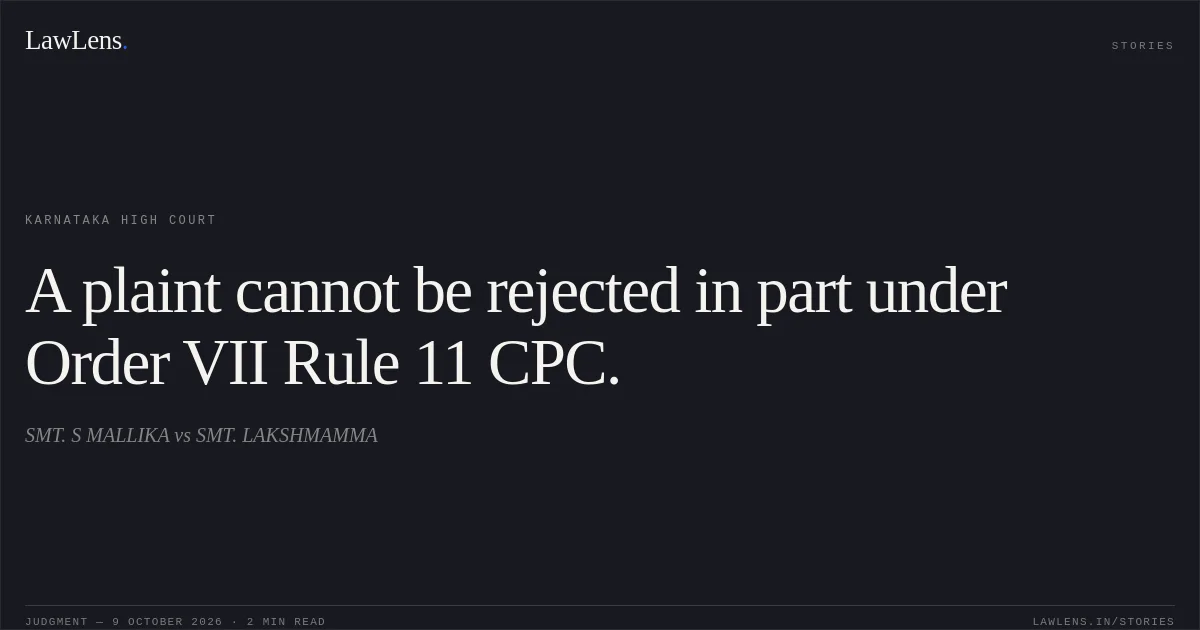
Source reference: p.5, 7The Court applied the rule that a plaint cannot be rejected in part under Order VII Rule 11, relying on Kum. Geetha v. Nanjundaswamy, (2024) 14 SCC 390
Source reference: p.6–7Reasoning
The Court noted that the petitioner was concerned only with Item No. 1, while the plaint sought relief concerning five properties
Source reference: p.7Whether the property was self-acquired or joint family property, whether the vendor had exclusive authority to alienate it, and whether the sale deed bound the plaintiffs were matters requiring adjudication on pleadings and evidence, not determination under Order VII Rule 11
Source reference: p.4Further, even if the petitioner’s objection succeeded in relation to Item No. 1, the plaint could not be rejected only as to that item; partial rejection was impermissible
Source reference: p.6–7The Court therefore found no basis to interfere with the trial court’s order
Source reference: p.7Holding
The High Court dismissed the civil revision petition and closed any pending interlocutory applications
It did not determine the merits of the petitioner’s claim under Section 6 of the Hindu Succession Act; it held that the plaint could not be rejected in part and that the disputed property questions required trial
Source reference: p.4, 7Acts & Sections Cited
2 provisions across 2 statutes referred to in this judgment. Each provision opens on LawLens.
Code of Civil Procedure, 19081
Hindu Succession Act, 19561
Original Court PDF
SMT. S MALLIKAvsSMT. LAKSHMAMMA
Click to open original judgment
Original judgment, available to read, download and summarize on LawLens.in