Facts
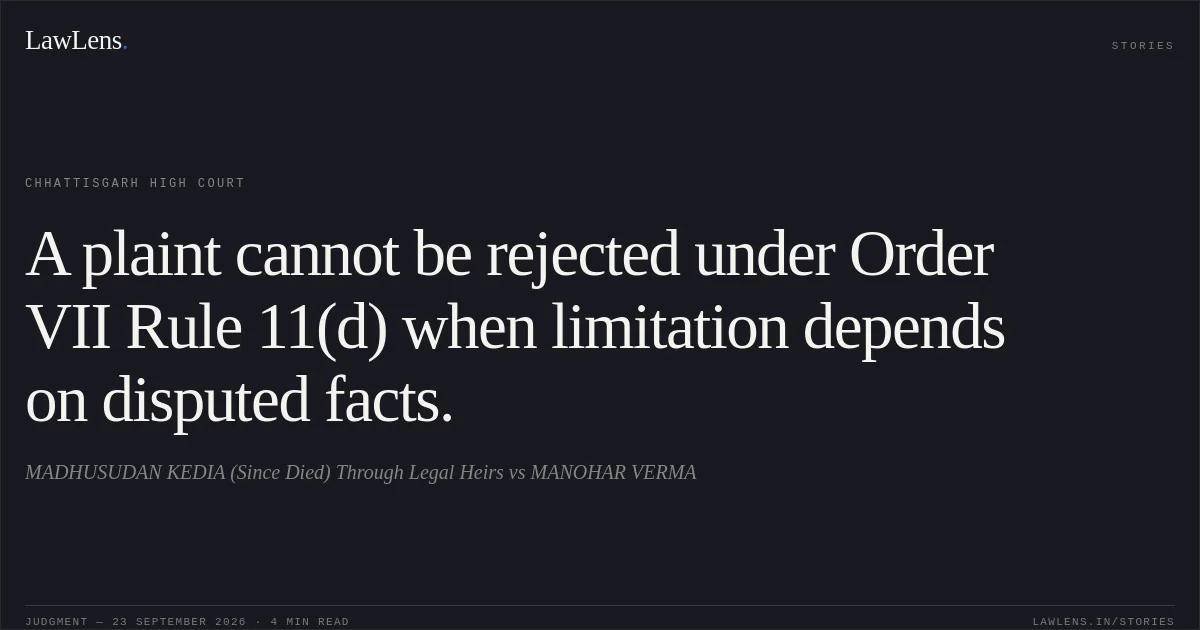
The plaintiff instituted a suit for specific performance of an alleged agreement to sell dated 20 September 2015 concerning agricultural land comprised in Khasra Nos. 1674, 1679 and 1690, for a total consideration of ₹15,00,000.
Source reference: para. 3–4The plaintiff pleaded that ₹12,50,000 had been paid and that the defendants had undertaken to execute the sale deed within eight months.
Source reference: para. 3–4According to the plaintiff, subsequent acknowledgments/documents dated 21 June 2016 and 3 August 2018 continued or extended the original transaction, but the defendants nevertheless failed to execute the sale deed, leading to institution of the suit on 12 December 2019.
Source reference: para. 4–5The defendants denied the agreement to sell, asserting that the plaintiff had merely advanced a loan of ₹10,00,000, out of which ₹4,70,000 had been repaid.
Source reference: para. 6–8The Trial Court accepted the limitation objection and rejected the plaint under Order VII Rule 11(d) of the Code of Civil Procedure, 1908.
Source reference: para. 9Issues
Whether the plaint disclosed, on its face, an unequivocal bar of limitation warranting rejection under Order VII Rule 11(d) CPC?
Source reference: para. 14–18Whether the question of limitation, in light of the alleged subsequent acknowledgments and extension of the agreement, was a mixed question of law and fact requiring determination after framing an issue and recording evidence?
Source reference: para. 15–20Whether the plaintiff was entitled to refund of the court fee paid on the memorandum of appeal upon remand of the matter?
Source reference: para. 23–26Law Applied
Under Order VII Rule 11(d) CPC, a plaint may be rejected where the suit appears from the statements in the plaint to be barred by any law; the court must ordinarily examine the plaint as a whole, assume the pleaded facts to be correct, and cannot rely on the defendant’s defence as the basis for rejection.
Source reference: para. 14Where limitation depends on disputed facts, including the date of accrual of the cause of action, acknowledgment, extension of contractual obligations, or the date of refusal, it constitutes a mixed question of law and fact and ordinarily cannot be conclusively decided at the threshold.
Source reference: para. 15–16The Court relied on Srihari Hanumandas Totala v. Hemant Vithal Kamat, (2021) 9 SCC 99, and Balsaria Construction (P) Ltd. v. Hanuman Seva Trust, (2006) 5 SCC 658, for these principles.
Source reference: para. 14–16The limitation period for specific performance is governed by Article 54 of the Limitation Act, 1963, and the issue may require examination of whether the date for performance was fixed or whether refusal occurred later.
Source reference: para. 18Under Order XIV Rule 2 CPC, an appropriate issue regarding limitation may be framed and adjudicated on the basis of pleadings and evidence.
Source reference: para. 18Regarding court-fee refund, Section 13 of the Court-fees Act, 1870, read with the principle underlying Order XLI Rule 23 CPC, permits refund where an appellate court reverses a decision and remands the matter for fresh adjudication.
Source reference: para. 24–25Reasoning
The High Court held that the plaint did not disclose an absolute or apparent limitation bar.
Source reference: para. 17–19Although the original agreement was dated 20 September 2015, the plaintiff had pleaded subsequent payments, acknowledgments, and documents allegedly executed in continuation of the original agreement, including the document dated 3 August 2018.
Source reference: para. 17–19Whether those documents were genuine, whether they extended or acknowledged the contractual obligation, and when the defendants finally refused performance were disputed factual matters.
Source reference: para. 14, 17–20These matters could not be resolved merely by accepting the defendants’ version in the written statement, particularly because the defence denied the very existence of the agreement and alleged a loan transaction.
Source reference: para. 14, 17–20The Trial Court therefore erred in treating limitation as conclusively established at the plaint-rejection stage instead of framing an issue under Order XIV Rule 2 CPC and deciding it after giving the parties an opportunity to lead evidence.
Source reference: para. 18–20The High Court declined to give any final finding on limitation and directed the Trial Court to examine all documents relied upon by the plaintiff.
Source reference: para. 18–20Holding
The appeal was allowed.
The order rejecting the plaint under Order VII Rule 11(d) CPC was set aside because the alleged limitation bar was not apparent from the plaint and involved disputed questions of fact.
Source reference: para. 21–22The matter was remanded to the Trial Court to reconsider limitation in accordance with law, after affording both parties due opportunity and, if necessary, framing an appropriate issue and recording evidence; the Trial Court was directed not to be influenced by the High Court’s observations on the ultimate merits.
Source reference: para. 22The plaintiff was also held entitled to refund of the court fee paid on the appeal, and the Registry was directed to issue the requisite certificate within four weeks.
Source reference: para. 23–26The parties were directed to appear before the Trial Court on 16 November 2026.
Source reference: para. 27Acts & Sections Cited
3 provisions across 3 statutes referred to in this judgment. Each provision opens on LawLens.
Code of Civil Procedure, 19081
Court-Fees Act, 18701
Limitation Act, 19631
Original Court PDF
MADHUSUDAN KEDIA (Since Died) Through Legal HeirsvsMANOHAR VERMA
Click to open original judgment
Original judgment, available to read, download and summarize on LawLens.in