Facts
Respondent No. 1, a registered public charitable trust, instituted CS (COMM) No. 1096/2025 seeking permanent injunction, damages and related reliefs concerning alleged copyright infringement in photographs/swaroops of “Guruji,” passing off and misrepresentation through the use of “Guruji” and “Guruji Ka Darbar,” alleged infringement of copyright in the architectural design of the plaintiff’s “Bade Mandir,” and solicitation of donations.
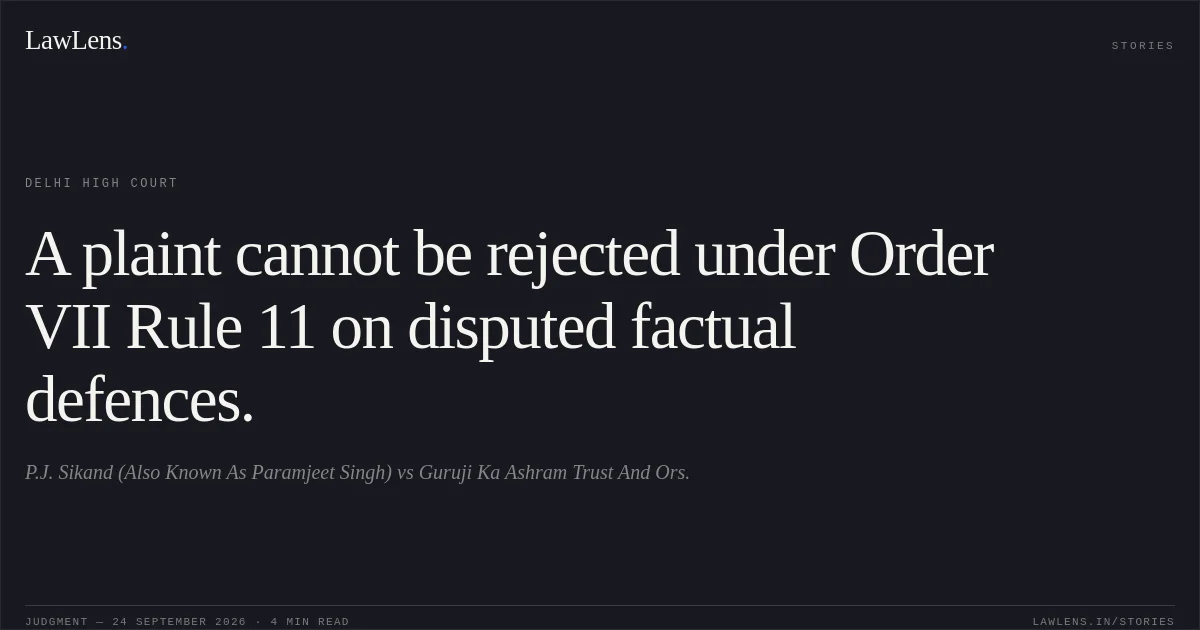
Source reference: para. 4The petitioner/defendant filed an application under Order VII Rule 11 read with Section 151 CPC seeking rejection of the plaint on grounds including absence of cause of action, invalidity of the assignment, limitation, lack of territorial jurisdiction, res judicata arising from a Lok Adalat settlement, want of locus standi, and non-commercial character of the dispute.
Source reference: paras. 6–7, 20By order dated 4 June 2026, the Commercial Court dismissed the application under Order VII Rule 11 CPC and framed issues concerning locus standi, cause of action, validity of the assignment deed, territorial jurisdiction, res judicata, commercial nature, valuation and limitation.
Source reference: para. 5The petitioner challenged that decision under Article 227 of the Constitution; the challenge was confined to dismissal of the Order VII Rule 11 application because the order granting interim relief was already under challenge in FAO (COMM) 168/2026.
Source reference: para. 3Issues
Whether the plaint disclosed a cause of action for copyright infringement, passing off, misrepresentation and related reliefs so as to withstand an application under Order VII Rule 11(a) CPC.
Source reference: paras. 12–15, 18–19Whether the suit was ex facie barred by limitation, res judicata, want of locus standi, lack of territorial jurisdiction, or any other law within the meaning of Order VII Rule 11(d) CPC.
Source reference: paras. 12, 20–21Whether the Commercial Court committed a jurisdictional error warranting interference under Article 227 of the Constitution by refusing to reject the plaint.
Source reference: paras. 9–12, 21Whether the suit constituted a “commercial dispute” under Section 2(1)(c)(xvii) of the Commercial Courts Act, 2015.
Source reference: para. 12Law Applied
The Court applied Order VII Rule 11 CPC, under which rejection of a plaint is permissible only where the plaint, read as a whole and together with documents relied upon by the plaintiff, does not disclose a cause of action or is barred by law; the provision must be applied strictly because rejection terminates the civil action.
Source reference: para. 13The Court held that the plaint’s averments are ordinarily presumed to be correct at this stage, while disputed questions of fact, the defendant’s defence, and the evidentiary validity of documents cannot be adjudicated.
Source reference: paras. 12–14It relied on *Dahiben*, *Liverpool & London S.P. & I Assn. Ltd. v. M.V. Sea Success I*, and *Hardesh Ores (P.) Ltd. v. Hede & Co.* for the principle that the plaint must be read meaningfully and as a whole, without isolating individual sentences.
Source reference: paras. 12–14The Court also relied on *Puja Aggarwal v. Pravesh Narula* for the distinction between absence of a cause of action and weakness or lack of merit in the plaintiff’s case.
Source reference: para. 14For Article 227, it applied the restrictive supervisory-jurisdiction principles in *Garment Craft v. Prakash Chand Goel*, (2022) 4 SCC 181, *Nandi Infrastructure Corridor Enterprises Ltd. v. B. Gurappa Naidu*, 2026 SCC OnLine SC 745, and *Black Diamond Trackparts Pvt. Ltd. v. Black Diamond Motors Pvt. Ltd.*, 2021 SCC OnLine Del 3946, under which interference is justified only for jurisdictional error, gross abuse, perversity, or patent illegality, particularly in commercial proceedings.
Source reference: paras. 9–11Intellectual-property disputes fall within “commercial disputes” under Section 2(1)(c)(xvii) of the Commercial Courts Act, 2015.
Source reference: para. 12Reasoning
The Court held that the plaint specifically pleaded ownership or assignment of copyright, alleged continuing use of the photographs/swaroops, and alleged imitation of the plaintiff’s temple structure and associated artistic works; these averments, if accepted as true, disclosed an actionable cause of action.
Source reference: paras. 12, 15, 17–19The petitioner’s objections regarding the alleged invalidity or afterthought nature of the 2024 assignment deed, public-domain status of the photographs, generic use of “Guruji,” commonality of religious architectural features, and absence of commercial activity were treated as substantive defences requiring evidence, not grounds for threshold rejection.
Source reference: paras. 15–17The fact that criminal proceedings had commenced earlier did not bar the subsequent civil action, and the alleged Lok Adalat settlement—being relied upon by the defendant and not forming part of the plaint—could not ordinarily be examined under Order VII Rule 11.
Source reference: para. 12Limitation could not be decided against the plaintiff because the plaint alleged continuing infringement and continuing operation of the structure, attracting consideration of Section 22 of the Limitation Act.
Source reference: para. 12Questions concerning territorial jurisdiction, valuation, locus standi, validity of trust documents, and res judicata involved mixed questions of law and fact and had already been framed as issues for trial.
Source reference: paras. 5, 20–21Since the Commercial Court’s view was at least a plausible view and disclosed no jurisdictional error, perversity, or patent illegality, the limited supervisory jurisdiction under Article 227 was not attracted.
Source reference: paras. 9–12, 21Holding
The High Court answered the issues against the petitioner. It held that the plaint disclosed a cause of action, was not ex facie barred by limitation or any other law, and raised claims falling within the scope of a commercial dispute under Section 2(1)(c)(xvii) of the Commercial Courts Act.
The objections concerning the assignment deed, res judicata, locus standi, territorial jurisdiction, valuation and merits were left open for adjudication at trial.
Source reference: para. 21Finding no ground for interference under Article 227, the Court dismissed/disposed of CM(M)-IPD 51/2026 and CM 248/2026, while clarifying that observations concerning the interim injunction, Local Commissioner’s report and chamber proceedings did not affect the pending FAO (COMM) 168/2026 or the merits of the suit.
Source reference: paras. 22–23Acts & Sections Cited
5 provisions across 3 statutes referred to in this judgment. Each provision opens on LawLens.
Code of Civil Procedure, 19082
Limitation Act, 19631
Original Court PDF
P.J. Sikand (Also Known As Paramjeet Singh)vsGuruji Ka Ashram Trust And Ors.
Click to open original judgment
Original judgment, available to read, download and summarize on LawLens.in