Facts
The respondents/plaintiffs instituted Title Suit No. 15/2025 before the Civil Judge (Senior Division), Tinsukia, concerning their alleged rights in the scheduled properties and challenging acts relating to a deed of dissolution, mutation entries, sale transactions and subsequent revenue records.
Source reference: p.7, para. 3; p.8, paras. 4–4.2The petitioners/defendants filed applications under Order VII Rule 11 read with Section 151 CPC, seeking rejection of the plaint principally on the ground that the suit was barred by limitation and did not disclose a cause of action.
Source reference: p.7, para. 3; p.8, paras. 4–4.2The Trial Court rejected the applications in Misc.(J) Case Nos. 49/2025 and 50/2025, holding that limitation involved mixed questions of law and fact requiring evidence and that the plaint prima facie disclosed a cause of action.
Source reference: p.11, para. 7The defendants consequently invoked the High Court’s supervisory jurisdiction under Article 227 of the Constitution.
Source reference: p.7, para. 3The plaint referred to several alleged causes of action, including the deed of dissolution dated 1 April 1974, mutation during 1981–82, a registered sale deed dated 12 September 2016, subsequent mutation orders, and the plaintiffs’ alleged discovery of the relevant transactions and revenue entries in July and December 2024.
Source reference: pp.13–14, para. 10The suit was instituted on 14 February 2025.
Source reference: p.14, para. 11Issues
1. Whether the plaint was liable to be rejected under Order VII Rule 11(d) CPC on the ground that the suit was barred by limitation on the face of the plaint?
Source reference: pp.12–15, paras. 8–142. Whether the plaint was liable to be rejected under Order VII Rule 11(a) CPC for failure to disclose a cause of action?
Source reference: p.11, para. 73. Whether the Trial Court committed a jurisdictional error warranting interference under Article 227 of the Constitution?
Source reference: p.7, para. 3; p.15, para. 14Law Applied
The Court applied Order VII Rule 11(a) and (d) CPC, under which a plaint may be rejected if it does not disclose a cause of action or if, from the statements in the plaint itself, the suit appears to be barred by any law, including limitation.
Source reference: p.12, para. 8Such power must be exercised cautiously and only where the statutory bar is clear and apparent on the face of the plaint, without examining disputed facts or evidence.
Source reference: p.12, para. 8Relying on Narne Rama Murthy v. Ravula Somasundaram, (2005) 6 SCC 614, the Court reiterated that limitation may be decided at the threshold where it is a pure question of law apparent from the pleadings; however, where limitation is a mixed question of law and fact, the necessary facts must be pleaded, framed as an issue and proved at trial.
Source reference: pp.12–13, para. 9The Court also considered P. Kumarakurubaran v. P. Narayanan & Ors., which affirmed that a mixed question of limitation ordinarily cannot result in summary rejection of the plaint.
Source reference: pp.14–15, paras. 13–14The Court further applied the principle that the plaint must be read meaningfully and as a whole, but cannot be rejected merely on an allegation of clever drafting where it discloses an arguable cause of action.
Source reference: p.15, para. 15Reasoning
The High Court held that the plaint did not disclose a clear and unequivocal limitation bar.
Source reference: pp.13–14, para. 10Although the defendants relied on the deed of dissolution dated 1 April 1974 and other transactions dating back to 1981–82 and 2016, the plaint also pleaded later mutation orders and the plaintiffs’ alleged knowledge of the transactions and revenue entries in July and December 2024.
Source reference: pp.13–14, para. 10The Court observed that, even treating the mutation order dated 19 May 2023 as the last pleaded cause of action, the suit instituted on 14 February 2025 appeared to be within limitation.
Source reference: p.14, para. 11Determining the effect of the plaintiffs’ alleged knowledge, the nature of their rights, the legal impact of the deed of dissolution, and the validity of the subsequent transactions would require examination of facts and evidence.
Source reference: pp.14–15, paras. 12–14Accordingly, limitation was a mixed question of law and fact and could not be conclusively decided under Order VII Rule 11 at the preliminary stage.
Source reference: pp.14–15, paras. 12–14The plaint also contained assertions regarding the plaintiffs’ rights in the property and alleged acts of the defendants, which prima facie constituted a cause of action under Order VII Rule 11(a) CPC.
Source reference: p.11, para. 7No jurisdictional error or perversity was therefore established in the Trial Court’s orders.
Source reference: p.15, para. 14Holding
The Court answered the issues against the petitioners.
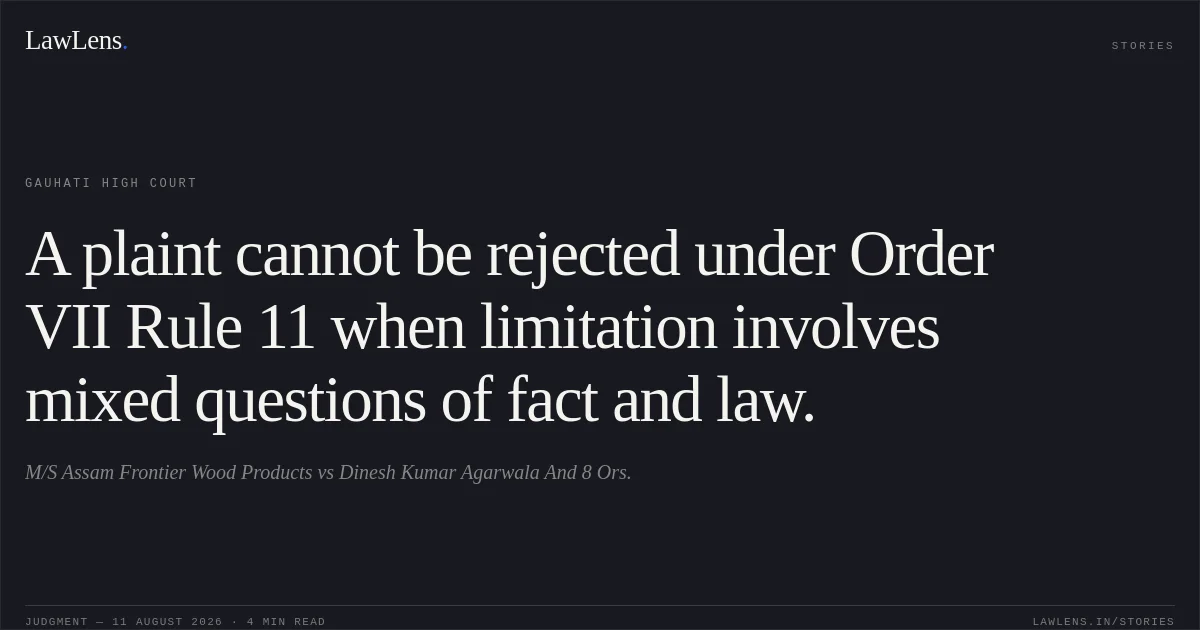
It held that the suit could not be rejected under Order VII Rule 11 CPC because limitation was not conclusively apparent from the plaint and involved mixed questions of law and fact requiring pleadings, issues and evidence; the plaint also disclosed a prima facie cause of action.
Source reference: pp.14–15, paras. 13–15Finding no merit or jurisdictional error in the Trial Court’s orders dated 16 March 2026, the High Court dismissed CRP(IO) Nos. 257/2026 and 258/2026 and directed that the parties bear their own costs.
Source reference: p.16, para. 17Acts & Sections Cited
1 provisions across 1 statute referred to in this judgment. Each provision opens on LawLens.
Code of Civil Procedure, 19081
Original Court PDF
M/S Assam Frontier Wood ProductsvsDinesh Kumar Agarwala And 8 Ors.
Click to open original judgment
Original judgment, available to read, download and summarize on LawLens.in