Facts
The plaintiffs claimed that the suit properties were ancestral and had been allotted to their father, who sold them under registered sale deeds dated 6 November 1992 and 6 March 1993.
Source reference: para. 4They sought declarations that the deeds were null and void, and partition and separate possession, alleging that the sales were not for family necessity and that the plaintiffs were minors when the sales occurred.
Source reference: para. 4, 8–10During trial, they applied under Order VII Rule 11(d) of the Code of Civil Procedure, 1908 (CPC). The trial court allowed the application and rejected the plaint, holding the suit time-barred under Article 109 of the Limitation Act, 1963.
Source reference: para. 5–7The plaintiffs appealed against that order.
Source reference: para. 1, 8Issues
Whether the trial court was justified in allowing the defendants’ application under Order VII Rule 11(d) CPC and rejecting the plaint as barred by limitation
Source reference: para. 12Law Applied
Order VII Rule 11(d) CPC permits rejection of a plaint where, from the statements in the plaint, the suit appears to be barred by law.
Source reference: para. 7Article 109 of the Limitation Act, 1963 prescribes a 12-year limitation period for a suit to set aside a father’s alienation of ancestral property, running from the date the alienee takes possession of the property.
Source reference: para. 15–16Reasoning
The High Court relied on the plaint’s own averments that the plaintiffs’ mother was a consenting witness to the sale deeds and later learned of the sales when she visited the properties to collect rent.
Source reference: para. 14–16It also noted that the defendants were in possession from the dates of the sales. The court treated the suit as having been filed more than 13 years after the first sale deed, beyond Article 109’s 12-year period.
Source reference: para. 14–16It further noted that the mother had previously filed a suit as guardian for the plaintiffs when they were minors, and that she was not joined in the present suit seeking partition; the court considered these circumstances relevant to its assessment of the suit.
Source reference: para. 14–16On that basis, it held that the plaint disclosed a time bar warranting rejection under Order VII Rule 11(d) CPC.
Source reference: para. 16Holding
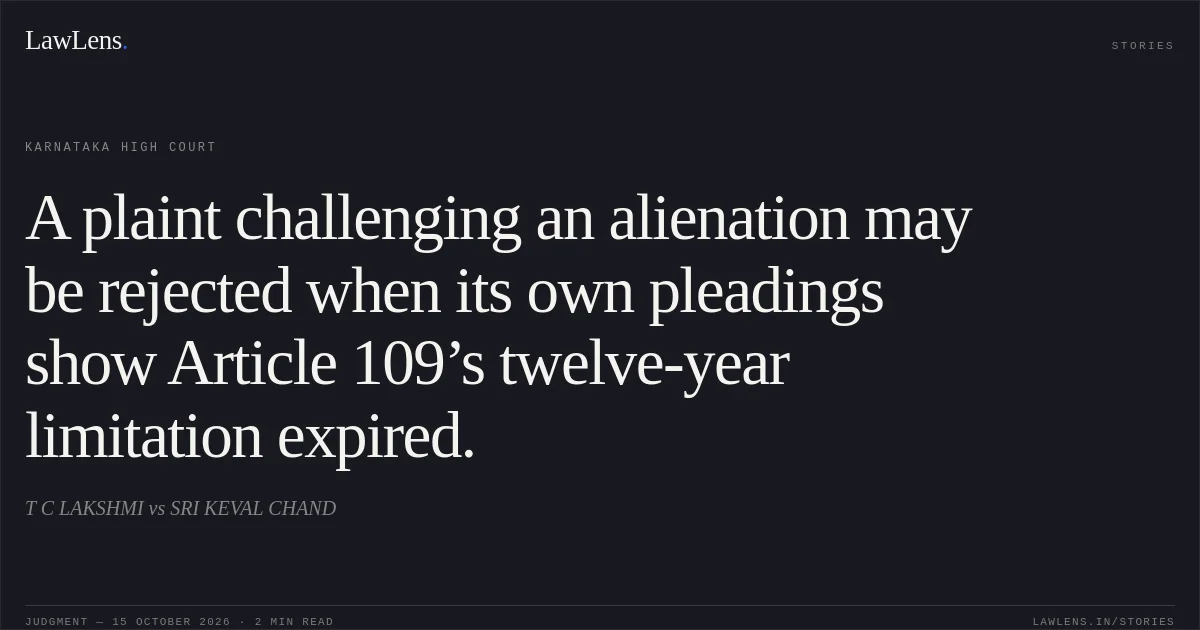
The High Court answered the issue in the affirmative, holding that the trial court had correctly rejected the plaint as time-barred under Article 109 of the Limitation Act, 1963.
It dismissed the appeal and left the trial court’s order undisturbed.
Source reference: para. 16Original Court PDF
T C LAKSHMIvsSRI KEVAL CHAND
Click to open original judgment
Original judgment, available to read, download and summarize on LawLens.in


