Facts
The respondent-plaintiff, a tenant in two godowns owned by the petitioner-defendant, paid ₹2,34,558 to the Indore Municipal Corporation towards property tax allegedly payable by the defendant, after the godowns had been sealed for non-payment.
Source reference: para. 2–2.1The plaintiff issued a demand notice seeking reimbursement and subsequently filed a suit for recovery on 22 August 2024.
Source reference: para. 2.2–2.3The plaint pleaded that the cause of action arose on 29 August 2019, when the payment was made, and again when the demand notice was issued; it also relied on the COVID-19 limitation orders of the Supreme Court and filed an application under Section 5 of the Limitation Act.
Source reference: para. 2.2–2.3The defendant sought rejection of the plaint under Order VII Rule 11(d) CPC, contending that the suit was barred by the three-year limitation period and that Section 5 of the Limitation Act did not apply to suits.
Source reference: para. 2.4The Trial Court dismissed the application on the ground that rejection of the plaint would cause financial loss to the plaintiff and frustrate the ends of justice.
Source reference: para. 2.5Issues
Whether, on the averments in the plaint, the suit for recovery was ex facie barred by limitation and liable to be rejected under Order VII Rule 11(d) CPC, particularly in light of the Supreme Court’s COVID-19 limitation directions.
Source reference: paras. 4–5, 8–12Whether the Trial Court was justified in dismissing the defendant’s application merely on the ground that rejection of the plaint would cause financial loss to the plaintiff and frustrate the object of justice.
Source reference: paras. 10–13Whether the limitation question required determination after evidence, or could be decided at the stage of considering the application under Order VII Rule 11(d) CPC.
Source reference: para. 12Law Applied
The Court applied Article 23 of the Schedule to the Limitation Act, 1963, prescribing a three-year limitation period for a suit concerning money paid for the defendant, ordinarily running from the date of payment.
Source reference: para. 4Section 5 of the Limitation Act, which permits condonation of delay in certain proceedings, does not apply to suits.
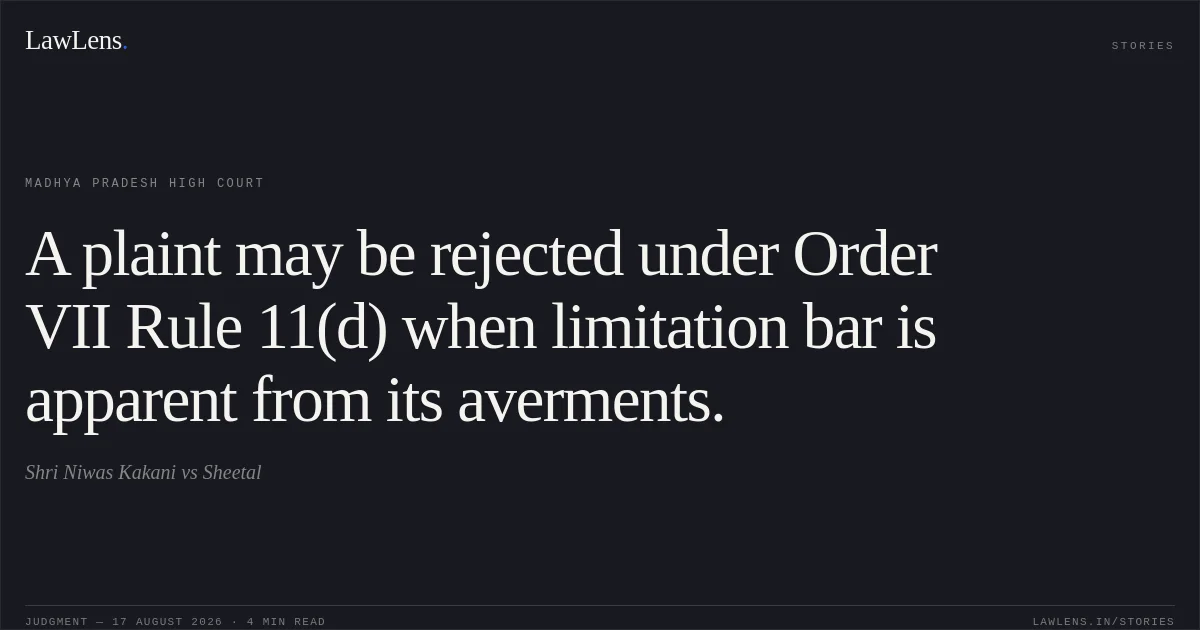
Source reference: para. 10Under Order VII Rule 11(d) CPC, a plaint must be rejected where the suit appears from the statements in the plaint to be barred by any law; however, where limitation depends upon disputed facts or requires evidence, the plaint should not be rejected at that stage and the issue may be tried along with other issues.
Source reference: para. 12The Court considered Ramesh B. Desai v. Bipin Vadilal Mehta, (2006) 5 SCC 638, and Kamala v. K.T. Eshwara Sa, (2008) 12 SCC 661, regarding limitation as a mixed question of law and fact where factual determination is necessary.
Source reference: para. 5.1–5.2It also applied the Supreme Court’s order dated 10 January 2022 in In Re: Cognizance for Extension of Limitation, Suo Motu Writ Petition (C) No. 3 of 2020, which excluded the period from 15 March 2020 to 28 February 2022 for limitation purposes and made the balance period available from 1 March 2022, subject to the specified 90-day protection where applicable.
Source reference: paras. 8–9Reasoning
The High Court held that the relevant facts concerning the date and amount of payment were undisputed: the plaintiff paid the defendant’s alleged property-tax liability on 29 August 2019 and instituted the suit on 22 August 2024.
Source reference: paras. 6–7Although the defendant correctly relied on the three-year limitation period and the non-application of Section 5 to suits, the effect of the Supreme Court’s COVID-19 exclusion order had to be properly calculated.
Source reference: paras. 8–10The Trial Court neither determined whether the period from 15 March 2020 to 28 February 2022 was excludable in the plaintiff’s case nor decided which category under the Supreme Court’s directions applied.
Source reference: para. 12Its conclusion that rejection would cause financial loss or frustrate justice was legally irrelevant to the application of Order VII Rule 11(d) CPC and did not address the statutory limitation question.
Source reference: paras. 10–13Since the Trial Court had not undertaken the necessary limitation analysis, the High Court declined to decide whether the plaint was actually barred and instead directed reconsideration on merits.
Source reference: para. 13Holding
The High Court held that the Trial Court’s dismissal order was unsustainable because it was based on the potential financial hardship to the plaintiff rather than on an examination of limitation under Order VII Rule 11(d) CPC.
The impugned order dated 13 October 2025 was set aside, and the matter was remanded to the Trial Court to decide the defendant’s application for rejection of the plaint on merits, after applying the Supreme Court’s COVID-19 limitation directions.
Source reference: para. 13The Trial Court was directed to decide the application uninfluenced by the observations of the High Court; the High Court expressly left the merits of the limitation objection open.
Source reference: para. 13The civil revision was allowed and disposed of without any order as to costs.
Source reference: para. 14Acts & Sections Cited
6 provisions across 4 statutes referred to in this judgment. Each provision opens on LawLens.
Code of Civil Procedure, 19082
Arbitration and Conciliation Act, 19961
Negotiable Instruments Act, 18811
Original Court PDF
Shri Niwas KakanivsSheetal
Click to open original judgment
Original judgment, available to read, download and summarize on LawLens.in