Facts
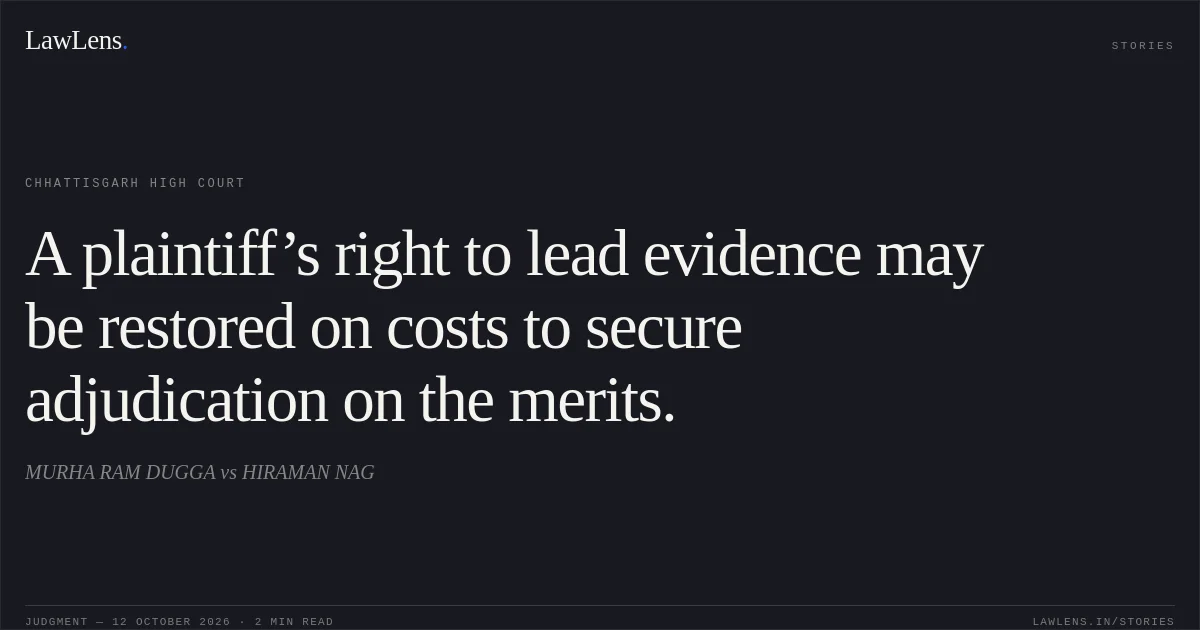
The petitioners, plaintiffs in a suit for declaration of title, partition and permanent injunction, challenged the trial court’s order forfeiting their right to lead evidence and fixing the suit for the defendants’ evidence.
Source reference: para. 1–2The trial court had granted several opportunities to the plaintiffs to produce evidence after issues were framed on 18 June 2024, but they did not do so; on 8 August 2026, it closed their evidence after they sought another adjournment on the ground of agricultural work.
Source reference: para. 5–6The plaintiffs invoked Article 227, submitting that the dispute concerned property rights, the defendants’ evidence had not begun, and one further opportunity could be granted subject to costs.
Source reference: para. 2–3Issues
1. Whether the trial court was justified in forfeiting the plaintiffs’ right to lead evidence after they failed to produce it on the dates fixed.
Source reference: para. 1, 5–62. Whether the plaintiffs should be granted a further opportunity to lead evidence, subject to costs, in the circumstances of the case.
Source reference: para. 3, 6–8Law Applied
Article 227 of the Constitution of India provides the High Court with supervisory jurisdiction over subordinate courts.
Source reference: para. 1Under Order XVII Rule 1 of the Code of Civil Procedure, a court may consider an application for adjournment; the Supreme Court in State Bank of India v. Km. Chandra Govindji, (2000) 8 SCC 532, held that an adjournment granted on a particular occasion is assessed on the grounds then presented, and earlier adjournments are not, by themselves, a relevant consideration for a later adjournment.
Source reference: para. 6The Court also recognised that the right to lead evidence is substantive and that technicalities should not prevent adjudication on the merits.
Source reference: para. 6Reasoning
The High Court noted that the plaintiffs had received repeated opportunities and had failed to produce their evidence, including after a last opportunity; nevertheless, the suit involved competing claims to title and partition, and the defendants’ evidence had not commenced.
Source reference: para. 5–6Applying the principle that the right to lead evidence is substantive, the Court considered that forfeiture would impede determination of the dispute on its merits.
Source reference: para. 6–9It therefore found that one further opportunity was appropriate, while imposing costs and directing that unnecessary adjournments not be granted.
Source reference: para. 6–9Holding
The petition was allowed and the trial court’s order dated 8 August 2026 was set aside, subject to the plaintiffs paying ₹10,000 in costs to the defendants before the trial court on the next hearing date.
The trial court was directed to fix a date and grant the plaintiffs one opportunity to produce their witnesses, then proceed in accordance with law; no unnecessary adjournments were to be granted, subject to any legal impediment.
Source reference: para. 8–10Original Court PDF
MURHA RAM DUGGAvsHIRAMAN NAG
Click to open original judgment
Original judgment, available to read, download and summarize on LawLens.in