Facts
On 16 September 2000, a motorcycle collided with a car, resulting in the death of the motorcycle rider, an Assistant Teacher aged approximately 35–36 years. The car was insured, and the insurer’s liability to satisfy the award was undisputed
Source reference: p.1, paras. 1–2The Motor Accident Claims Tribunal attributed negligence in the ratio of 90:10 between the car driver and the deceased motorcyclist. It assessed the deceased’s monthly income at ₹8,537, added 50% towards future prospects, applied a multiplier of 16, and awarded ₹17,00,676 to the claimants
Source reference: p.1, para. 3The claimants appealed, challenging both the finding of contributory negligence and the adequacy of compensation
Source reference: p.1, para. 4Issues
Whether the deceased motorcyclist was contributorily negligent to the extent of 10%, or whether the car driver alone was responsible for the accident
Source reference: p.2, para. 5Whether the compensation awarded by the Tribunal was inadequate and required enhancement based on the deceased’s income, future prospects, multiplier, deductions, and conventional heads of compensation
Source reference: pp. 3–4, paras. 6–11Law Applied
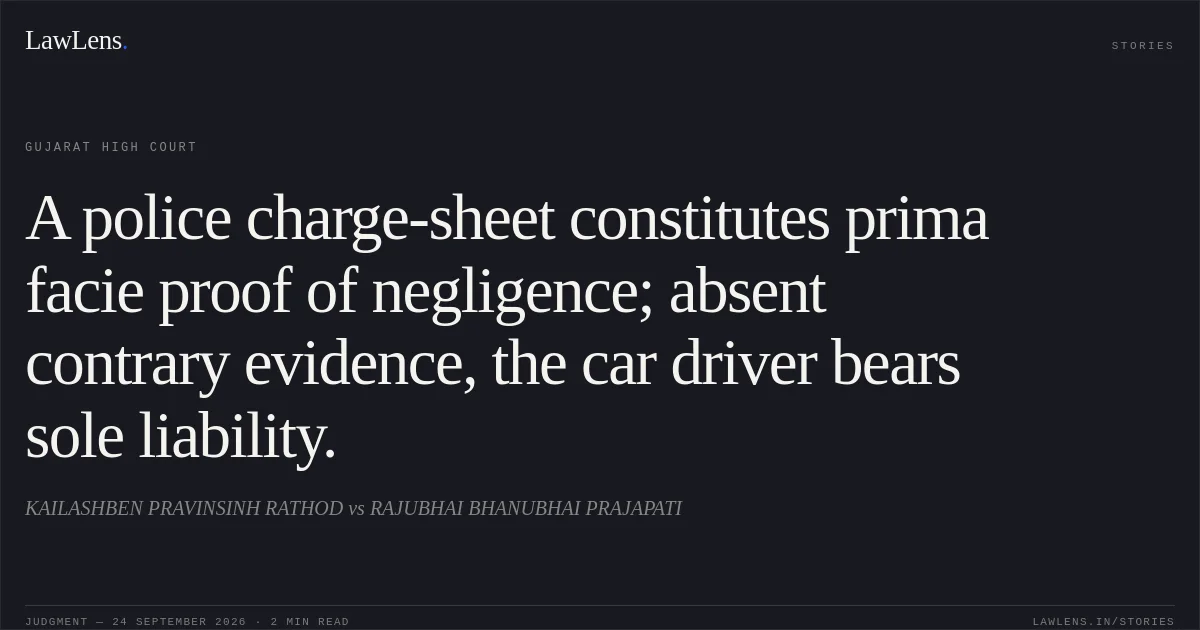
In motor accident claim proceedings, the filing of a police charge-sheet against a driver constitutes prima facie evidence of negligence, as held in Mangla Ram v. Oriental Insurance Co. Ltd., (2018) 5 SCC 656
Source reference: p.2, para. 5The Court applied the principles governing computation of loss of dependency, including addition of future prospects, application of the appropriate multiplier, and deduction for personal expenses.
Source reference: no citationIt also relied on National Insurance Co. Ltd. v. Pranay Sethi, (2017) 16 SCC 680, under which the claimants were awarded compensation for loss of consortium, loss of estate, and funeral expenses
Source reference: p.3, para. 10Reasoning
The Court found that the car driver had been charge-sheeted, which constituted prima facie proof of negligence under Mangla Ram. Since the driver was not examined to establish any negligence on the part of the deceased, the Tribunal’s attribution of 10% contributory negligence to the deceased was held unsustainable; responsibility was placed entirely on the car driver
Source reference: p.2, para. 5On quantum, the Court accepted that the deceased had income from animal husbandry and agricultural activities, but recognised that the family would need to engage another person to supervise those activities. It therefore enhanced the monthly income from ₹8,537 to ₹10,000
Source reference: p.3, paras. 7–9Applying 50% future prospects, a multiplier of 16, and a one-fourth deduction for personal expenses considering six dependants, the Court calculated future loss of income at ₹21,60,000. It added ₹3,12,000 towards consortium, ₹19,500 towards loss of estate, and ₹19,500 towards funeral expenses, resulting in total compensation of ₹25,11,000
Source reference: pp. 3–4, paras. 9–11Holding
The appeal was partly allowed. The finding of 10% contributory negligence against the deceased was set aside, and the car driver was held solely responsible for the accident
The total compensation was enhanced from ₹17,00,676 to ₹25,11,000, granting the claimants an additional ₹8,10,324 with interest at 9% per annum from the date of filing of the claim petition until realisation
Source reference: p.4, paras. 11–12The enhanced amount was directed to be deposited within ten weeks and disbursed to the claimants through NEFT/RTGS after proper verification
Source reference: p.5, paras. 12–13Original Court PDF
KAILASHBEN PRAVINSINH RATHODvsRAJUBHAI BHANUBHAI PRAJAPATI
Click to open original judgment
Original judgment, available to read, download and summarize on LawLens.in
![Subsequent criminal proceedings do not warrant review absent an error apparent on the record.. M/o Finance vs R C BAKSHI. CAT - ['Delhi']. LawLens](/stories/thumbnails/subsequent-criminal-proceedings-do-not-warrant-review-absent-an-error-apparent-on-the-reco-1686b1e451684d1590db13b17e36a8d2.webp)
![Transfer-policy tenure guidelines create no indefeasible right; interference requires statutory violation or established mala fides.. PRIYADARSHI PARIMAL AROHI vs BSNL. CAT - ['Patna']. LawLens](/stories/thumbnails/transfer-policy-tenure-guidelines-create-no-indefeasible-right-interference-requires-statu-110afbbb489a444f8a39741589297e68.webp)
![Recovery of excess pay from a retired employee is impermissible absent fraud or misrepresentation.. RAVI KANT vs Bharat Sanchar Nigam Ltd. CAT - ['Patna']. LawLens](/stories/thumbnails/recovery-of-excess-pay-from-a-retired-employee-is-impermissible-absent-fraud-or-misreprese-074b3b610aa14d1799eeaee490035275.webp)