Facts
On 1 September 2017, K. Janova was riding pillion on a motorcycle when she fell and sustained fatal injuries.
Source reference: p. 3, 6Her husband, son and daughters claimed compensation, alleging that the motorcycle’s rider had applied the brakes rashly and negligently.
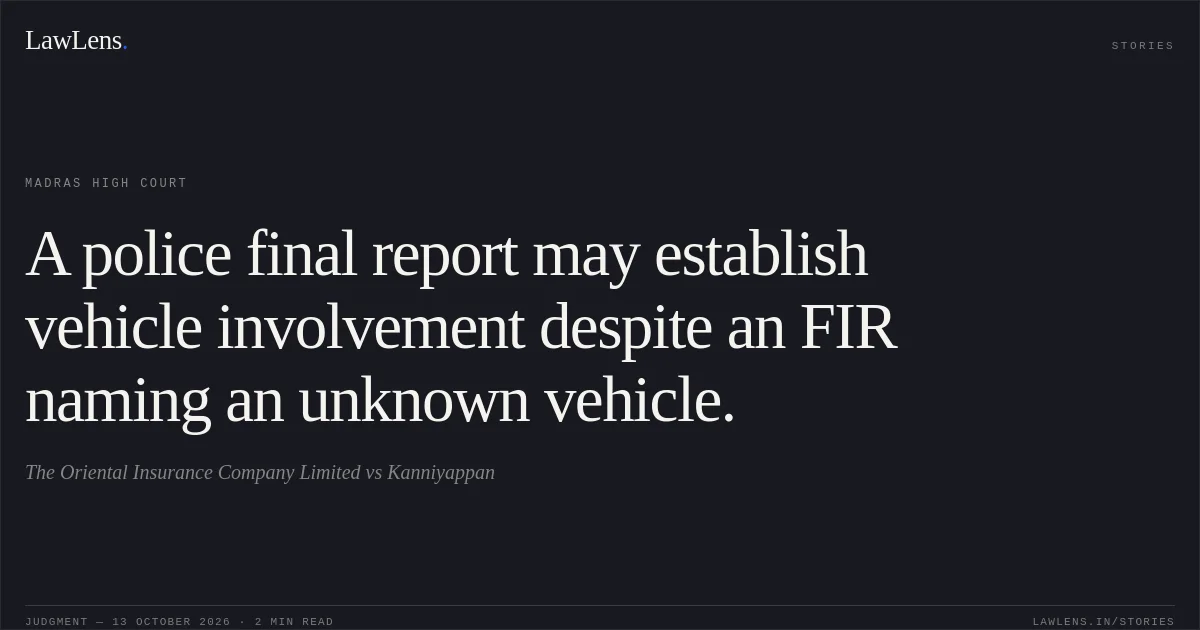
Source reference: p. 3, 6Although the FIR initially recorded the vehicle as unknown, the subsequent police final report identified the insured motorcycle and its rider.
Source reference: p. 3, 6The Tribunal partly allowed the claim and awarded Rs. 19,61,900, directing the insurer to pay and recover from the vehicle owner because the rider lacked a valid driving licence.
Source reference: p. 4, 7The insurer appealed, disputing the vehicle’s involvement and the quantum; the claimants cross-objected for enhancement.
Source reference: p. 4–5Issues
1. Whether the claimants established that the insured motorcycle was involved in the accident despite the FIR initially referring to an unknown vehicle.
Source reference: p. 5–62. Whether the insurer’s liability to pay and recover from the owner was justified because the rider did not hold a valid driving licence.
Source reference: p. 73. Whether the compensation for loss of dependency required enhancement.
Source reference: p. 7–10Law Applied
An FIR sets the criminal law in motion but is not conclusive proof or an exhaustive account of the incident; its initial contents do not preclude reliance on subsequent investigation evidence.
Source reference: p. 6The Court applied Syed Sadiq v. United India Insurance Company, 2014 (1) TANMAC 459, in fixing notional income, and National Insurance Company Ltd. v. Pranay Sethi, (2017) 16 SCC 680, for future prospects.
Source reference: p. 8It applied Sarla Verma v. DTC, (2009) 6 SCC 121, to select the multiplier based on the deceased’s age.
Source reference: p. 8Where the rider lacked a valid driving licence, the insurer was required to pay the claimants first, with liberty to recover the amount from the vehicle owner.
Source reference: p. 7Reasoning
The Court rejected the insurer’s challenge to vehicle involvement because the police final report identified the insured motorcycle and rider after investigation, the claimants’ police witnesses supported that conclusion, and the insurer produced no evidence to disprove it; the FIR’s initial reference to an unknown vehicle was not decisive.
Source reference: p. 6The absence of a valid driving licence established a policy breach, supporting the Tribunal’s pay-and-recover direction.
Source reference: p. 7For dependency, the Court treated the deceased as 43 years old, fixed notional monthly income at Rs. 15,000, added 25% for future prospects, deducted one-fourth for personal expenses and applied a multiplier of 14, calculating loss of dependency at Rs. 23,62,500.
Source reference: p. 7–9It left the awards under the other heads undisturbed.
Source reference: p. 9–10Holding
The Court dismissed the insurer’s appeal and partly allowed the cross-objection, enhancing total compensation from Rs. 19,61,900 to Rs. 25,52,500.
It confirmed the pay-and-recover direction and ordered the insurer to deposit the enhanced award with interest at 7.5% per annum from the claim petition date, together with costs, after crediting any amount already deposited; the Tribunal was directed to transfer the amount to the claimants in accordance with its apportionment.
Source reference: p. 10–11Acts & Sections Cited
1 provisions across 1 statute referred to in this judgment. Each provision opens on LawLens.
Motor Vehicles Act, 19881
Original Court PDF
The Oriental Insurance Company LimitedvsKanniyappan
Click to open original judgment
Original judgment, available to read, download and summarize on LawLens.in