Facts
The complainant and the revision petitioner were acquainted.
Source reference: no citationThe petitioner allegedly borrowed ₹1,30,000 from the complainant for her son’s marriage and subsequently issued Cheque No. 463045 dated 16.12.2016, drawn on the State Bank of India, Dergaon Branch, towards repayment.
Source reference: no citationShe also allegedly executed a handwritten acknowledgment of the debt bearing her signature.
Source reference: no citationThe cheque was dishonoured, following which the complainant issued a legal notice dated 09.01.2017.
Source reference: no citationThe Chief Judicial Magistrate, Golaghat convicted the petitioner under Section 138 of the Negotiable Instruments Act, 1881, sentencing her to one year’s simple imprisonment and compensation of ₹3,00,000.
Source reference: no citationIn appeal, the Sessions Judge, Golaghat upheld the conviction but modified the sentence to six months’ simple imprisonment and compensation of ₹2,60,000.
Source reference: no citationThe petitioner challenged the appellate judgment in revision under Sections 438/442 of the BNSS.
Source reference: pp. 2–3Issues
1. Whether the complainant’s failure to specify the exact date on which the loan was advanced rebutted the statutory presumption under Section 139 of the Negotiable Instruments Act, particularly when the petitioner admitted her signature on the cheque?
Source reference: p. 32. Whether the legal notice dated 09.01.2017 satisfied the requirement under proviso (b) to Section 138 of the Negotiable Instruments Act by making a demand for payment, although it used the expression “advice” rather than an express “demand”?
Source reference: pp. 3–4Law Applied
Section 138 of the Negotiable Instruments Act, 1881 criminalises the dishonour of a cheque issued towards a legally enforceable debt, subject to fulfilment of the statutory conditions, including a written demand for payment under proviso (b).
Source reference: pp. 3–5Section 139 raises a presumption in favour of the holder that the cheque was issued for discharge of a debt or liability; the accused must rebut this presumption through cross-examination or defence evidence.
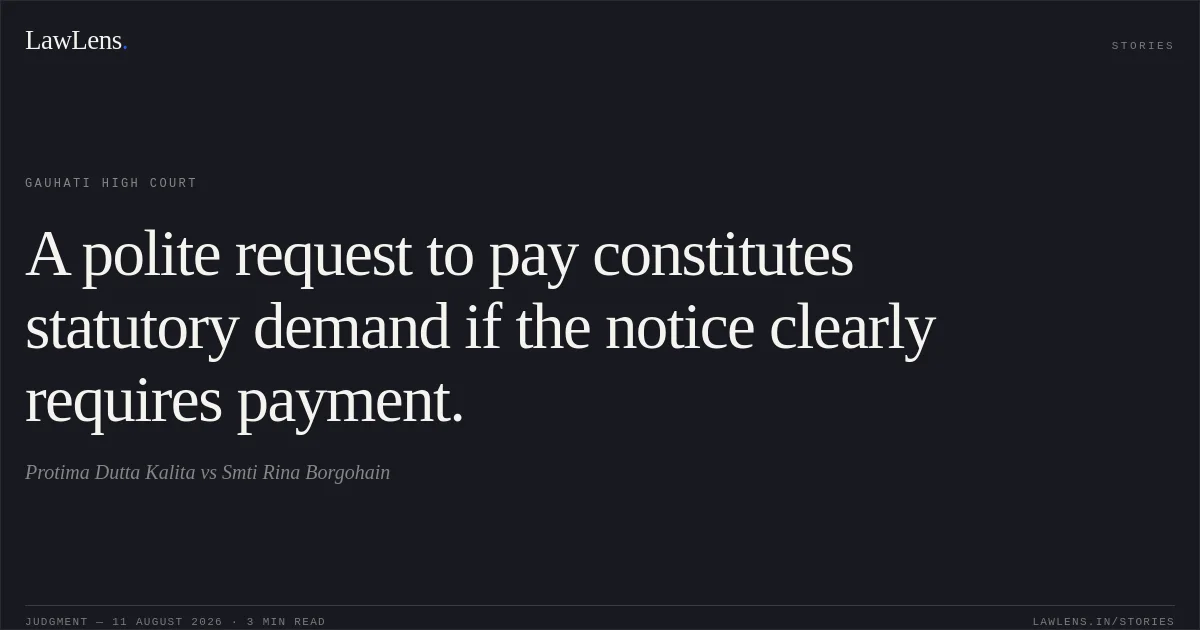
Source reference: pp. 3–5The demand requirement under proviso (b) is assessed from the notice as a whole, and no particular form of words is prescribed.
Source reference: pp. 3–5Relying on Central Bank of India & Anr. v. Saxons Farma & Ors. , (1999) 8 SCC 221, the Court held that a polite expression such as “kindly arrange to make the payment” may constitute a valid demand if the notice communicates the necessity of paying the cheque amount and specifies the consequences of non-payment.
Source reference: pp. 3–5Reasoning
Since the petitioner did not dispute her signature on the cheque, the presumption under Section 139 operated in favour of the complainant.
Source reference: p. 3The petitioner failed, either through cross-examination or by leading defence evidence, to rebut the presumption or establish that the cheque was not issued towards a legally enforceable debt.
Source reference: p. 3The absence of the exact date of the loan transaction was therefore insufficient to displace the statutory presumption.
Source reference: p. 3On the notice issue, the Court examined the notice dated 09.01.2017 as a whole.
Source reference: pp. 3–5Although the notice advised the petitioner to pay rather than expressly using the word “demand,” it conveyed that payment of the cheque amount was required and warned that failure would result in proceedings under the Negotiable Instruments Act.
Source reference: pp. 3–5Applying Central Bank of India , the Court treated the language as a legally sufficient demand under proviso (b) to Section 138.
Source reference: pp. 3–5Holding
The Court answered both issues against the revision petitioner.
It held that the statutory presumption under Section 139 had not been rebutted and that the notice fulfilled the demand requirement under proviso (b) to Section 138.
Source reference: p. 6Finding no merit in the revision petition, the Gauhati High Court dismissed it and affirmed the conviction under Section 138, along with the appellate sentence of six months’ simple imprisonment and compensation of ₹2,60,000.
Source reference: p. 6Acts & Sections Cited
4 provisions across 2 statutes referred to in this judgment. Each provision opens on LawLens.
Bharatiya Nagarik Suraksha Sanhita, 20232
Negotiable Instruments Act, 18812
Original Court PDF
Protima Dutta KalitavsSmti Rina Borgohain
Click to open original judgment
Original judgment, available to read, download and summarize on LawLens.in