Facts
The petitioner, a Class III employee, retired as a UDT on 31 July 2016.
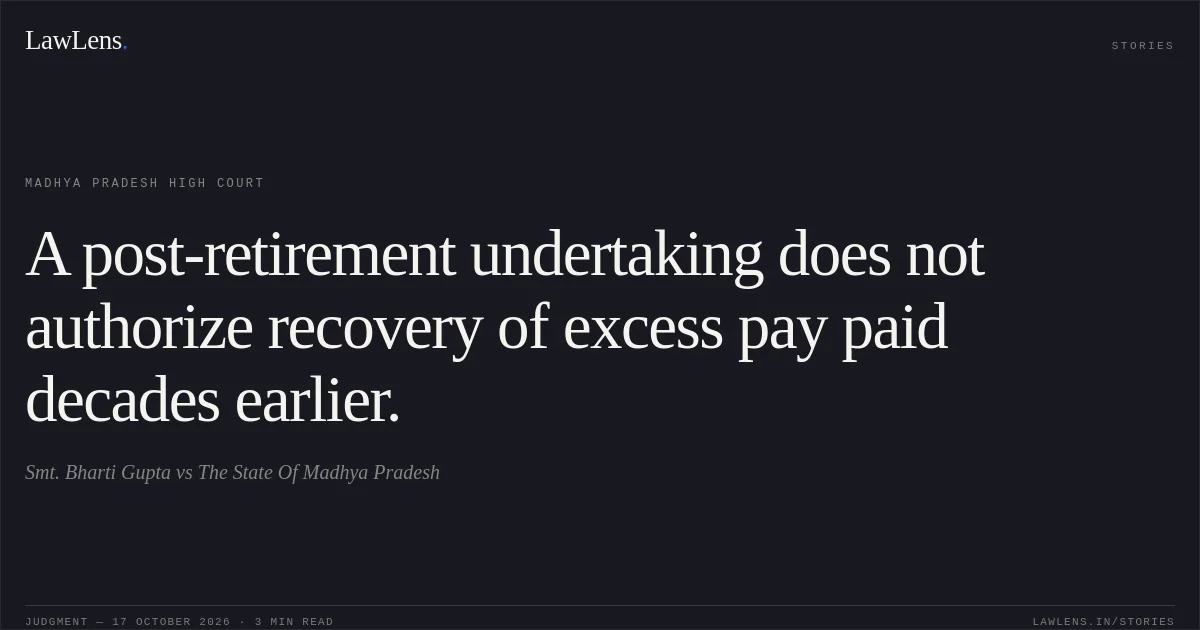
Source reference: no citationFollowing a review of her service book at retirement, the respondents concluded that her pay had been wrongly fixed and ordered recovery of ₹1,59,965 for excess payments made from 19 April 1999 onwards.
Source reference: pp. 2, 7The petitioner challenged the recovery, asserting that it was ordered without notice or a hearing and that she had given no undertaking when the pay benefit was first extended.
Source reference: pp. 2–3, 6–7The State relied on an undertaking furnished at retirement.
Source reference: pp. 2–3, 6–7Issues
1. Whether recovery of excess pay could be made from the petitioner, a retired Class III employee, where the excess payments arose from a pay fixation made years earlier and were not attributable to fraud or misrepresentation by her.
Source reference: pp. 2–3, 72. Whether the undertaking furnished at retirement permitted recovery of the excess payments, despite the absence of an undertaking when the pay benefit was granted.
Source reference: pp. 3–4, 6–73. Whether the recovery was unsustainable for want of notice and an opportunity of hearing.
Source reference: pp. 2, 7Law Applied
In State of Punjab v. Rafiq Masih (White Washer), (2015) 4 SCC 334, recovery is ordinarily impermissible, among other circumstances, from Class III/IV employees, retired employees, and where excess payment continued for more than five years before the recovery order.
Source reference: p. 4The Full Bench in State of Madhya Pradesh v. Jagdish Prasad Dubey, (2024) 2 M.P.L.J. 198, held that an undertaking given at the time of retiral benefits cannot be used to recover amounts arising from pay refixation made decades earlier; an undertaking given when a financial benefit is extended may permit recovery only if it is voluntary, while a forced undertaking is unenforceable.
Source reference: pp. 3–4The Court also relied on Jogeswar Sahoo v. District Judge, Cuttack, 2025 (3) M.P.L.J. (S.C.) 25, concerning recovery from retired ministerial employees without a hearing.
Source reference: pp. 5–6The Court also relied on the coordinate Bench’s application of the voluntary-undertaking principle in Ravindra Kumar Joshi v. State of Madhya Pradesh, W.P. No. 17831/2019, order dated 13 May 2024.
Source reference: pp. 5–6Reasoning
The Court found that the alleged excess payment resulted from pay fixation beginning on 19 April 1999, and that no undertaking had been furnished when that benefit was granted.
Source reference: p. 6The undertaking relied on by the State was given only at retirement and could not validate recovery of the long-standing excess payment.
Source reference: p. 6Applying Rafiq Masih, the Court further noted that the petitioner was a retired Class III employee and that the recovery related to payments made over a period exceeding five years before recovery was ordered.
Source reference: p. 7The recovery had also been initiated without notice or an opportunity of hearing.
Source reference: p. 7In these circumstances, the undertaking did not displace the protections against recovery.
Source reference: no citationHolding
The Court held the recovery of ₹1,59,965 impermissible and set it aside.
The respondents were directed to refund that amount with interest at 6% per annum from the date of retirement until payment, provided the amount had in fact been recovered from the petitioner’s retiral dues.
Source reference: p. 7The refund exercise was to be completed within 90 days of submission of a certified copy of the order; failing that, interest at 12% per annum was directed from the date of entitlement until actual payment.
Source reference: p. 8Original Court PDF
Smt. Bharti GuptavsThe State Of Madhya Pradesh
Click to open original judgment
Original judgment, available to read, download and summarize on LawLens.in