Facts
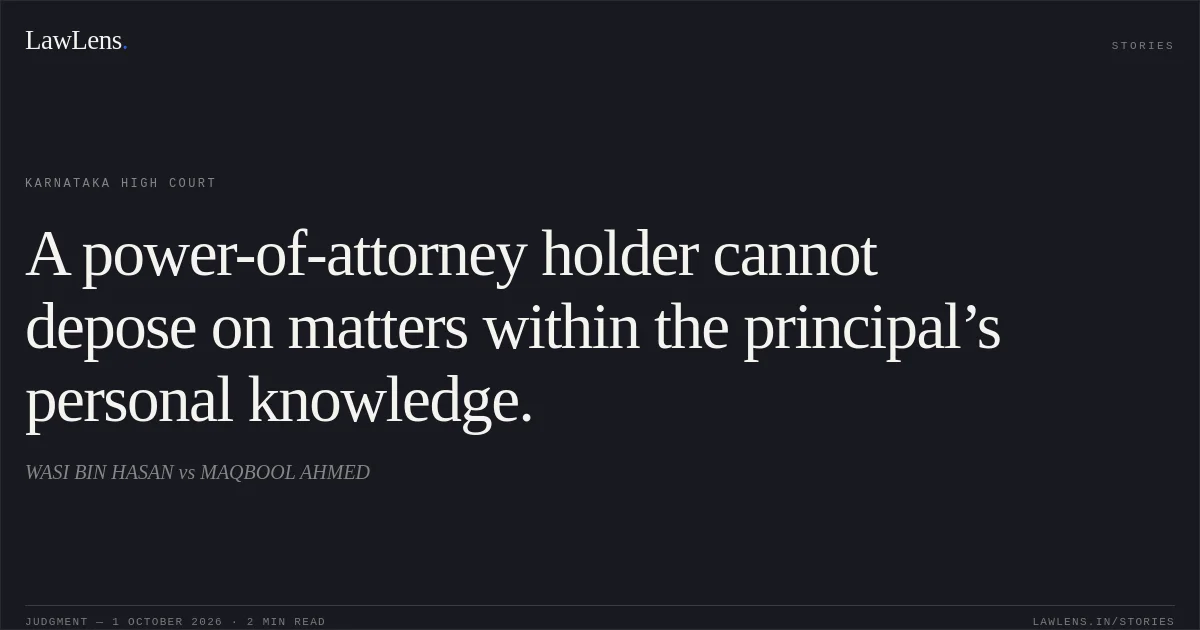
The petitioner filed O.S. No. 70 of 2020 seeking specific performance of a sale agreement. After the petitioner led evidence and the matter was posted for the defendant’s evidence, the respondent sought permission under Order III Rule 2 read with Section 151 CPC to testify through his power-of-attorney holder, citing his age and physical weakness. The petitioner objected that the attorney holder lacked personal knowledge of the transaction. The trial court allowed the application, prompting this writ petition.
Source reference: p.2-3, p.5During the hearing, the respondent’s counsel conceded that the written statement did not plead that the attorney holder was present at the alleged transaction.
Source reference: p.6Issues
1. Whether a power-of-attorney holder may depose on behalf of a principal about a transaction of which the holder has no personal knowledge.
Source reference: p.3-4, p.6-72. Whether the trial court’s order permitting the power-of-attorney holder to lead evidence was contrary to the governing principles in Janki Vashdeo Bhojwani.
Source reference: p.4, p.8Law Applied
Order III Rules 1 and 2 CPC permit a power-of-attorney holder to perform acts authorised by the instrument, but the term “acts” does not extend to deposing in place of the principal about acts done by the principal or matters within the principal’s personal knowledge. An attorney holder may testify about acts personally performed by the holder under the power of attorney.
Source reference: p.4, p.7The Court applied the Supreme Court’s decision in Janki Vashdeo Bhojwani v. Indusind Bank Ltd. and others, Appeal (Civil) No. 6790 of 2003, decided 6 December 2004, for these principles.
Source reference: p.4, p.7The respondent’s application invoked Order III Rule 2 read with Section 151 CPC.
Source reference: p.2Reasoning
The respondent asserted that the attorney holder had personal knowledge of, and was present at, the transaction. However, the written statement did not plead the attorney holder’s presence, and counsel conceded that omission.
Source reference: p.6The Court therefore found that the attorney holder had no personal knowledge of the transaction between the parties. Because the disputed transaction was within the respondent’s personal knowledge, the respondent could not delegate testimony about it to the attorney holder. The trial court’s permission was consequently inconsistent with the rule in Janki Vashdeo Bhojwani.
Source reference: p.6-8Holding
The Court answered that a power-of-attorney holder without personal knowledge could not lead evidence for the respondent concerning the transaction.
It allowed the writ petition, set aside the trial court’s order dated 11 October 2023, and dismissed I.A. No. 6 in O.S. No. 70 of 2020.
Source reference: p.9Acts & Sections Cited
1 provisions across 1 statute referred to in this judgment. Each provision opens on LawLens.
Code of Civil Procedure, 19081
Original Court PDF
WASI BIN HASANvsMAQBOOL AHMED
Click to open original judgment
Original judgment, available to read, download and summarize on LawLens.in