Facts
On 5 July 2019, the Assistant Commissioner of Police, Model Town, issued an order under Section 144 of the Code of Criminal Procedure, 1973 (“CrPC”), directing landlords, owners and persons letting out premises within specified police-station jurisdictions to furnish tenant particulars to the concerned Station House Officer before letting or renting the accommodation. The order was expressly made effective for 60 days, from 5 July 2019 to 2 September 2019.
Source reference: pp. 2, 6–7; paras. 2, 13On 14 September 2019, police officials visiting the petitioner’s premises for tenant verification found two women residing there. They stated that they had been occupying the premises as tenants for approximately four months and had provided their verification documents to the petitioner. The petitioner allegedly admitted that they were his tenants and that their police verification had not been conducted.
Source reference: pp. 2, 7–8; paras. 3, 16–17An FIR was consequently registered under Section 188 of the Indian Penal Code, 1860 (“IPC”).
Source reference: para. 3After investigation, a charge-sheet was filed, and the Trial Court took cognizance on 28 October 2021 and framed charges on 12 July 2023.
Source reference: p. 3; para. 4Although the petition initially challenged the FIR, summoning order and charge-framing order, the petitioner ultimately pressed only the prayer for quashing of the FIR.
Source reference: p. 3; paras. 5–6, 11Issues
1. Whether the petitioner’s alleged failure to obtain police verification of tenants who had already occupied the premises before 5 July 2019 constituted disobedience of the ACP’s order punishable under Section 188 IPC
Source reference: pp. 6–9; paras. 13–212. Whether the FIR and proceedings arising from it were liable to be quashed in exercise of the High Court’s inherent jurisdiction under Section 528 of the Bharatiya Nagarik Suraksha Sanhita, 2023 (“BNSS”)
Source reference: p. 4; paras. 1, 123. Whether cognizance under Section 188 IPC was barred in the absence of a written complaint under Section 195(1)(a)(i) CrPC, as argued by the petitioner
Source reference: p. 4; para. 8Law Applied
The Court exercised its inherent jurisdiction under Section 528 BNSS, corresponding to Section 482 CrPC, to prevent abuse of process and secure the ends of justice.
Source reference: pp. 1, 4; paras. 1, 12Relying on State of Haryana v. Bhajan Lal, 1992 Supp (1) SCC 335, the Court reiterated that quashing may be undertaken where the allegations, even if accepted in their entirety, do not disclose an offence, or where an express legal bar exists.
Source reference: pp. 4–6; para. 12Section 188 IPC criminalises disobedience of an order duly promulgated by a public servant, while Section 144 CrPC permits preventive orders of limited duration and purpose.
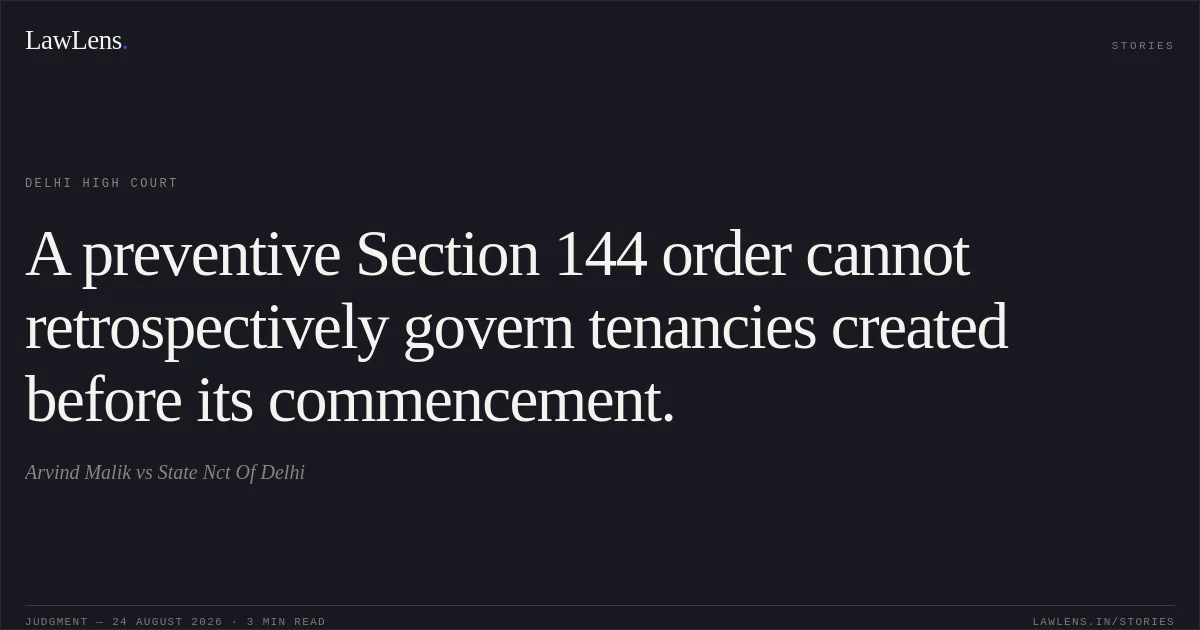
Source reference: pp. 2, 6–7; paras. 2, 13The Court applied the principle that a preventive order under Section 144 CrPC cannot operate retrospectively so as to regulate conduct or arrangements that arose before the order came into force.
Source reference: pp. 6–9; paras. 14–19The petitioner also relied on Section 195(1)(a)(i) CrPC, which requires a written complaint by the concerned public servant or an authorised superior before cognizance of an offence under Section 188 IPC; however, the Court’s ultimate decision rested on the absence of the substantive offence.
Source reference: p. 4; para. 8Reasoning
The prosecution’s case depended entirely on the ACP’s order dated 5 July 2019.
Source reference: p. 6; para. 13That order was operative only until 2 September 2019 and could govern only tenancies created during its operative period; it could not retrospectively apply to tenancies already in existence before 5 July 2019.
Source reference: pp. 6–7; paras. 14–15The FIR itself recorded that the two occupants had been residing in the premises for approximately four months as of 14 September 2019, indicating that their tenancy had commenced before the ACP’s order was issued.
Source reference: pp. 7–9; paras. 16–18Accordingly, the petitioner’s alleged failure to complete their police verification on 14 September 2019 could not amount to disobedience of that order.
Source reference: pp. 7–9; paras. 16–18Since the foundational facts alleged did not disclose an offence under Section 188 IPC, the case fell within the Bhajan Lal categories warranting quashing.
Source reference: pp. 4–6, 8–9; paras. 12, 19–21Holding
The Court held that the ACP’s order dated 5 July 2019 could not be applied retrospectively to the alleged tenancy, which had commenced before the order came into force. Therefore, the inspection on 14 September 2019 did not constitute disobedience punishable under Section 188 IPC.
FIR No. 407/2019 registered at Police Station Mukherjee Nagar, Delhi, and all proceedings emanating from it were quashed.
Source reference: p. 9; paras. 21–22The petition and pending application were accordingly allowed and disposed of.
Source reference: p. 9; paras. 21–22Acts & Sections Cited
8 provisions across 4 statutes referred to in this judgment. Each provision opens on LawLens.
Bharatiya Nagarik Suraksha Sanhita, 20231
Indian Penal Code, 18601
Code of Criminal Procedure, 19735
Delhi Police Act, 19781
Original Court PDF
Arvind MalikvsState Nct Of Delhi
Click to open original judgment
Original judgment, available to read, download and summarize on LawLens.in