Facts
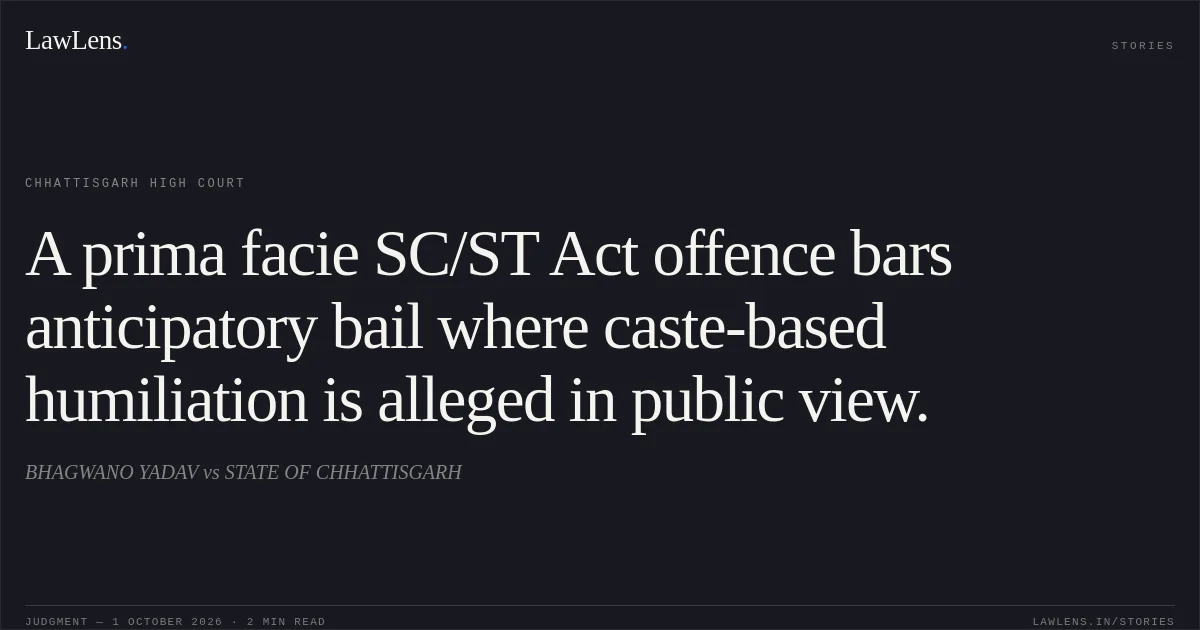
The appellants challenged the Special Judge’s order dated 24 August 2026 refusing anticipatory bail and sought relief under Section 14-A(2) of the Scheduled Castes and Scheduled Tribes (Prevention of Atrocities) Act, 1989.
Source reference: para. 1–5The FIR alleged that the appellants and others entered the complainant’s agricultural field, assaulted members of his family, used caste-based abuse, and attempted to outrage the modesty of the complainant’s sister.
Source reference: para. 1–5The appellants relied on a land dispute and prior revenue proceedings to argue that they had been falsely implicated; the State opposed bail, relying on the FIR and witness statements.
Source reference: para. 1–5Issues
Whether the FIR and supporting material disclosed a prima facie offence under the SC/ST Act, such that the statutory bar on anticipatory bail applied.
Source reference: para. 6–10Whether the appellants were entitled to anticipatory bail in light of their land-dispute defence and the allegations against them.
Source reference: para. 3, 9–12Law Applied
Section 14-A(2) of the SC/ST Act provides the appellate route invoked by the appellants; Sections 18 and 18-A bar anticipatory bail under Section 438 of the Code of Criminal Procedure where a prima facie offence under the SC/ST Act is disclosed.
Source reference: para. 6Under Prathvi Raj Chauhan v. Union of India, the bar does not apply if the FIR and supporting material fail to disclose such a prima facie case.
Source reference: para. 6Kiran v. Rajkumar Jivraj Jain requires the court to examine the complaint’s averments to determine whether an offence under Section 3(1) of the SC/ST Act is prima facie made out; specific caste-based intimidation intended to humiliate weighs against anticipatory bail.
Source reference: para. 7At the bail stage, the court determines whether a prima facie case is disclosed and must not conduct a mini-trial or test the truth of competing versions.
Source reference: para. 11Reasoning
The Court found specific allegations that the appellants participated in the assault, used caste-based insults, and caught and dragged the complainant’s sister while attempting to outrage her modesty; her statement under Section 180 of the BNSS supported that allegation.
Source reference: para. 9–10As the alleged incident occurred in a place within public view, the Court held that an intention to humiliate could not be ruled out at this stage.
Source reference: para. 10The appellants’ claim that the case arose from a land dispute and that the complainant’s family were the aggressors raised a competing factual account, but resolving its truth would amount to a mini-trial, which was impermissible at the bail stage.
Source reference: para. 3, 11Holding
The Court held that a prima facie case under the SC/ST Act was disclosed and found no basis to interfere with the Special Judge’s refusal of anticipatory bail.
The criminal appeal was dismissed.
Source reference: para. 12Acts & Sections Cited
11 provisions across 4 statutes referred to in this judgment. Each provision opens on LawLens.
Scheduled Castes and the Scheduled Tribes (Prevention of Atrocities) Act, 19892
Bharatiya Nyaya Sanhita, 20237
Bharatiya Nagarik Suraksha Sanhita, 20231
Code of Criminal Procedure, 19731
Original Court PDF
BHAGWANO YADAVvsSTATE OF CHHATTISGARH
Click to open original judgment
Original judgment, available to read, download and summarize on LawLens.in