Facts
Archana Kumari alleged that, after her husband’s death, her in-laws harassed her, demanded ₹2 lakhs for her daughter, and ultimately ousted her from the matrimonial home.
Source reference: p. 2–3A police case was registered against five accused; following investigation, the police submitted a charge-sheet under Sections 341, 323, 498A and 504/34 IPC.
Source reference: p. 2–3The Magistrate took cognizance of those offences against three accused, including the petitioners.
Source reference: p. 2–3The petitioners sought to quash the cognizance order. They relied on a 10 March 2013 agreement reached at a panchayat and submitted that the informant had remarried in 2022.
Source reference: p. 4–5The informant did not dispute the agreement or remarriage but contended that the agreement had not been fully acted upon.
Source reference: p. 4–5During the petition, petitioner no. 1, Khublal Sah, died.
Source reference: p. 1Issues
1. Whether the cognizance order and consequential criminal proceedings against petitioner no. 2, Manju Devi, should be quashed under the High Court’s inherent jurisdiction, given the asserted settlement and the informant’s subsequent remarriage.
Source reference: p. 4–5, 82. Whether the petition against petitioner no. 1, who died during its pendency, could proceed.
Source reference: p. 1Law Applied
The Court considered the High Court’s inherent power under Section 482 CrPC to quash criminal proceedings to prevent abuse of process or secure the ends of justice.
Source reference: p. 5–8It relied on Abhishek v. State of Madhya Pradesh, 2023 SCC OnLine SC 1083, which reiterates that quashing must be exercised sparingly and with circumspection; courts ordinarily should not assess the reliability of allegations, but may examine the complaint and relevant attending circumstances within the recognised limits of Section 482.
Source reference: p. 5–8The Court also reproduced the illustrative categories in State of Haryana v. Bhajan Lal, including proceedings manifestly attended by mala fides or instituted for an ulterior purpose.
Source reference: p. 7–8Reasoning
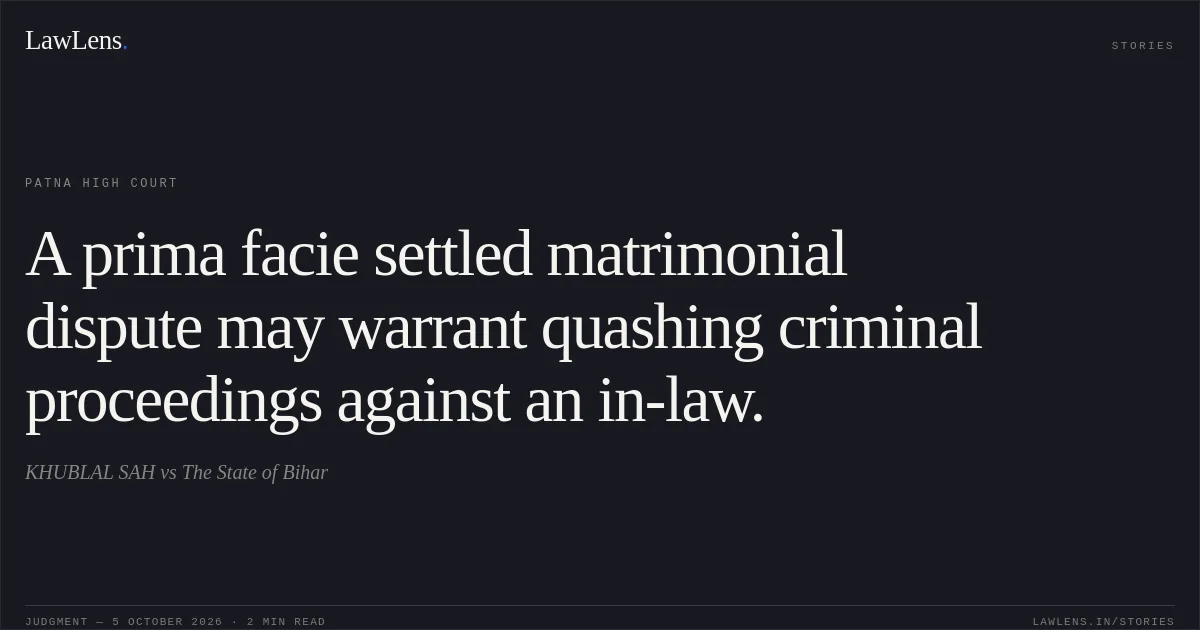
The Court noted that the parties’ dispute appeared, prima facie, to have been settled by agreement and that the informant had since remarried.
Source reference: p. 4–5, 8Although the informant asserted that the agreement was not fully performed, the Court considered the settlement and remarriage sufficient circumstances, guided by Abhishek, to quash the proceedings against Manju Devi.
Source reference: p. 4–5, 8As Khublal Sah had died during the proceedings, the Court treated the petition as infructuous insofar as it concerned him.
Source reference: p. 1Holding
The petition was dismissed as infructuous in respect of petitioner no. 1, Khublal Sah.
In respect of petitioner no. 2, Manju Devi, the cognizance order dated 27 April 2016 and all consequential proceedings were quashed.
Source reference: p. 1, 8–9The petition was accordingly allowed, and the judgment was directed to be communicated to the trial court.
Source reference: p. 1, 8–9Acts & Sections Cited
13 provisions across 3 statutes referred to in this judgment. Each provision opens on LawLens.
Indian Penal Code, 18608
Code of Criminal Procedure, 19733
Original Court PDF
KHUBLAL SAHvsThe State of Bihar
Click to open original judgment
Original judgment, available to read, download and summarize on LawLens.in