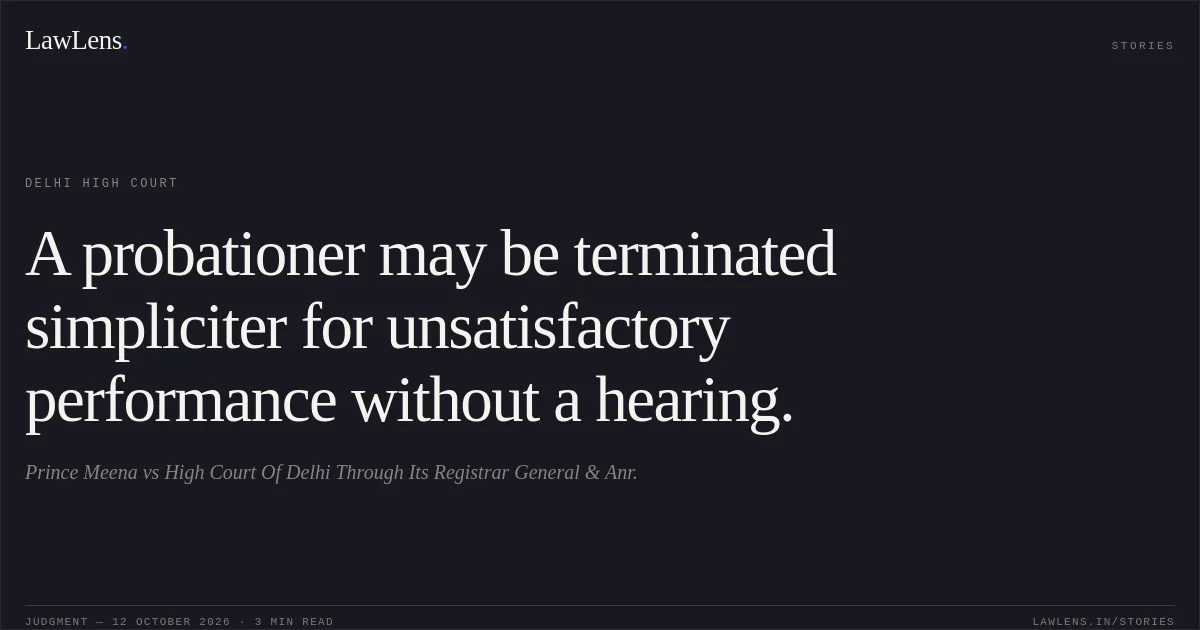
Facts
The petitioner was appointed as a Temporary Chauffeur on probation for one year, without any automatic right to confirmation.
Source reference: p.2, para. 5The Protocol Committee recommended that his probation not be extended, citing alleged insubordination and leave without valid reasons.
Source reference: p.2, para. 6He was later served memoranda concerning a “below average” APAR and unauthorised absence, and submitted responses to both.
Source reference: pp.3–4, paras. 7–10His services were terminated under Rule 5(1) of the Central Civil Services (Temporary Service) Rules, 1965, by an order dated 19 August 2025.
Source reference: p.4, para. 11After his representation against the termination was considered, he challenged the termination, the APAR and related decisions, alleging that the termination was founded on misconduct, that the Committee had prejudged the matter, and that he had not received a fair opportunity to respond.
Source reference: pp.1–2, paras. 1–4; p.4, para. 12Issues
1. Whether the petitioner’s termination during probation was a stigmatic, misconduct-based termination requiring an inquiry and observance of Article 311 or natural justice, rather than a valid termination simpliciter.
Source reference: pp.9–10, paras. 22–242. Whether the Committee’s earlier recommendation and the handling of the petitioner’s representations showed prejudgment or denial of an adequate opportunity to respond.
Source reference: pp.9–10, paras. 24–263. Whether the petitioner had a right to continue in service during or after probation.
Source reference: p.9, para. 24Law Applied
Under Rule 5(1) of the Central Civil Services (Temporary Service) Rules, 1965, a probationer may be discharged by a termination simpliciter where the decision rests on unsuitability and does not impose a penalty.
Source reference: pp.4–9, paras. 13–21A probationer has no vested or indefeasible right to continue in service or to automatic confirmation; an employer may assess the probationer’s performance and conduct and terminate service if found unsatisfactory.
Source reference: pp.4–9, paras. 13–21Under Article 311 of the Constitution, procedural protections are attracted where termination is punitive—founded on misconduct or carrying stigma or other adverse legal consequences—not where it is a non-stigmatic discharge based on unsuitability.
Source reference: pp.4–9, paras. 13–21The Court relied on OIL and Natural Gas Commission v. Dr. Md. S. Iskender Ali, (1980) 3 SCC 428; Shamsher Singh v. State of Punjab, (1974) 2 SCC 831; Rajesh Kohli v. High Court of J&K, (2010) 12 SCC 783; Parshotam Lal Dhingra v. Union of India, AIR 1958 SC 36; Rajasthan High Court v. Ved Priya, (2021) 13 SCC 151; and Sarita Choudhary v. High Court of Madhya Pradesh, (2025) 9 SCC 297.
Source reference: pp.4–9, paras. 13–21Reasoning
The Court found that the termination order itself made no reference to misconduct or any adverse finding and was therefore a termination simpliciter, not an inquiry-based punitive termination.
Source reference: p.9, paras. 22–23The petitioner’s probationary status and the absence of automatic confirmation meant he had no crystallised right to continued employment.
Source reference: p.9, para. 24The Committee’s earlier action was a recommendation, and the record showed that memoranda concerning the APAR and absence were subsequently issued, the petitioner responded to both, and his responses and later representation were considered.
Source reference: pp.9–10, paras. 24–26The Court also noted the negative reporting comments and “below average” APAR grading, concluding that the termination rested on an overall assessment of unsatisfactory performance and conduct, rather than punishment for a specific misconduct.
Source reference: p.10, paras. 25–27Holding
The Court held that the termination was non-stigmatic and validly based on the petitioner’s unsatisfactory performance and conduct during probation; neither Article 311 nor the asserted denial of an opportunity to respond invalidated it.
The writ petition was dismissed, and pending applications were rendered infructuous.
Source reference: p.11, para. 28Original Court PDF
Prince MeenavsHigh Court Of Delhi Through Its Registrar General & Anr.
Click to open original judgment
Original judgment, available to read, download and summarize on LawLens.in
![Excess-pay recovery from retired Group C employees is impermissible absent fraud or misrepresentation.. SATYA NAND YADAV vs NORTH EASTERN RAILWAY. CAT - ['Allahabad']. LawLens](/stories/thumbnails/excess-pay-recovery-from-retired-group-c-employees-is-impermissible-absent-fraud-or-misrep-c357cbdd195c44d68331385eea2a3c9a.webp)
![A different Tribunal Bench cannot adjudicate claims seeking implementation of another Bench’s order.. KAMLA DEVI vs NORTH CENTRAL RAILWAY. CAT - ['Allahabad']. LawLens](/stories/thumbnails/a-different-tribunal-bench-cannot-adjudicate-claims-seeking-implementation-of-another-benc-cca646896f904d429d1270d122130c8b.webp)