Facts
The applicant sought anticipatory bail in Case Crime No. 9 of 2026, Police Station Kotwali Konch, District Jalaun, registered under Sections 69, 352 and 351(3) of the Bharatiya Nyaya Sanhita.
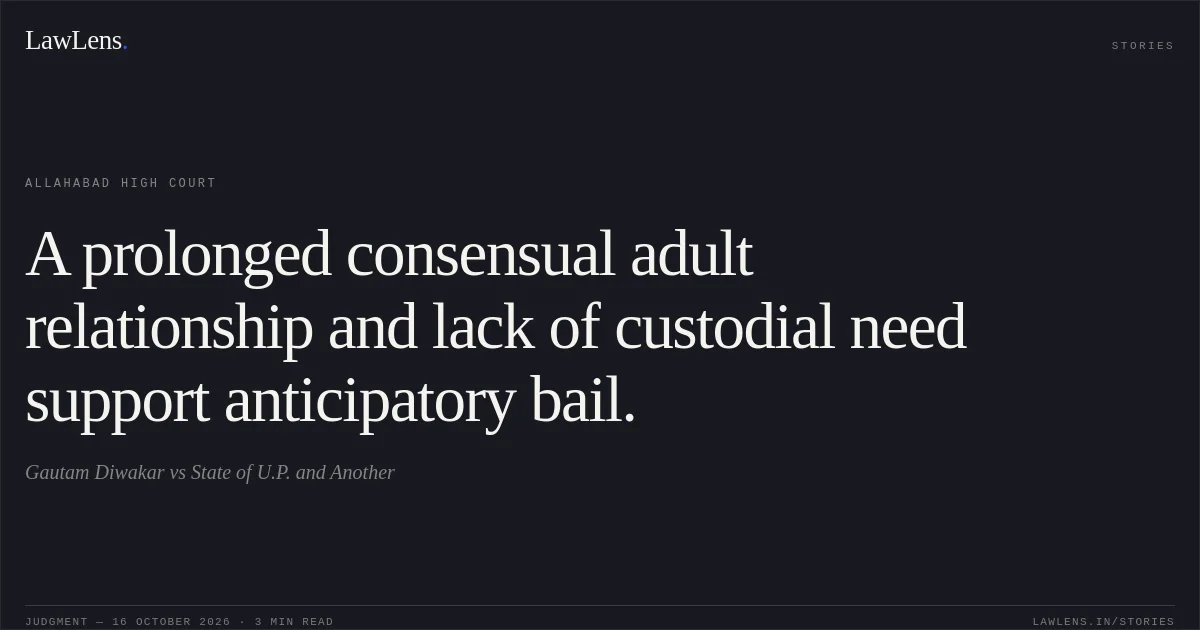
Source reference: para. 2The prosecution allegation was that the victim had been subjected to sexual intercourse on a false promise of marriage. The applicant contended that the victim, then aged about 24, had been in a consensual relationship with him for approximately three years and that the FIR followed the breakdown of the relationship; he also relied on the victim’s refusal to undergo medical examination and the absence of any need for custodial interrogation.
Source reference: paras. 2–5The applicant’s arrest had earlier been stayed by a Division Bench. After the charge-sheet was filed and cognizance taken on 15 April 2026, he sought anticipatory bail; the State opposed the application but did not dispute the factual aspects stated by the applicant.
Source reference: paras. 3, 6Issues
1. Whether the applicant was entitled to anticipatory bail where he had not been arrested during the investigation and the charge-sheet had since been filed.
Source reference: paras. 3, 8, 172. Whether the circumstances alleged—particularly the claimed prolonged relationship between two adults and the asserted absence of custodial-interrogation requirements—supported granting anticipatory bail, without expressing an opinion on the merits.
Source reference: paras. 3–4, 17Law Applied
The Court considered the anticipatory-bail application under Section 482 of the Bharatiya Nagarik Suraksha Sanhita and applied the principle in Aman Preet Singh v. CBI, (2022) 13 SCC 764, that where an accused was not arrested during investigation and custody was not required, filing of the charge-sheet alone does not ordinarily justify arrest; the court should generally issue summons, with a warrant requiring reasons.
Source reference: para. 8It also relied on Mahesh Damu Khare v. State of Maharashtra, (2024) 11 SCC 398; Prashant v. State of NCT of Delhi, (2025) 5 SCC 764; Samadhan v. State of Maharashtra, 2025 SCC OnLine SC 2528; Rajnish Singh @ Soni v. State of U.P., (2025) 4 SCC 197; Pramod Kumar Navratna v. State of Chhattisgarh, 2026 SCC OnLine SC 154; and Ravish Singh Rana v. State of Uttarakhand, 2025 SCC OnLine SC 1055, for principles concerning prolonged consensual relationships and the need to distinguish genuine sexual violence or consent vitiated by a false promise from a relationship that later breaks down.
Source reference: paras. 9–14Under Pramod Suryabhan Pawar v. State of Maharashtra, (2019) 9 SCC 608, a promise to marry vitiates consent only where the promise was false from its inception and made with no intention of being fulfilled; mere subsequent breach is insufficient.
Source reference: para. 15The Court also referred to Sonu @ Subhash Kumar v. State of Uttar Pradesh, (2021) 18 SCC 517, concerning proceedings arising from a consensual relationship followed by a refusal to marry.
Source reference: para. 16Reasoning
The Court considered the applicant’s account of a three-year relationship between adults, the asserted absence of custodial-interrogation needs, and the fact that he had not been arrested during the investigation. It assessed those circumstances against the cited authorities on post-relationship allegations based on a promise of marriage and the principle that non-arrest during investigation is relevant when deciding whether custody is warranted after the charge-sheet.
Source reference: paras. 6, 17On the submissions, the State’s response, the nature of the accusation and the attending circumstances, the Court held that a case for anticipatory bail was made out, while expressly reserving its opinion on the merits.
Source reference: para. 17Holding
The Court allowed the anticipatory-bail application.
In the event of arrest or appearance, the applicant was directed to be released on anticipatory bail until conclusion of trial on a personal bond of ₹50,000 with two sureties of the like amount. He must cooperate with the trial, attend court when required, refrain from influencing persons acquainted with the case, and not leave India without prior permission. The prosecution, Investigating Officer or complainant may seek cancellation for breach or misuse of the conditions.
Source reference: paras. 18–19Acts & Sections Cited
8 provisions across 4 statutes referred to in this judgment. Each provision opens on LawLens.
Bharatiya Nagarik Suraksha Sanhita, 20231
Bharatiya Nyaya Sanhita, 20233
Code of Criminal Procedure, 19733
Indian Penal Code, 18601
Original Court PDF
Gautam DiwakarvsState of U.P. and Another
Click to open original judgment
Original judgment, available to read, download and summarize on LawLens.in