Facts
On 31 March 2009, the parties entered into an agreement for sale of the defendant’s mortgaged house for ₹4,70,000. The plaintiff was to pay ₹3,86,000 towards the bank liability, in instalments or in a lump sum, and the sale deed was to be executed after the mortgage was discharged.
Source reference: p. 3, 17; paras. 4, 26The plaintiff claimed to have made payments towards the liability and sought specific performance and an injunction. The defendant denied that the plaintiff had complied with the agreement and counterclaimed for possession.
Source reference: pp. 4–9; paras. 6–13The trial court dismissed the specific-performance claim, ordered the plaintiff to restore possession, and directed the defendant to refund ₹3,58,700, with interest in default.
Source reference: pp. 9–10; para. 14The plaintiff appealed against dismissal of her suit and the possession order; the defendant appealed against the refund direction.
Source reference: pp. 10–13; paras. 15–16Issues
1. Whether the trial court was justified in dismissing the plaintiff’s claims for specific performance and permanent injunction
Source reference: p. 13; para. 18(i)2. Whether the trial court was justified in allowing the defendant’s counterclaim and directing restoration of possession
Source reference: p. 13; para. 18(ii)3. Whether the trial court was justified in directing the defendant to refund ₹3,58,700, with interest in default
Source reference: p. 13; para. 18(iii)Law Applied
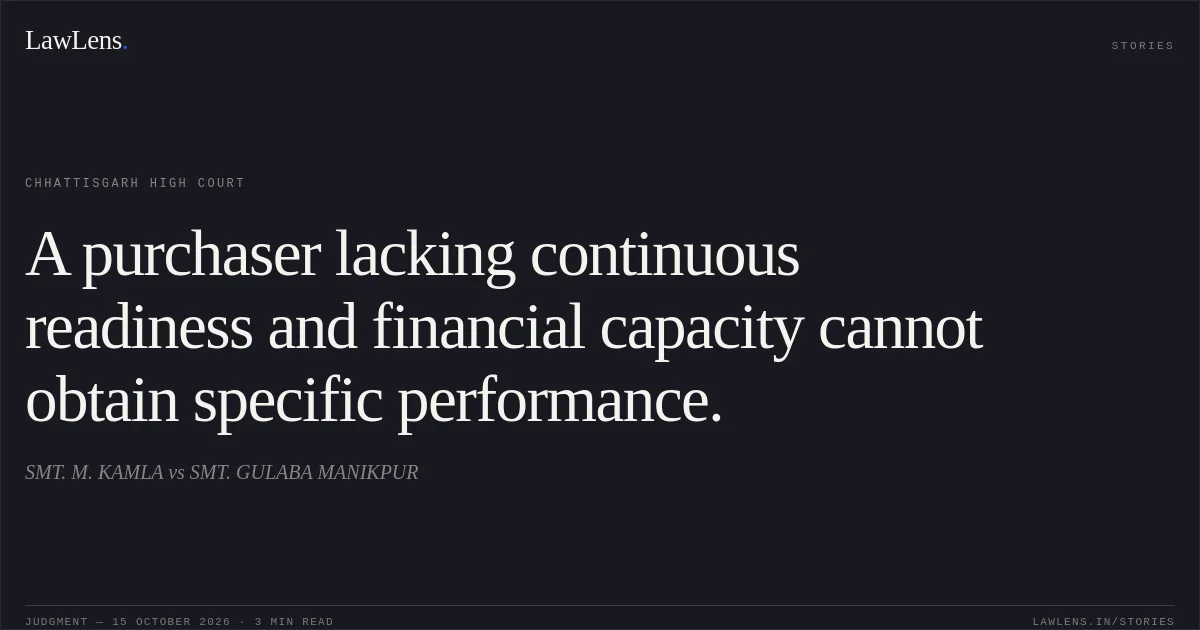
Section 16(c) of the Specific Relief Act, 1963 bars specific performance in favour of a plaintiff who fails to aver and prove performance, or continuous readiness and willingness to perform, the essential contractual terms required of them; readiness concerns financial capacity, while willingness is assessed from the plaintiff’s conduct.
Source reference: pp. 19–21; paras. 31–32The court relied on N.P. Thirugnanam v. Dr. R. Jagan Mohan Rao, (1995) 5 SCC 115, for the requirement of continuous readiness and willingness from the contract’s execution through the decree, assessed by conduct and surrounding circumstances.
Source reference: p. 21; para. 33R.C. Chandiok v. Chuni Lal Sabharwal, (1970) 3 SCC 140, for assessing readiness and willingness from the totality of the facts and circumstances; and M/s J.P. Builders v. A. Ramadas Rao, (2011) 1 SCC 429, for the distinction between financial readiness and conduct demonstrating willingness.
Source reference: pp. 19–22; paras. 32, 34The court also referred to Telikicherla v. Kalli Raj Rao, (2014) 15 SCC 743, and U.N. Krishnamurthy v. A.M. Krishnamurthy, (2023) 11 SCC 775, in support of its conclusion on readiness and willingness.
Source reference: p. 24; para. 39Reasoning
The court treated the agreement’s execution and terms as undisputed, but found that the plaintiff had made payments towards the bank liability only up to 12 December 2012 and had not established that the full consideration was financially available to her.
Source reference: pp. 22–24; paras. 36–39It considered the instalment payments over several years and the absence of bank-account evidence demonstrating sufficient funds, and concluded that she had not proved continuous financial readiness and willingness to perform.
Source reference: pp. 22–24; paras. 36–39Because specific performance was unavailable, the plaintiff’s continued possession could not be sustained on the agreement, and the defendant was entitled to recover possession.
Source reference: p. 24; para. 40The court found no basis to disturb the trial court’s finding that ₹3,58,700 had been paid and its order directing repayment. It also rejected the defendant’s objection to the admissibility of the agreement, noting that it did not record delivery of possession pursuant to the agreement.
Source reference: pp. 24–25; paras. 41–43Holding
The High Court dismissed both appeals and affirmed the trial court’s decree: specific performance was refused, the plaintiff was directed to restore possession to the defendant, and the defendant was required to refund ₹3,58,700, with interest at 6% per annum from 31 March 2009 if payment was not made within the prescribed two months.
The parties were directed to bear their own costs.
Source reference: pp. 25–26; paras. 44–46Acts & Sections Cited
2 provisions across 2 statutes referred to in this judgment. Each provision opens on LawLens.
Code of Civil Procedure, 19081
Specific Relief Act, 19631
Original Court PDF
SMT. M. KAMLAvsSMT. GULABA MANIKPUR
Click to open original judgment
Original judgment, available to read, download and summarize on LawLens.in