Facts
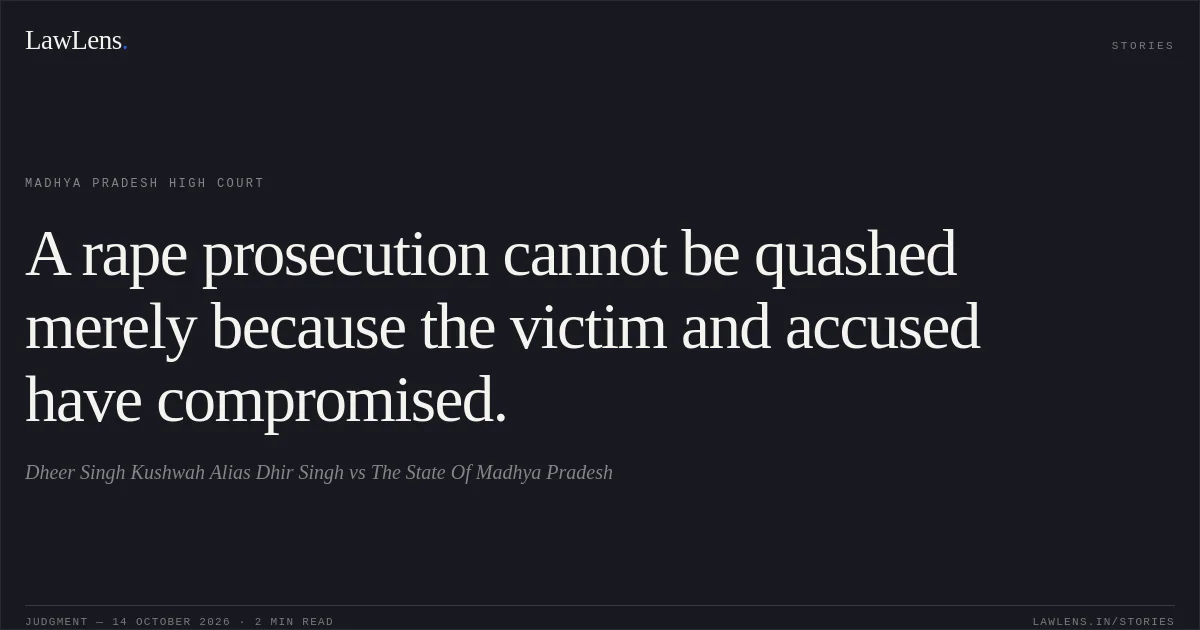
The petitioner sought to quash FIR Crime No. 63/2023, registered at Police Station Rampur, District Morena, for offences under Sections 64(1) and 351(2) of the Bharatiya Nyaya Sanhita (BNS), and the consequential proceedings, under Section 528 of the Bharatiya Nagarik Suraksha Sanhita (BNSS), on the basis of a compromise with the complainant
Source reference: para. 1The prosecution alleged that the petitioner entered the complainant’s house, raped her, and threatened to kill her and her children
Source reference: para. 2The parties filed a compromise application supported by affidavits; the Principal Registrar verified the parties, signatures, and voluntariness of the compromise
Source reference: paras. 3–4The State opposed quashing, while the complainant supported the petitioner’s request
Source reference: paras. 6–7Issues
Whether the High Court should quash the FIR and consequential proceedings for an alleged offence of rape under Section 528 BNSS because the petitioner and complainant have settled the matter
Source reference: paras. 1, 11Whether the alleged offence’s gravity and the possibility of pressure or inducement prevent the Court from acting on the compromise
Source reference: para. 11Law Applied
Section 528 BNSS preserves the High Court’s inherent power to quash proceedings to secure the ends of justice or prevent abuse of process
Source reference: paras. 1, 9In Gian Singh v. State of Punjab, (2012) 10 SCC 303, the Supreme Court held that this power is distinct from statutory compounding and must be exercised with due regard to the nature and gravity of the offence; heinous offences such as rape, which are not private in nature and affect society, are not fittingly quashed on compromise
Source reference: para. 9Narinder Singh v. State of Punjab, (2014) 6 SCC 466, and State of M.P. v. Madanlal, (2015) 7 SCC 681, reiterate that rape prosecutions should generally not be quashed on the basis of settlement; Madanlal, relying on Shimbhu v. State of Haryana, (2014) 13 SCC 318, further cautions that compromise in rape cases may be the product of pressure and cannot justify intervention
Source reference: para. 10Reasoning
The Court treated the alleged rape as a grave offence against society, rather than a dispute that could be resolved solely by private settlement
Source reference: paras. 9–10It found that the material on record suggested that the petitioner had committed rape, so the possibility of conviction could not be regarded as remote or bleak
Source reference: para. 11It also held that compulsion, inducement, or force in securing the compromise could not be ruled out
Source reference: para. 11Applying the principles in Gian Singh, Narinder Singh, and Madanlal, the Court concluded that the compromise did not warrant exercise of its inherent jurisdiction
Source reference: paras. 9–11Holding
The alleged rape offence could not be terminated on the basis of the parties’ compromise.
It dismissed the petition and disposed of any pending interlocutory applications
Source reference: paras. 11–13Acts & Sections Cited
5 provisions across 4 statutes referred to in this judgment. Each provision opens on LawLens.
Bharatiya Nagarik Suraksha Sanhita, 20231
Bharatiya Nyaya Sanhita, 20232
Code of Criminal Procedure, 19731
Indian Penal Code, 18601
Original Court PDF
Dheer Singh Kushwah Alias Dhir SinghvsThe State Of Madhya Pradesh
Click to open original judgment
Original judgment, available to read, download and summarize on LawLens.in