Facts
The petitioner was declared elected as Sarpanch of Gram Panchayat Sodpur after the 2022 election, winning by one vote.
Source reference: no citationRespondent No. 1, an unsuccessful candidate, challenged the election under Section 122 of the Madhya Pradesh Panchayat Raj Evam Gram Swaraj Adhiniyam, 1993, alleging irregularities in counting and seeking appropriate consequential relief.
Source reference: no citationThe Election Tribunal initially directed recounting, which was set aside by the High Court and the matter was remanded for fresh adjudication.
Source reference: para. 2After further proceedings, including closure and restoration of the petitioner’s right to lead evidence, the Sub-Divisional Officer passed the impugned order dated 18 September 2025, allowing the election petition and directing recounting of votes; consequentially, the authorities fixed a date for recounting.
Source reference: paras. 2, 11During the writ proceedings, the High Court permitted recounting subject to the result being kept in a sealed cover. The recount was completed and the result was produced before the Court.
Source reference: paras. 5, 7Issues
1. Whether a writ petition under Articles 226/227 of the Constitution was maintainable against the order directing recounting of votes in an election petition under Section 122 of the 1993 Adhiniyam.
Source reference: paras. 4–5, 112. Whether the Election Tribunal could direct recounting where the election was allegedly decided by a margin of one vote and material irregularities in counting and rejection of ballots were alleged and proved.
Source reference: paras. 3–4, 11–123. Whether the impugned order directing recounting amounted to an impermissible grant of final relief while the election proceedings remained pending.
Source reference: paras. 3–5, 11Law Applied
Section 122 of the Madhya Pradesh Panchayat Raj Evam Gram Swaraj Adhiniyam, 1993 provides that an election may be challenged only through an election petition presented before the prescribed authority and disposed of in the prescribed manner.
Source reference: para. 10The applicable election rules require an election petition to contain the material facts and particulars of the grounds of challenge, and permit a declaration that the returned candidate’s election is void and a further declaration that another candidate was duly elected.
Source reference: para. 9, citing Rule 5 and Rule 6In Sohan Lal v. Babu Gandhi, (2003) 1 SCC 108, the Supreme Court held that a tribunal may direct recounting in an election petition even if the candidate had not first applied for recounting before the Returning Officer, provided the case is made out on the evidence.
Source reference: para. 9Dharmin Bai Kashyap v. Babli Sahu, (2023) 10 SCC 461, clarified that recounting may be ordered where justified by the evidence, but an election petition seeking only recounting without the substantive reliefs contemplated by the rules is not maintainable.
Source reference: para. 9The Court also considered the principle that recounting is exceptional and cannot be ordered on mere suspicion, narrow margin, or for a roving inquiry, as reflected in Bhabhi v. Sheo Govind, P.K.K. Shamsudeen v. K.A.M. Mappillai Mohindeen, Bahoran Lal v. Ganesh Prasad, Vadivelu v. Sundaram, and Kattinokkula Murali Krishna v. Veeramalla Koteswara Rao.
Source reference: paras. 3, 8Raj Kumari v. Asha Devi, 2025 SCC OnLine SC 3271, was relied upon for the proposition that an order directing recounting may be interlocutory and does not necessarily constitute the final adjudication of the election dispute.
Source reference: para. 9Reasoning
The Court held that the impugned order was passed after adjudication of the election petition and findings regarding irregularities in the counting process; the direction for recounting was therefore a consequential fact-finding measure intended to determine the actual electoral result.
Source reference: para. 11The petitioner’s own evidence showed that he was outside the polling station during counting and lacked personal knowledge of the internal counting process, whereas the respondent had led evidence regarding the alleged irregularities.
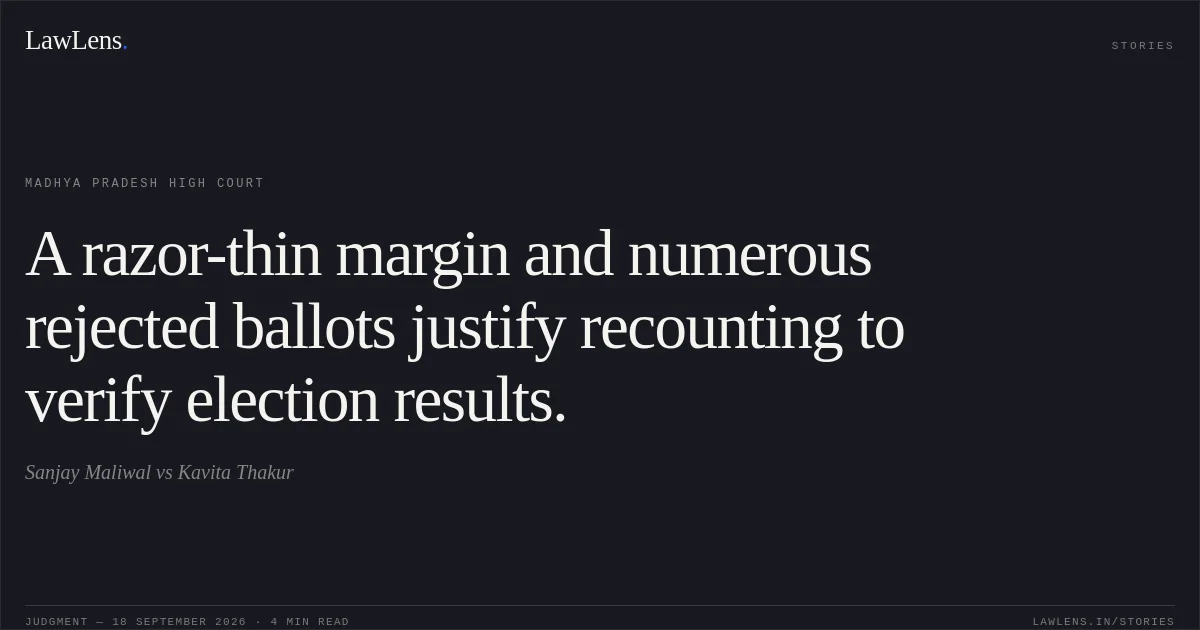
Source reference: para. 11The extremely narrow margin of one vote, together with 84 rejected ballots, constituted a compelling factual basis for physical inspection and recounting rather than a mere fishing or roving inquiry.
Source reference: paras. 11–12The Court further found that the impugned order did not finally declare the result or conclusively dispose of the election dispute, making the writ challenge prima facie premature and not maintainable.
Source reference: para. 11Since recounting had already been conducted under the Court’s supervision and the result had been placed in a sealed cover, interference at that stage was also unwarranted.
Source reference: paras. 7, 11Holding
The Court answered the issues against the petitioner.
It held that the direction for recounting was legally permissible, supported by the evidence and the one-vote margin coupled with the substantial number of rejected ballots, and did not warrant interference under Article 226.
Source reference: para. 12The writ petition challenging the order dated 18 September 2025 and the consequential letter dated 23 September 2025 was dismissed.
Source reference: para. 13No interference was made with the recounting process or the consequential proceedings.
Source reference: para. 13Acts & Sections Cited
1 provisions across 1 statute referred to in this judgment. Linked provisions open on LawLens.
M.P. Panchayat Raj Avam Gram Swaraj Adhiniyam, 19931
Original Court PDF
Sanjay MaliwalvsKavita Thakur
Click to open original judgment
Original judgment, available to read, download and summarize on LawLens.in