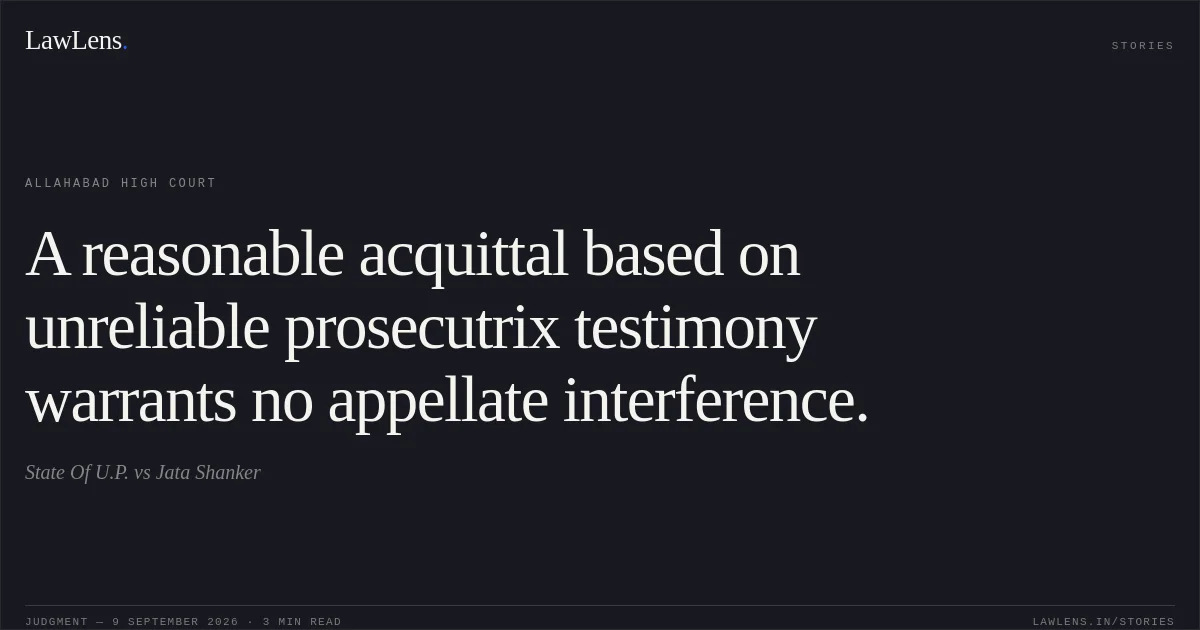
Facts
On 03.01.1988, the prosecution alleged that the accused-respondent forcibly raped the minor prosecutrix in an agricultural field while she was collecting cow dung.
Source reference: paras. 4–6Her father and other witnesses allegedly reached the spot after hearing her cries, and the accused fled.
Source reference: paras. 4–6The FIR was lodged the same evening at 6:45 p.m.; the prosecutrix was medically examined, and the doctor found no external injuries but noted a torn hymen, a 1.5 cm laceration, tenderness and slight bleeding on internal examination.
Source reference: paras. 4–6, 17The accused was charged under Section 376 IPC and denied the allegation, claiming false implication due to pre-existing enmity.
Source reference: paras. 7–10The Sessions Court, Unnao acquitted him on 12.01.1990, finding that the prosecution evidence did not establish guilt beyond reasonable doubt.
Source reference: para. 10The State preferred the present appeal.
Source reference: no citationAs the original trial record had been weeded out and could not be reconstructed, the High Court decided the appeal on the material available on record.
Source reference: para. 3Issues
Whether the testimony of the prosecutrix, considered with the medical and ocular evidence, was sufficiently cogent, credible and reliable to sustain the respondent’s conviction under Section 376 IPC.
Source reference: paras. 18–21, 31–32Whether the discrepancies and circumstances identified by the trial court rendered the prosecution case doubtful and justified the acquittal.
Source reference: paras. 23–30Whether the High Court, exercising appellate jurisdiction against an order of acquittal, had substantial and compelling reasons to interfere with the trial court’s view.
Source reference: paras. 33–37Law Applied
The Court applied Section 376 IPC and the principle that the testimony of a prosecutrix in a rape case may, if reliable and confidence-inspiring, support conviction without mandatory corroboration.
Source reference: no citationRelying on State of Punjab v. Gurmit Singh, as quoted in Raju v. State of Madhya Pradesh, the Court held that the evidence of a sexual-assault victim is to be assessed with sensitivity and is broadly comparable to that of an injured witness, although the principle cannot be applied mechanically and the testimony must still be trustworthy.
Source reference: para. 19Relying on Lok Mal @ Loku v. State of Uttar Pradesh, the Court further held that absence of external or private-part injuries is not invariably fatal to the prosecution case.
Source reference: para. 16The Court also applied the appellate principles in Dhanapal v. State by Public Prosecutor, Madras: an acquittal strengthens the presumption of innocence, and an appellate court should interfere only for substantial and compelling reasons; where two reasonable views are possible, the view favouring the accused must prevail.
Source reference: para. 33Reasoning
Although the medical evidence disclosed a torn hymen, laceration, tenderness and slight bleeding, the High Court found that the prosecutrix’s testimony was not sufficiently reliable when assessed as a whole.
Source reference: para. 17Material inconsistencies included her differing accounts of the time of occurrence, her assertion that she had returned from school despite the date being a Sunday, and her statements that her parents instructed her regarding what to say at the police station and in court.
Source reference: paras. 21–26The Court also noted inconsistencies concerning the manner in which the FIR was prepared, the alleged suppression of her cries, and the timing and presence of her father and other witnesses.
Source reference: paras. 27–30The father and Rajendra Kumar appeared to have reached the spot after the accused had allegedly fled, making their direct witnessing of the assault improbable.
Source reference: paras. 27–30Since the prosecution evidence did not constitute a cogent, clinching and convincing account, and the trial court’s view was at least a reasonable one, the enhanced presumption of innocence arising from the acquittal precluded appellate interference.
Source reference: paras. 31–37Holding
The High Court held that the prosecution failed to prove the charge under Section 376 IPC beyond reasonable doubt and that the trial court’s acquittal was neither perverse nor legally infirm.
The Government Appeal was dismissed, and the acquittal of Jata Shanker was affirmed.
Source reference: para. 39As the respondent was in jail pursuant to a non-bailable warrant, the Court directed that he be released forthwith unless his detention was required in any other case.
Source reference: para. 40Acts & Sections Cited
4 provisions across 2 statutes referred to in this judgment. Each provision opens on LawLens.
Indian Penal Code, 18601
Code of Criminal Procedure, 19733
Original Court PDF
State Of U.P.vsJata Shanker
Click to open original judgment
Original judgment, available to read, download and summarize on LawLens.in
![Similarly situated employees cannot be denied TBP financial upgradation solely because their promotional appointments were ad hoc.. A K PATHAK vs NEW DELHI MUNICIPAL CORPORATION. CAT - ['Delhi']. LawLens](/stories/thumbnails/similarly-situated-employees-cannot-be-denied-tbp-financial-upgradation-solely-because-the-b3dc1522387f4de79b828475ad651568.webp)