Facts
On 18 March 2014, during the Holi festival, Avinash allegedly became involved in a quarrel concerning the playing of a DJ. Later that day, Avinash, his father, brother and cousin were allegedly assaulted by a group of accused persons with iron pipes, an iron bar and wooden planks. Avinash died at the spot, while the other three sustained injuries. The informant, Avinash’s mother, lodged an FIR naming 21 persons and attributing specific roles and weapons to the accused
Source reference: paras. 2–5The trial court convicted 20 accused under Sections 302/149, 307/149, 147 and 148 IPC, while acquitting them of the conspiracy and Bombay Police Act charges.
Source reference: paras. 7–9AThe Bombay High Court reversed the convictions and acquitted all the accused, principally on the grounds that the ocular testimony was stereotyped, conflicted with the medical evidence, and was unsupported by independent witnesses.
Source reference: para. 10The informant and the State challenged the acquittal before the Supreme Court under Article 136 of the Constitution.
Source reference: paras. 11, 23Issues
Whether the High Court’s acquittal, based on the allegedly identical and stereotyped testimony of the injured and eyewitnesses, was a reasonable and possible view of the evidence?
Source reference: paras. 23–29Whether the conflict between the ocular account and the medical evidence—particularly the attribution of repeated head blows by four assailants despite only one laceration being found—created a reasonable doubt regarding the prosecution case?
Source reference: paras. 30–33Whether the cumulative effect of the delayed statements, absence of independent witnesses, FIR and investigation irregularities, and unexplained injuries on the accused justified sustaining the acquittal?
Source reference: paras. 34–41Whether the Supreme Court could interfere with the High Court’s order of acquittal in the exercise of its jurisdiction under Article 136?
Source reference: paras. 42–46Law Applied
The Court applied Sections 147, 148, 149, 302 and 307 of the Indian Penal Code, 1860, concerning unlawful assembly, rioting with deadly weapons, constructive liability, murder and attempt to murder
Source reference: paras. 2, 7–9AIt held that although an injured witness ordinarily commands greater evidentiary confidence, such status does not make the witness’s detailed attribution of specific roles to every member of a large assembly automatically reliable
Source reference: paras. 28–29Identical and stereotyped testimony concerning the acts of numerous accused may indicate tutoring rather than truthful recollection
Source reference: para. 27A material and unexplained conflict between ocular testimony and medical evidence can create reasonable doubt, particularly where the prosecution relies on detailed attribution of separate acts to separate accused
Source reference: paras. 30–33Non-explanation of injuries sustained by the accused may cast doubt on whether the prosecution has disclosed the true genesis of the occurrence, especially where the prosecution witnesses are interested or related
Source reference: paras. 40–41Under the principles restated in Babu Sahebagouda Rudragoudar v. State of Karnataka, an appellate court may reverse an acquittal only where it is perverse, manifestly illegal, founded on a misreading or omission of material evidence, or where no two reasonable views are possible
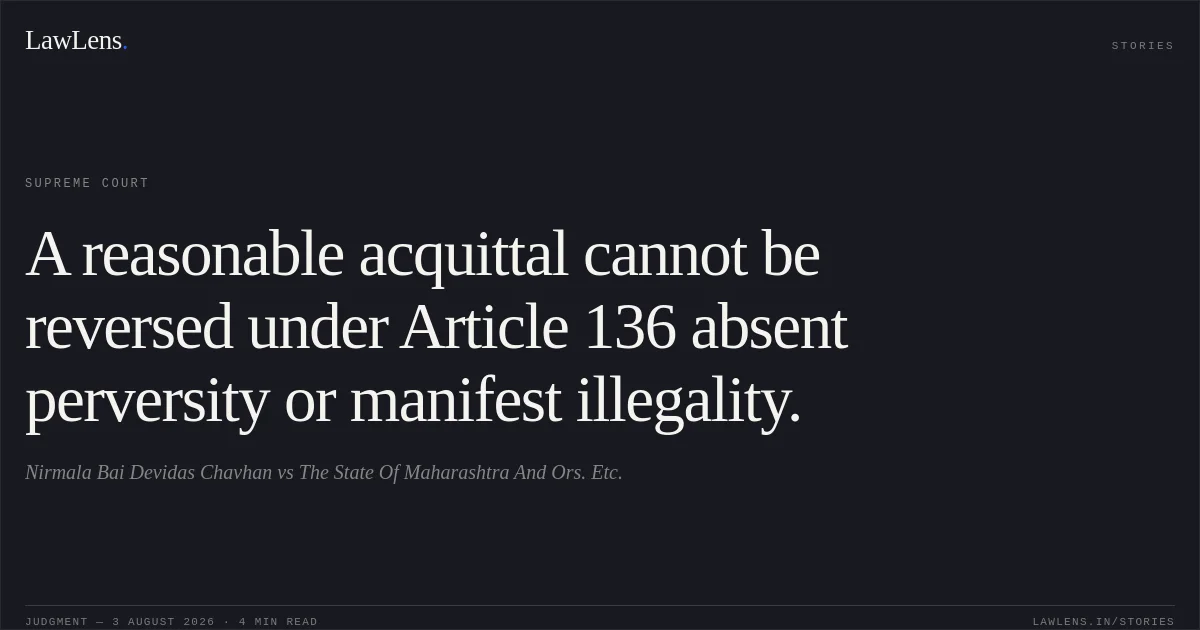
Source reference: para. 42This restraint applies with greater force under Article 136, and a reasonable and possible view resulting in acquittal should not be disturbed
Source reference: paras. 43–46Reasoning
The Supreme Court held that the High Court was entitled to doubt the witnesses’ uniform attribution of specific weapons, acts and victims to 23 accused persons. The evidence was unusually identical despite the sudden, violent and simultaneous nature of the assault and the different positions of the witnesses
Source reference: paras. 24–29More significantly, the prosecution alleged that four accused repeatedly struck Avinash’s head with iron pipes for two to three minutes, whereas the post-mortem revealed only one laceration; the medical evidence indicated that repeated blows at different points would ordinarily produce several injuries or potentially crush the head
Source reference: paras. 30–31Similar inconsistencies appeared in the account of the injuries to Devidas, including the alleged extrusion of his eyeball and displacement of his teeth, which were not supported by the medical records or spot panchanama
Source reference: para. 32These discrepancies were aggravated by the absence of independent witnesses despite the occurrence taking place in a residential locality, unexplained delays in recording eyewitness statements, irregularities in the FIR, defective handling of seized articles, and the non-explanation of injuries sustained by some accused
Source reference: paras. 36–41Although defects in investigation alone would not warrant acquittal, they assumed significance because the substantive ocular evidence was itself unsafe
Source reference: para. 39The High Court’s conclusion was therefore not perverse or based on a misreading of the record; it represented at least a reasonable and possible view of the evidence
Source reference: paras. 44–46Holding
The Supreme Court held that the High Court’s acquittal was legally sustainable and that the threshold for interference under Article 136 was not crossed.
The Court declined to restore the trial court’s convictions and sentences, dismissed Criminal Appeal Nos. 502–507 of 2023 filed by the informant and Criminal Appeal Nos. 508–513 of 2023 filed by the State of Maharashtra, and disposed of any pending applications
Source reference: paras. 46–49Original Court PDF
Nirmala Bai Devidas ChavhanvsThe State Of Maharashtra And Ors. Etc.
Click to open original judgment
Original judgment, available to read, download and summarize on LawLens.in