Facts
The State appealed the acquittal of the respondents in Special SC/ST Case No. 2/2011, in which they had faced charges including cheating under Section 420 IPC and an offence under Section 3(1)(ix) of the SC/ST (Prevention of Atrocities) Act.
Source reference: para. 1, 3–7The prosecution alleged that the accused falsely claimed Scheduled Tribe status, obtained caste certificates, and used them to secure education and other benefits.
Source reference: para. 1, 3–7The trial court acquitted the accused, finding that the prosecution had not proved the alleged false caste claim or the necessary elements of the offences.
Source reference: para. 1, 3–7The High Court considered the State’s appeal against that acquittal.
Source reference: para. 1, 3–7Issues
1. Whether the State had established grounds for appellate interference with the trial court’s judgment of acquittal
Source reference: para. 102. Whether the prosecution evidence established beyond reasonable doubt that the accused obtained caste certificates through false representations and thereby committed the charged offences
Source reference: paras. 12–33Law Applied
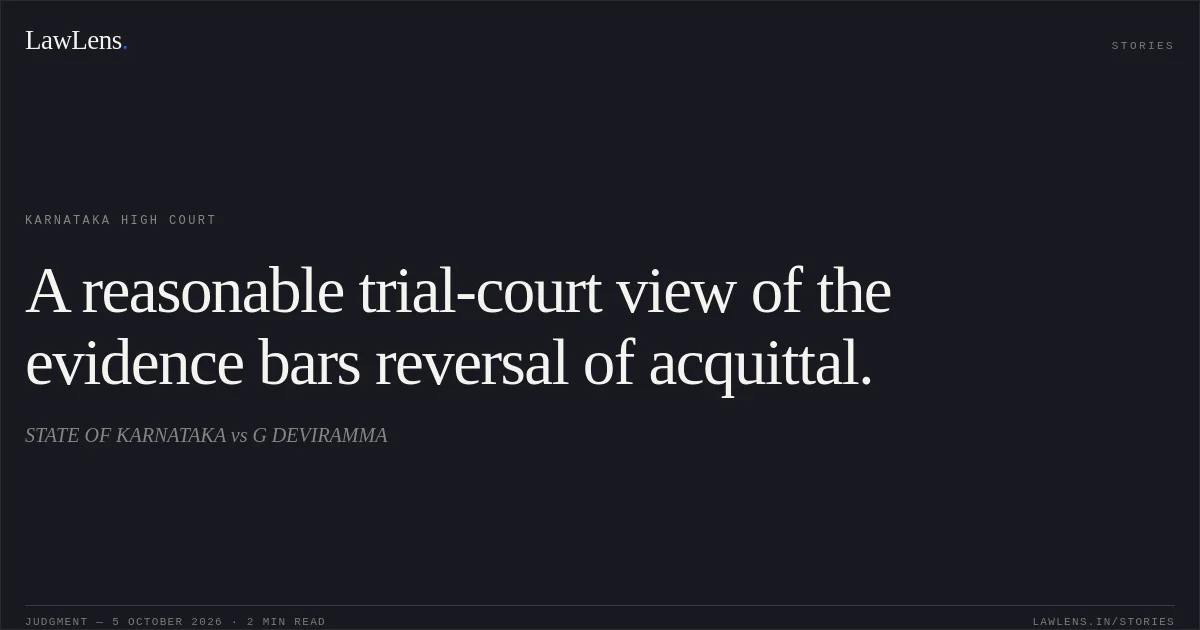
Under Section 378 CrPC, an appellate court may reappreciate the evidence in an appeal against acquittal, but the acquittal reinforces the presumption of innocence. If the trial court’s view is a reasonable view supported by the record, it cannot be displaced merely because another view is possible; interference is warranted where the acquittal is perverse, rests on a misreading or omission of material evidence, or the evidence permits only a conclusion of guilt.
Source reference: para. 11The court relied on Constable 907 Surendra Singh v. State of Uttarakhand, (2025) 5 SCC 433; Babu Sahebgouda Rudragoudar v. State of Karnataka, (2024) 8 SCC 149; Chandrappa v. State of Karnataka, (2007) 4 SCC 415; and H.D. Sundara v. State of Karnataka, (2023) 9 SCC 581.
Source reference: para. 11The prosecution was required to prove the accused’s guilt beyond reasonable doubt, including the alleged false representation underlying the cheating charge.
Source reference: paras. 15, 32Reasoning
The High Court reviewed the evidence and found that several witnesses—including family members—did not support the prosecution and denied their recorded police statements; the documentary and official evidence did not, in the High Court’s assessment, conclusively establish that the accused had falsely claimed Scheduled Tribe status.
Source reference: paras. 14–31The evidence included differing caste entries in school records and testimony concerning the accused’s family background and caste certificates.
Source reference: paras. 14–31The Court concluded that the prosecution had not produced cogent and convincing evidence proving guilt beyond reasonable doubt, and that the trial court’s acquittal did not disclose a legal or factual error warranting interference.
Source reference: paras. 14–31, 33Holding
The High Court answered the question of interference in the negative.
The High Court dismissed the State’s appeal. The acquittal of the respondents was therefore left undisturbed.
Source reference: paras. 33–34Acts & Sections Cited
6 provisions across 3 statutes referred to in this judgment. Each provision opens on LawLens.
Code of Criminal Procedure, 19733
Indian Penal Code, 18602
Scheduled Castes and the Scheduled Tribes (Prevention of Atrocities) Act, 19891
Original Court PDF
STATE OF KARNATAKAvsG DEVIRAMMA
Click to open original judgment
Original judgment, available to read, download and summarize on LawLens.in