Facts
The petitioner, an electrical contractor engaged for works under the Saubhagya Yojna, challenged a recovery order dated 10 December 2021 for ₹15,61,822.
Source reference: para. 1–3The petitioner contended that the work had been inspected, the site handed over, and the 12-month defect-liability period completed before recovery was sought; the inquiry underlying the recovery had been conducted without notice or disclosure of the relied-upon material
Source reference: para. 1–3The respondents alleged irregularities including billing for connections not established, use of non-prescribed or substandard materials, and duplicate billing.
Source reference: para. 4–5They also stated that they were willing to reconsider the matter after giving the petitioner an opportunity to respond.
Source reference: para. 4–5Issues
1. Whether the recovery order could stand when the petitioner had not been supplied the complaint or inquiry material relied upon and had not been given an effective opportunity to respond
Source reference: para. 9, 11–122. Whether the matter should be remitted to the respondents for reconsideration after disclosure of the material, a hearing, and a fresh decision
Source reference: para. 5–6, 13–14Law Applied
A decision affecting a person’s rights must comply with the principles of natural justice and fair play; a person must have a meaningful opportunity to answer the material relied upon against them.
Source reference: no citationIn Kranti Associates (P) Ltd. v. Masood Ahmed Khan, (2010) 9 SCC 496, the Supreme Court affirmed that quasi-judicial authorities must give cogent reasons, and that reasoned decisions support fairness, accountability, and judicial review
Source reference: para. 8The Court also referred to Techno Prints v. Chhattisgarh Textbook Corporation, 2025 SCC OnLine SC 343, concerning the risk that a hearing opportunity may be merely formal where the decision-making process is effectively predetermined
Source reference: para. 10Reasoning
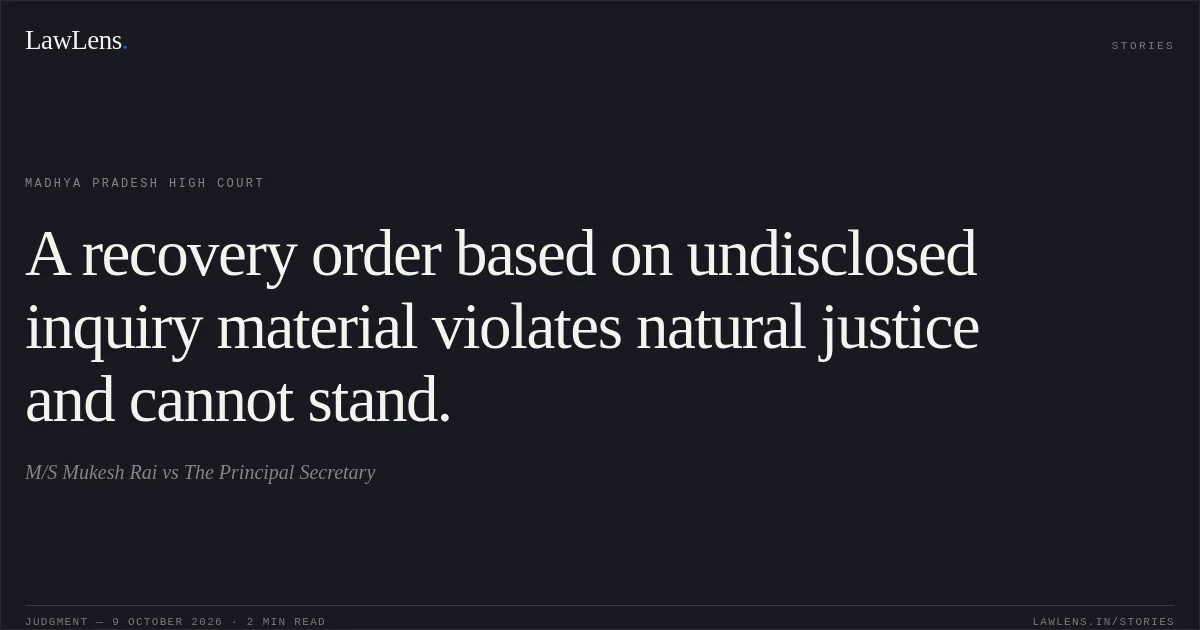
The respondents did not rebut the petitioner’s assertion that the complaint and material underlying the inquiry had not been supplied; the inquiry report had also not been provided, and the recovery order was issued without an effective opportunity to respond
Source reference: para. 9, 11In those circumstances, the petitioner could not meaningfully address the allegations, rendering the recovery order inconsistent with natural justice and fair play.
Source reference: para. 11–13The respondents’ willingness to reconsider the matter supported remitting it for a fresh decision following disclosure and a hearing
Source reference: para. 5–6, 11–13Holding
The Court quashed the recovery order dated 10 December 2021 and remanded the matter to respondents 2 and 3 for reconsideration
The respondents were directed to supply the complaint and relied-upon material within seven days; the petitioner may submit a detailed representation within seven days of receiving it.
Source reference: para. 14–15The respondents must then provide a personal hearing, pass a fresh order, and communicate the outcome within 30 days thereafter.
Source reference: para. 14–15Any interim order previously granted was to continue until the authorities decide the matter
Source reference: para. 14–15The petition was disposed of
Source reference: para. 16Original Court PDF
M/S Mukesh RaivsThe Principal Secretary
Click to open original judgment
Original judgment, available to read, download and summarize on LawLens.in