Facts
Late Rect. Manjit Singh, husband of the petitioner, was enrolled in the Indian Army on 1 September 1977 and invalidated from service on 29 May 1978 after approximately 270 days of service.
Source reference: para. 2His claim for disability pension was rejected by the PCDA (P), Allahabad, on 17 July 1979 on the ground that his disability was neither attributable to nor aggravated by military service.
Source reference: para. 2He died in a motor vehicle accident on 22 November 1995.
Source reference: para. 2The petitioner subsequently filed Original Application No. 218/2019 before the Armed Forces Tribunal seeking disability pension allegedly due to her deceased husband and consequential family pension.
Source reference: para. 3The Tribunal dismissed the application on 24 January 2023, holding that the rejection of disability pension had not been challenged during the husband’s lifetime and that the relevant service records had since been destroyed.
Source reference: para. 3The petitioner challenged that decision in WP(C) No. 726/2024, which was dismissed on 30 August 2025 on merits and on the grounds of delay and laches.
Source reference: para. 5The present review petition alleged an error apparent on the face of the record, particularly in the Court’s treatment of pension as a recurring cause of action and its alleged failure to consider the authorities cited by the petitioner.
Source reference: para. 6Issues
Whether the judgment dismissing the writ petition disclosed an error apparent on the face of the record by rejecting the claim on the grounds of delay and laches despite the assertion that pension constitutes a recurring cause of action?
Source reference: paras. 6, 11–12Whether the non-specific reference to the judgments relied upon by the petitioner constituted a ground for review?
Source reference: para. 13Whether the petitioner established any ground under Order XLVII Rule 1 CPC—such as discovery of new evidence, an error apparent on the face of the record, or any other sufficient reason—to warrant review of the earlier judgment?
Source reference: paras. 8–10, 16–19Law Applied
Review jurisdiction in writ proceedings is governed by Rule 65 of the J&K High Court Rules read with Order XLVII Rule 1 CPC; review is permissible only on discovery of new and important matter or evidence, an error apparent on the face of the record, or any other sufficient reason.
Source reference: paras. 8–9The Court relied on Kamlesh Verma v. Mayawati, (2013) 8 SCC 320, for the principle that review is not an appeal in disguise, cannot be used for rehearing on the same material, and is unavailable merely because another view is possible.
Source reference: para. 16It also relied on Parsion Devi v. Sumitri Devi, (1997) 8 SCC 715, holding that an error requiring a process of reasoning is not an error apparent on the face of the record.
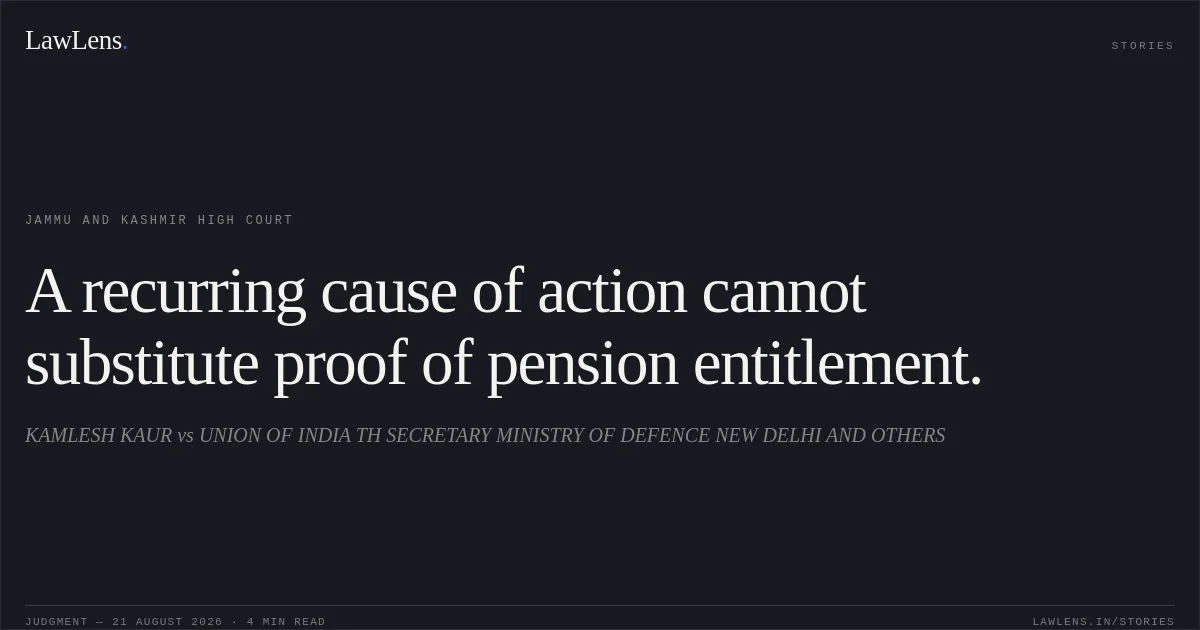
Source reference: para. 18Although pension may give rise to a recurring cause of action, that principle does not eliminate the requirement of proving the underlying entitlement through legally relevant material.
Source reference: para. 11Reasoning
The Court held that the recurring nature of pension claims did not cure the petitioner’s failure to establish the foundational entitlement to disability pension.
Source reference: para. 12The deceased serviceman had accepted the rejection of his disability pension claim for approximately 17 years and had never challenged it during his lifetime; the petitioner also waited approximately 23 years after his death before initiating proceedings, and the claim was ultimately raised more than four decades after the original rejection.
Source reference: para. 12The material service and medical records had been destroyed after expiry of the prescribed retention period, leaving only the Long Roll, and the claim could not be determined on assumptions or presumptions.
Source reference: para. 14The authorities cited by the petitioner were distinguishable because they were decided on factual records that were available for adjudication.
Source reference: para. 14The Court further found that the authorities relied upon had been considered, even if each was not individually discussed; such non-reference did not amount to an error apparent on the face of the record.
Source reference: para. 13Since the review petition merely sought reconsideration of the same arguments and material, it amounted to an impermissible rehearing rather than a proper review.
Source reference: paras. 15, 17, 19Holding
The Court answered the issues against the petitioner.
It held that the recurring nature of pension did not independently establish entitlement where the foundational service and medical records were unavailable, and that neither the omission to discuss every cited judgment nor the Court’s conclusions on delay and merits constituted an error apparent on the face of the record.
Source reference: paras. 11–14, 19Finding no discovery of new evidence, patent error, or other sufficient reason under Order XLVII Rule 1 CPC, the Court dismissed Review Petition No. 61/2025.
Source reference: para. 20Any pending applications were also disposed of.
Source reference: para. 20Original Court PDF
KAMLESH KAURvsUNION OF INDIA TH SECRETARY MINISTRY OF DEFENCE NEW DELHI AND OTHERS
Click to open original judgment
Original judgment, available to read, download and summarize on LawLens.in