Facts
The plaintiff alleged that the defendant agreed on 1 July 2008 to sell him 1.17 hectares of agricultural land for ₹1,80,000, of which ₹80,000 was paid in advance. The defendant denied a sale agreement but admitted receiving ₹80,000 as a loan. The plaintiff sued for specific performance and possession.
Source reference: para. 3–6The trial court found that the agreement had been executed but declined specific performance because the defendant’s competence to transfer the land was not established; it instead ordered repayment of ₹80,000 with interest. The first appellate court affirmed that decree.
Source reference: para. 7–10In second appeal, the defendant challenged, among other matters, the failure to decide his objection under the Madhya Pradesh Adhiniyam, 1976 and the decree for repayment despite the absence of a specific prayer.
Source reference: para. 11–12Issues
1. Whether the first appellate court could decline to decide the defendant’s maintainability objection solely because the trial court had rejected it under Order VII Rule 11 CPC and that interlocutory order had not been separately challenged.
Source reference: para. 11(i)2. Whether the suit was barred by Section 14 of the Madhya Pradesh Adhiniyam, 1976.
Source reference: para. 11(ii)3. Whether Section 22 of the Specific Relief Act, as amended in 2018, applied to the suit filed in 2013.
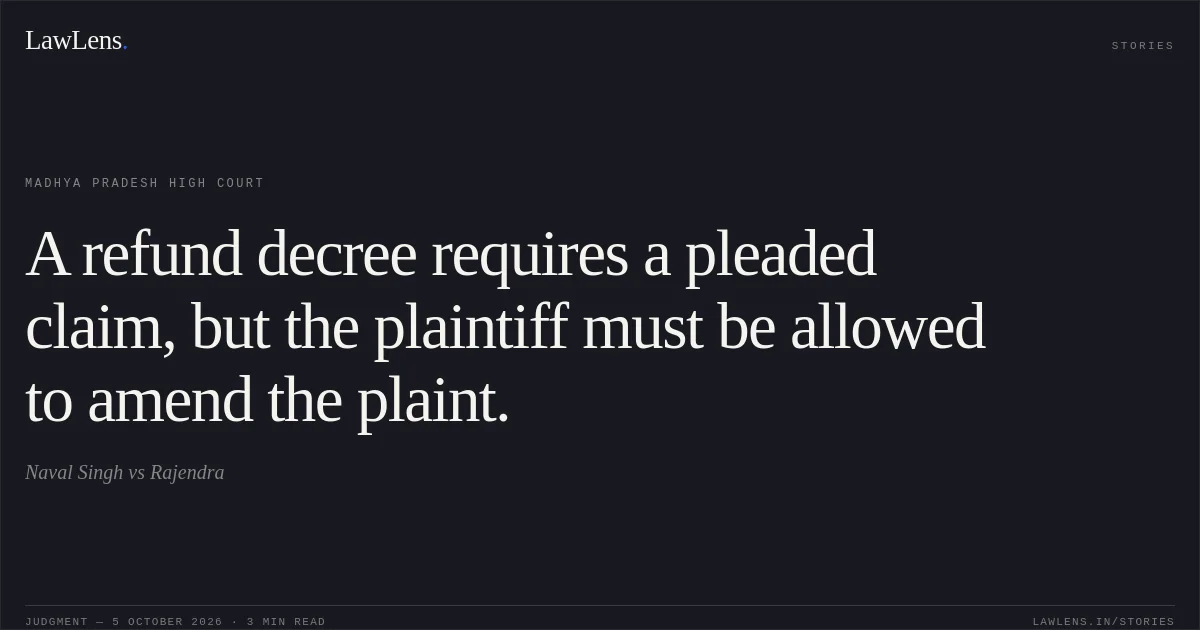
Source reference: para. 11(iii)4. Whether the repayment decree could be sustained when the plaint did not seek refund of the advance or compensation.
Source reference: para. 33–39Law Applied
Under Satyadhyan Ghosal v. Deorajin Debi, an interlocutory order may, in appropriate circumstances, be challenged in an appeal from the final decision; a party need not necessarily appeal each interlocutory order immediately.
Source reference: para. 17Section 14 of the Madhya Pradesh Adhiniyam, 1976 bars civil-court jurisdiction over matters assigned to the statutory authority; the Act’s protections concern a qualifying holder of agricultural land and a prohibited loan transaction as defined in Section 2(c) and (f).
Source reference: para. 21–25Under Sections 21 and 22 of the Specific Relief Act, compensation or refund relief must be claimed, but the court may permit amendment of the plaint to include it.
Source reference: para. 33–38Desh Raj v. Rohtash Singh confirms that a refund decree ordinarily requires a specific prayer, while Srinivas Ram Kumar v. Mahabir Prasad permits relief on an alternative case expressly admitted by the opposing party, where no injustice results.
Source reference: para. 30, 33Section 73 of the Contract Act supplies the principles for compensation for contractual breach.
Source reference: para. 35–36Reasoning
The defendant was entitled to raise the maintainability issue in the appeal from the final decree notwithstanding his failure to separately challenge the Order VII Rule 11 order; the appellate court erred in refusing to consider it on that ground.
Source reference: para. 13–19The Section 14 objection nevertheless failed: the defendant had not pleaded or proved that he met the statutory definition of a holder of agricultural land in the weaker sections, and there was no evidence that he had sought protection before the Sub-Divisional Officer under the Adhiniyam.
Source reference: para. 20–25As to repayment, the plaintiff had not sought a refund or compensation decree, so the court could not simply sustain that relief without addressing the statutory requirement for a claim. However, the defendant had admitted receiving ₹80,000, and the court considered it just to allow the plaintiff to amend the plaint to claim repayment, rather than require a separate suit.
Source reference: para. 28–38The court also observed that the 2018 amendment question did not arise because Sections 21 and 22 had not been amended in the relevant respect.
Source reference: para. 39Holding
The Court held that the first appellate court erred in treating the unchallenged Order VII Rule 11 order as preventing consideration of the maintainability objection, but found the suit was not barred by Section 14 of the Adhiniyam, 1976.
It held that the 2018 amendment issue did not arise.
Source reference: para. 39The appeal was disposed of by modifying the decree: the plaintiff was permitted to amend the plaint to claim repayment of the advance, and the direction to repay ₹80,000 with interest at 6% per annum would be executable only after that amendment. The amendment was to be made within 15 days of delivery of judgment, without requiring a formal application.
Source reference: para. 40Acts & Sections Cited
5 provisions across 3 statutes referred to in this judgment. Each provision opens on LawLens.
Code of Civil Procedure, 19082
Specific Relief Act, 19632
Indian Contract Act, 18721
Original Court PDF
Naval SinghvsRajendra
Click to open original judgment
Original judgment, available to read, download and summarize on LawLens.in