Facts
The dispute concerned a four-storeyed residential house with shops and an attic situated at Tanki Sarai, S.R. Gunj, Srinagar.
Source reference: para. 2The plaintiff, Ram Prakash Matta, claimed ownership pursuant to a family settlement and alleged that he had executed a Power of Attorney (PoA) in favour of Bashir Ahmad Pootu, authorising him to deal with and sell the property.
Source reference: paras. 3–4Although the PoA was registered on 4/5 December 2000, the plaintiff claimed to have cancelled it through a document notarised in Delhi on 27/28 September 2002.
Source reference: paras. 4–5, 13–14Bashir Ahmad Pootu subsequently executed a sale deed in favour of Shabir Ahmad on 30 November 2005, which was registered on 9 January 2006.
Source reference: para. 5The plaintiff instituted a suit seeking cancellation of the sale deed and permanent injunction, alleging that the PoA had already been revoked and that the attorney consequently lacked authority to execute the sale.
Source reference: para. 5The defendants disputed this contention and pleaded that a subsequent PoA had been executed on 23 August 2003 and that the plaintiff had himself applied for permission to alienate the property under the Jammu & Kashmir Migrant Immovable Property (Preservation, Protection and Restraint on Distress Sales) Act, 1997.
Source reference: paras. 6–7, 15By order dated 26 February 2026, the trial court held that where the PoA did not create any interest in favour of the attorney, it could be revoked through notice, communication, or a notarised document without registration of the cancellation instrument.
Source reference: para. 9Issues
Whether a registered Power of Attorney, which does not create an interest in the subject property in favour of the attorney, can be cancelled through a notarised document or by oral communication without registration of the cancellation instrument?
Source reference: paras. 8–9, 16–17, 20Whether the cancellation of the PoA was communicated to the attorney before execution of the sale deed, and what effect that question had on the validity of the sale deed and the pending suit?
Source reference: para. 21Whether the trial court’s order deciding the preliminary issue warranted interference in revisional jurisdiction?
Source reference: paras. 10, 18–23Law Applied
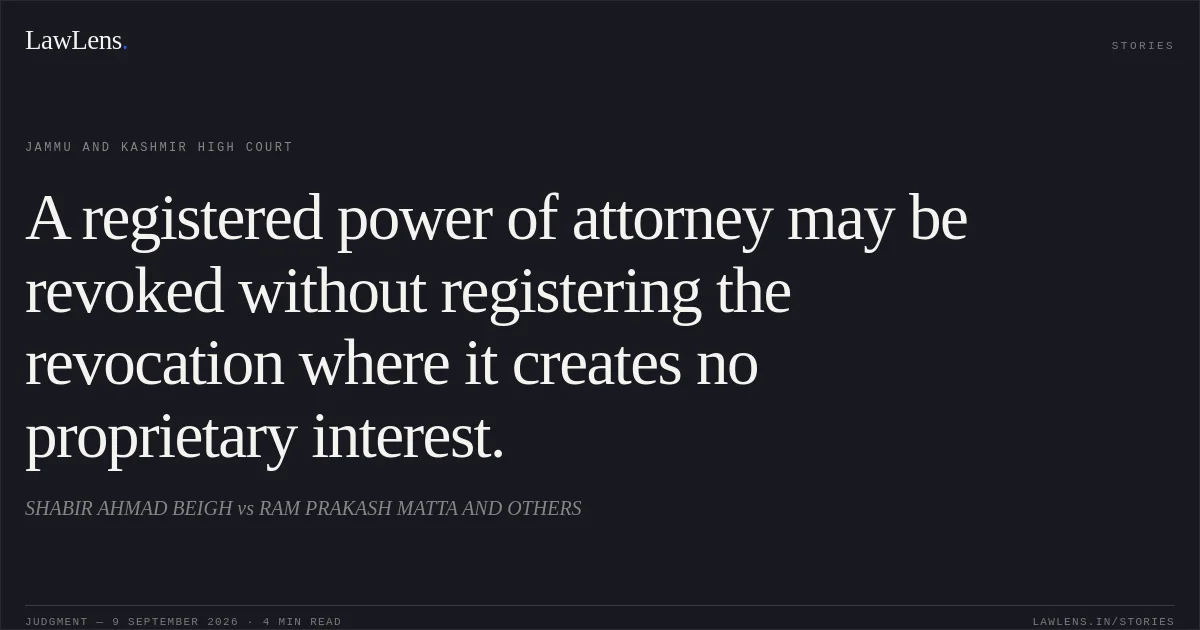
The Court applied the principle that a Power of Attorney which does not create any proprietary or other interest in favour of the agent may be revoked without registration of the revocation instrument; revocation may be effected through notice, communication, or a notarised document.
Source reference: paras. 17, 20–21The Court also considered the procedural framework of Order XII Rule 6 of the Code of Civil Procedure, 1908, under which a decree may be passed on clear admissions, while emphasising that disputed matters concerning the execution, cancellation, communication, and subsequent conduct of the parties may require adjudication on evidence.
Source reference: para. 18, 22The defendants’ reliance on the Jammu & Kashmir Migrant Immovable Property (Preservation, Protection and Restraint on Distress Sales) Act, 1997 was relevant to the plaintiff’s alleged application for permission to alienate the property and his subsequent conduct.
Source reference: paras. 15, 22The Court relied on the authorities considered by the trial court supporting revocation of a non-proprietary registered PoA without registration of the cancellation instrument, though the specific citations are not reproduced in the judgment.
Source reference: para. 17Reasoning
The Court upheld the legal conclusion that registration of the original PoA did not, by itself, require registration of the instrument cancelling it where the PoA had not transferred or created an interest in the property in favour of the attorney.
Source reference: paras. 17, 20–21However, the Court distinguished the validity of the mode of revocation from the effectiveness of revocation against the attorney and third parties.
Source reference: para. 21It held that the material question not addressed by the trial court was whether the alleged cancellation had been communicated to Bashir Ahmad Pootu before he executed the sale deed on 30 November 2005.
Source reference: para. 21The Court further observed that the alleged subsequent PoA dated 23 August 2003 and the plaintiff’s application for permission to sell under the Migrants Act could bear upon estoppel, authority, and the parties’ conduct; these matters could be raised before the trial court while opposing the plaintiff’s application under Order XII Rule 6 CPC.
Source reference: para. 22Since the defendant had not demonstrated any illegality or perversity in the trial court’s determination of the preliminary legal issue, revisional interference was not warranted.
Source reference: paras. 19–23Holding
The Court held that a registered PoA may be revoked through a notarised document, notice, or communication where it does not create an interest in the subject property in favour of the attorney; registration of the revocation instrument is not necessarily required.
However, the consequences of the alleged revocation—including whether it was communicated before execution of the sale deed, the effect of any subsequent PoA, and the plaintiff’s conduct in seeking alienation permission—remained matters for consideration by the trial court.
Source reference: paras. 21–22The Civil Revision Petition was accordingly dismissed as misconceived and lacking merit, and the trial court record was directed to be returned.
Source reference: para. 23–24Original Court PDF
SHABIR AHMAD BEIGHvsRAM PRAKASH MATTA AND OTHERS
Click to open original judgment
Original judgment, available to read, download and summarize on LawLens.in