Facts
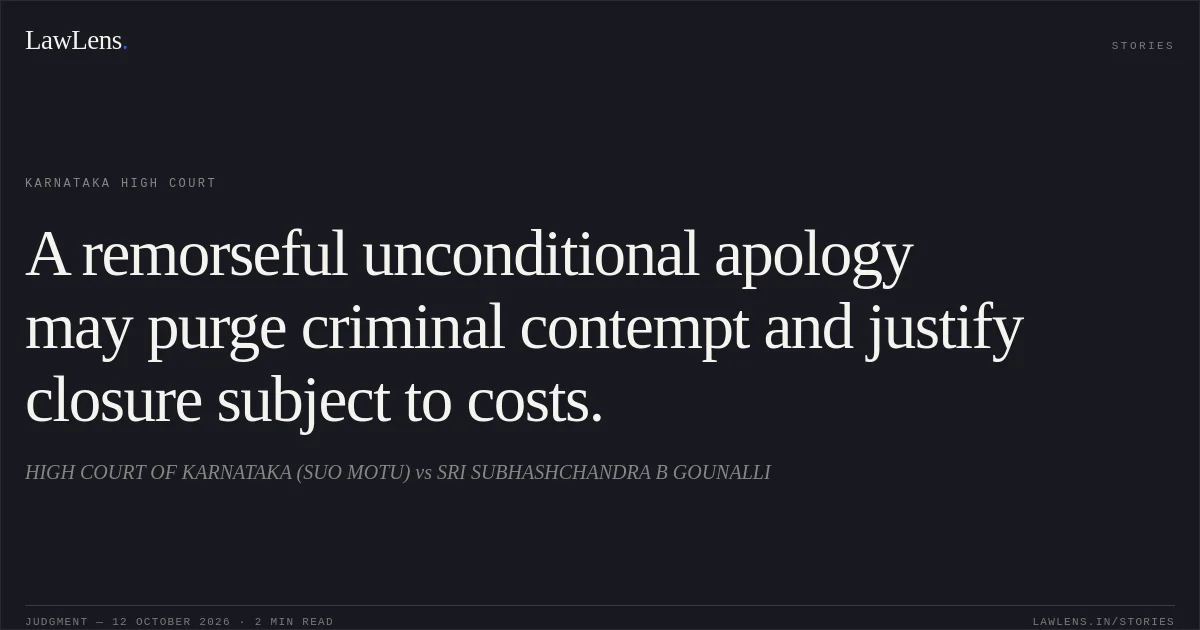
The proceeding was initiated suo motu under Section 15 of the Contempt of Courts Act, 1971, read with Article 215 of the Constitution, following alleged scandalous and unwarranted remarks against the judicial officer who presided over Criminal Revision Petition No. 64/2024.
Source reference: p. 2–3After the respondent failed to appear despite service of notice, the Court issued a bailable warrant and then a non-bailable warrant; he was arrested and produced before the Court on 17 August 2026.
Source reference: p. 3–4The respondent later filed an affidavit tendering an unconditional apology, expressing remorse, and undertaking not to repeat such conduct.
Source reference: p. 4–7The order also records an affidavit dated 18 September 2026 as filed “today,” although the judgment is dated 16 September 2026.
Source reference: p. 5–6Issues
1. Whether the respondent’s alleged remarks against the judicial officer constituted criminal contempt under Section 2(c) of the Contempt of Courts Act, 1971.
Source reference: p. 32. Whether the respondent’s unconditional apology, remorse, and undertaking justified closing the criminal contempt proceedings on payment of costs.
Source reference: p. 7–8Law Applied
Article 215 of the Constitution recognises the High Court’s power as a court of record to punish for contempt, while Section 2(c) of the Contempt of Courts Act, 1971 defines criminal contempt to include conduct or publication that scandalises or tends to scandalise, or lowers or tends to lower, the authority of a court. Section 15 provides for cognizance of criminal contempt.
Source reference: p. 3The Court also considered the respondent’s apology and assurance that the conduct would not recur in deciding whether to continue the proceedings. No precedent was cited in the order.
Source reference: p. 6–8Reasoning
The Court recorded that the proceeding arose from alleged scandalous remarks about a judicial officer, but its order did not undertake a detailed assessment of the remarks or make a separate finding on each element of criminal contempt.
Source reference: p. 3Instead, it considered the respondent’s unconditional apology, expressed remorse, undertaking not to repeat the conduct, age of 76 years, and reported ailments, and concluded that he had purged the contempt. On those circumstances, the Court took a lenient view and found that continuation of the proceedings was unnecessary.
Source reference: p. 6–8Holding
The Court closed the criminal contempt proceedings against the respondent.
The Court closed the criminal contempt proceedings against the respondent, subject to payment of ₹5,000 in costs to the High Court Legal Services Committee, Kalaburagi Bench, within two weeks.
Source reference: p. 8Acts & Sections Cited
2 provisions across 1 statute referred to in this judgment. Each provision opens on LawLens.
Contempt of Courts Act, 19712
Original Court PDF
HIGH COURT OF KARNATAKA (SUO MOTU)vsSRI SUBHASHCHANDRA B GOUNALLI
Click to open original judgment
Original judgment, available to read, download and summarize on LawLens.in
![Excess-pay recovery from retired Group C employees is impermissible absent fraud or misrepresentation.. SATYA NAND YADAV vs NORTH EASTERN RAILWAY. CAT - ['Allahabad']. LawLens](/stories/thumbnails/excess-pay-recovery-from-retired-group-c-employees-is-impermissible-absent-fraud-or-misrep-c357cbdd195c44d68331385eea2a3c9a.webp)
![A different Tribunal Bench cannot adjudicate claims seeking implementation of another Bench’s order.. KAMLA DEVI vs NORTH CENTRAL RAILWAY. CAT - ['Allahabad']. LawLens](/stories/thumbnails/a-different-tribunal-bench-cannot-adjudicate-claims-seeking-implementation-of-another-benc-cca646896f904d429d1270d122130c8b.webp)