Facts
The claimant alleged that he was travelling as a hamali in a lorry owned by the appellant when it met with an accident on 24 May 2012, causing him injuries.
Source reference: p. 3–5The Tribunal awarded compensation of ₹78,000 with interest at 6% per annum but dismissed the claim against the insurer because the vehicle’s permit was not shown as current on the accident date, and held the driver and owner liable.
Source reference: p. 3–5The owner appealed, relying on Section 81(5) of the Motor Vehicles Act and evidence that the renewal fee had been paid before the previous permit expired.
Source reference: p. 5, 8The insurer opposed the appeal, also disputing that the claimant was employed as a hamali.
Source reference: p. 6–7Issues
Whether the Tribunal was justified in dismissing the claim against the insurer and denying indemnification to the insured.
Source reference: p. 7Whether the insurer could avoid liability on the ground that the claimant’s status as a hamali travelling in the goods vehicle was not established.
Source reference: p. 8–9Law Applied
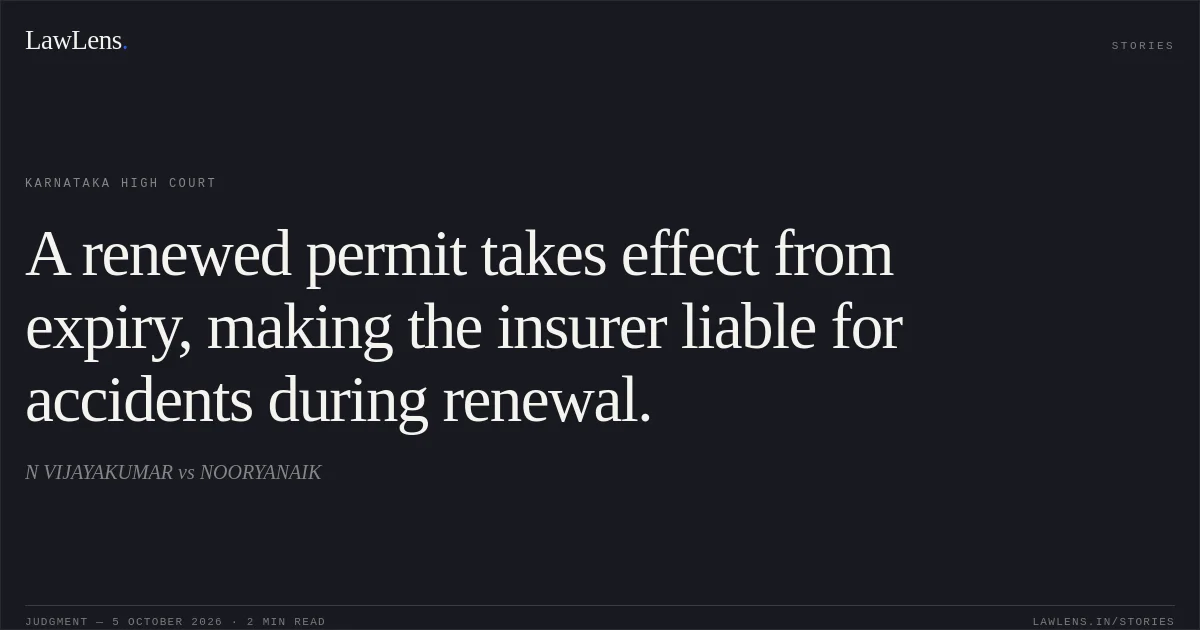
Section 81(5) of the Motor Vehicles Act provides that, upon renewal of a permit after its expiry, the renewal is effective from the date of expiry.
Source reference: p. 8The court also considered the insurer’s reliance on Sanjeev Kumar Samrat v. National Insurance Company Ltd., (2014) 14 SCC 243, concerning insurer liability where a person is carried in a goods vehicle; it held that the precedent did not apply on the evidence in this case.
Source reference: p. 6, 9The insurer had obtained permission under Section 170 of the Act to contest the claim on grounds available to the owner, but the court noted that it had not produced material to rebut the claimant’s account that he was travelling as a hamali.
Source reference: p. 9Reasoning
The court found that the earlier permit expired on 23 May 2012 and that the subsequent permit record showed validity beginning on 25 May 2012.
Source reference: p. 8However, the renewal-fee challan showed payment on 21 May 2012, supporting the inference that renewal had been sought before expiry.
Source reference: p. 8Applying Section 81(5), the court concluded that renewal took effect from the expiry date and therefore covered the accident on 24 May 2012; the Tribunal’s permit-based reason for absolving the insurer was unsustainable.
Source reference: p. 8The claimant had consistently described himself as a hamali in the police records, claim petition and deposition, while the insurer produced no material to disprove that account.
Source reference: p. 8–9The court therefore rejected the insurer’s objection and distinguished Sanjeev Kumar Samrat.
Source reference: p. 8–9Holding
The appeal was allowed, and the Tribunal’s award was modified to hold the insurer liable to pay the compensation.
The owner was denied a refund of the amount deposited, with the deposited amount and accrued interest ordered to be transmitted to the Tribunal for disbursement to the claimant; the insurer was directed to deposit the balance within six weeks.
Source reference: p. 10Acts & Sections Cited
5 provisions across 1 statute referred to in this judgment. Each provision opens on LawLens.
Motor Vehicles Act, 19885
Original Court PDF
N VIJAYAKUMARvsNOORYANAIK
Click to open original judgment
Original judgment, available to read, download and summarize on LawLens.in